


NASA’s Perseverance rover has found compelling subsurface evidence of an ancient river coursing through Mars’ Jezero Crater, revealing a buried landscape of water-shaped sediments that points to a larger, swifter, and longer-lived flow than previously assumed.
The discovery, reported by mission scientists and detailed in Science Advances, strengthens the case that Mars once hosted sustained surface water—precisely the kind of environment capable of trapping and preserving chemical clues to past life.

Buried River Revealed by Perseverance Rover Radar
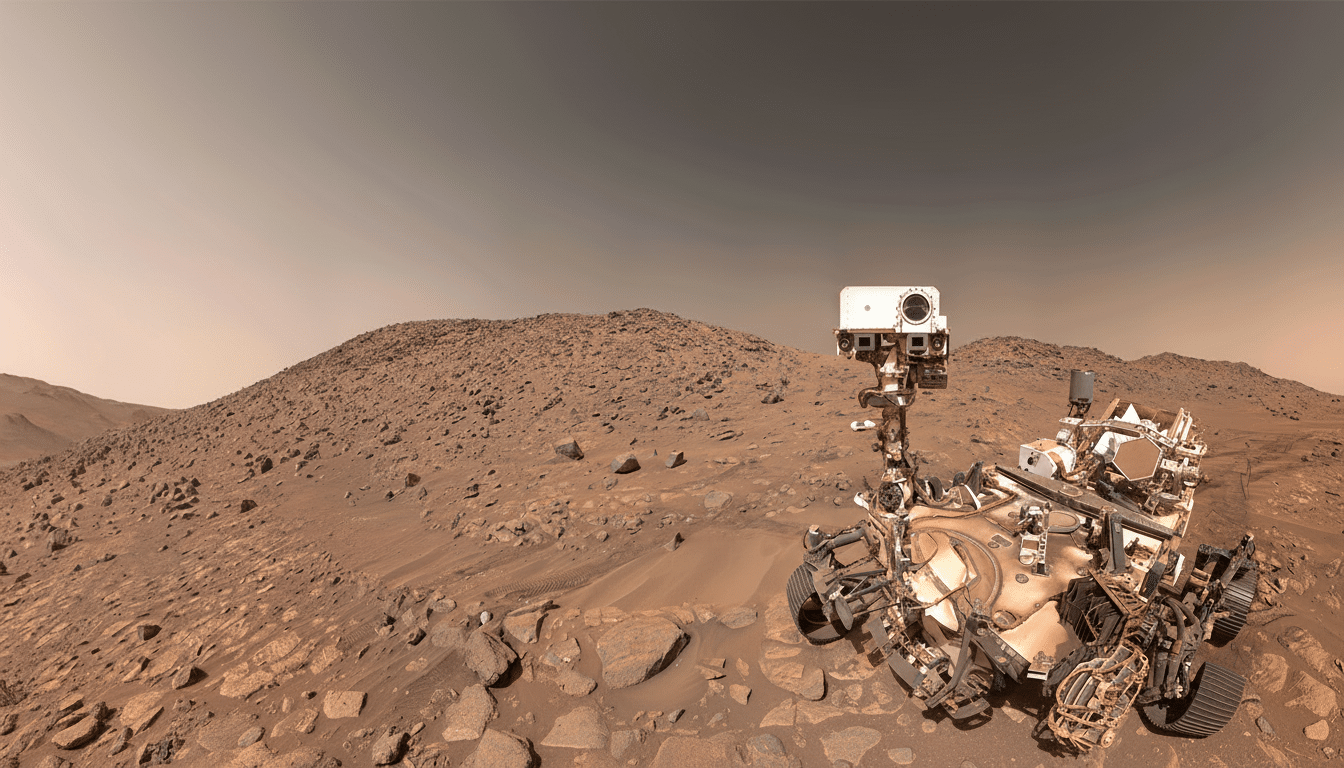
Perseverance’s Radar Imager for Mars Subsurface Experiment, known as RIMFAX, uses ground-penetrating radar to map layers hidden beneath the rover’s wheels. By transmitting radio waves and interpreting returning echoes, the instrument distinguishes sand, rock, and other materials and reconstructs slices of the underground geology.
Across 78 drive segments, the rover probed to depths exceeding 115 feet—nearly twice as deep as earlier looks—exposing a stack of steep, slanted reflectors that geologists recognize as cross-bedding. On Earth, these inclined layers form as river currents migrate sandbars and dunes, depositing sediment in orderly stacks that record flow direction and energy.
What orbiters long ago suggested from above—an ancient fan-shaped delta in Jezero—now has a matching signature below the surface. The subsurface patterns indicate channelized water, not just isolated ponds or sporadic mudflows, expanding the known footprint of the river system beyond what cameras alone could see.
Bigger and Faster Than Expected, Scientists Say
RIMFAX profiles point to a river capable of moving sand and small pebbles, a sign of moderate to energetic flow more akin to medium-size terrestrial rivers than to brief torrents. The architecture of the buried layers—consistent, repeated, and laterally extensive—suggests a stable channel that persisted, avulsed, and rebuilt itself over time, rather than a one-off catastrophic flood.
That stability matters. Rivers that endure rework their beds and banks, store fine-grained sediment in sheltered zones, and create chemical gradients where organics can accumulate. The signals detected by Perseverance imply not just water, but water with duration and dynamism—conditions more favorable to habitability in the planet’s distant past, between roughly 3.7 and 4.2 billion years ago.
Why It Matters for the Search for Life on Mars
Deposits laid down by flowing water are prime targets for biosignature hunting because they can entomb organic molecules and microtextures before they degrade. NASA’s Jet Propulsion Laboratory team is using the new radar maps to guide where the rover drills, caches cores, and documents the surrounding context—critical steps for interpreting any potential biosignatures back on Earth.
While Perseverance carries a powerful suite of instruments, the most definitive tests for ancient life—stable isotope analyses, nanoscale imaging, and ultra-trace organic screening—require Earth-based laboratories. That’s the rationale behind Mars Sample Return. The program has faced cost and schedule challenges, with independent assessments placing projected expenses above $11 billion, prompting NASA to rethink its architecture. The river find raises the scientific stakes for delivering the right samples home.
A Planetwide Water Story Comes Into Focus
Perseverance’s result joins a growing body of evidence that ancient Mars was far wetter than its modern, arid face suggests. China’s Zhurong rover, operating on Utopia Planitia, used ground-penetrating radar to identify features interpreted as ancient shorelines, consistent with an ocean that may have covered about 33% of the Martian surface. Those radar scans revealed beach-like deposits stretching nearly a mile, buried some 30 to 115 feet below ground.
Though Jezero and Utopia are separated by roughly 3,000 miles, the convergence of findings from independent missions, instruments, and research teams—including U.S. and international collaborators—strengthens the case for widespread, long-lived water systems on early Mars.
What Comes Next in Jezero Crater Exploration
Armed with a subsurface map of river-built layers, the Perseverance team can prioritize targets most likely to preserve organic clues: fine-grained bottomset beds, protected channel margins, and zones where currents slowed enough to trap organics and microstructures. Each carefully documented core sample builds a geologic storyline linking river dynamics, sediment deposition, and habitability.
In practical terms, the newly identified river deposits give scientists a stratigraphic roadmap—stack by stack—for testing how water shaped Jezero and where the record of potential ancient life would most likely be written. If Mars once ran with rivers, Perseverance is now reading their buried pages.

