


Chemical manufacturing companies are evolving for the year 2026. Read our article to explore new partnership approaches with insights and why Echemi is a trusted B2B marketplace for such partnerships.
Introduction:
As the year comes to a close, we are witnessing chemical manufacturing companies shifting toward AI technologies for greater control and adopting service-based business models to promote sustainability. However, this is not an omnidirectional effort, as businesses must work with suppliers, agents, traders, and other related entities. All of them are required to implement a similar initiative to achieve the desired results in such a partnership.
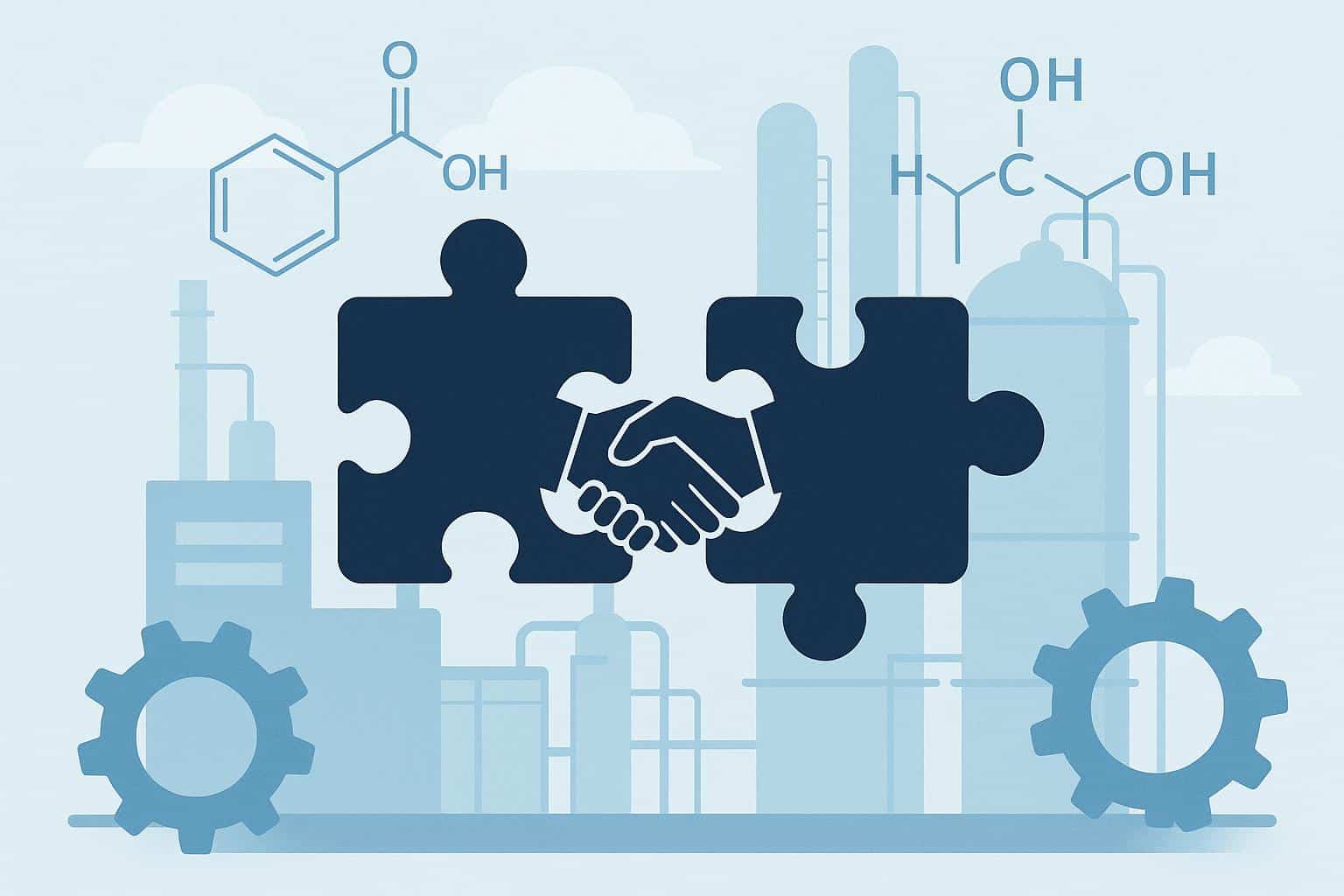
Moreover, such partnerships are no longer limited to joint ventures or just supply agreements, as the dynamic and fast-paced landscape of 2026 requires chemical companies to collaborate through data-driven partnerships, data-sharing ecosystems, sustainability initiatives, and co-innovation models. Thus, these companies need to focus on key considerations before teaming up.
Considerations for Partnerships:
When hundreds of employees and millions of dollars are at stake, forming successful partnerships in the chemical industry becomes an extremely crucial decision for a company’s management. By thoughtfully addressing related concerns and considerations of these partnerships upfront and with transparency, the result can be tremendous and can help build long-lasting alliances.
Taking into account the significant impact of partnerships on any business, such moves require careful consideration of several factors to avoid any disasters for chemical manufacturing companies; a few of them are as follows:
1. Complementary Expertise
Companies should properly evaluate whether partnering with suppliers and companies has the capacity to bring complementary skills, related technology, or desirable market access that can enhance overall capabilities for both parties. This becomes particularly important when businesses aim to build partnerships for scaling their operations.
2. Alignment of Values and Goals
This is extremely important, as common objectives, along with organizational values and commitment levels, naturally make partnerships better and focused on mutual growth and success.
3. Resource Allocation with Risk Sharing
As the market becomes more volatile in 2025, and the same is expected for 2025, chemical production companies are required to assess how risks, resources, and collective costs will be distributed among the partnering parties. This will enable the businesses to be flexible and will also help balance investment and potential rewards fairly among partners.
Partnership Strategies for 2026
1. Address Regional Market Needs
Chemical companies are required to address regional market needs by building strategic alliances with suppliers and traders. Such partnerships will help them easily tailor their products to local demands and also tackle geopolitical effects by quickly opting between them. This will help businesses to improve their responsiveness to regional challenges, maintaining product relevance in the market.
2. Collective Sustainability Initiatives
While building regional partnerships is important, producing chemicals with sustainability is also crucial in 2026. This is why management has to collaborate with different parties on sustainability initiatives. The result will be smoother sourcing and production, which meets legal requirements by embedding eco-friendly and sustainable practices into the core business.
3. Engage in Supply Chain Collaboration
In 2026, chemical manufacturing companies will have to prioritize supply chain collaborations to survive the ever-changing market conditions due to trade wars, tax variations, regional conflicts, and rising costs of labor and transport. This will improve both the efficiency and resilience of their supply chains by coordinating sourcing and logistics among partners and help prevent disruptions, enable lower costs, and optimize inventory.
4. Leverage Technological Advancements
Companies can’t afford to work with their partners just in a supplier-buyer relationship, as modern supply chains demand more flexibility and implementation of advanced forecasting and monitoring. This is why leveraging technological advancements like AI and machine learning is extremely essential in 2026 to foster breakthroughs, boost efficiency, and reduce operational costs.
Platform for Reliable Partnerships in 2026
In the current chemical industry, ECHEMI has established itself as a respectable and well-known chemical platform for businesses to make long-term partnerships with other players in the supplier business and also diversify their supplier base. Serving globally, the platform helps businesses to connect with distribution partners from regions they wish to enter and does that with complete transparency and adherence to compliance.
This can be done by proactively searching ECHEMI’s vast network of verified and vetted suppliers and traders with a layer of transparency. Interested parties can check each individual supplier by looking at their business licenses, previous (verified) customer reviews, and product certifications. This B2B chemical platform is a comprehensive partnership enabler for chemical manufacturing companies this year and beyond.
Wrapping Up:
A thoughtful and well-planned strategic approach is needed when chemical manufacturing companies seek to partner with key players in their business. Platforms like ECHEMI enable such partnerships from all around the world with diversity and transparency.

