


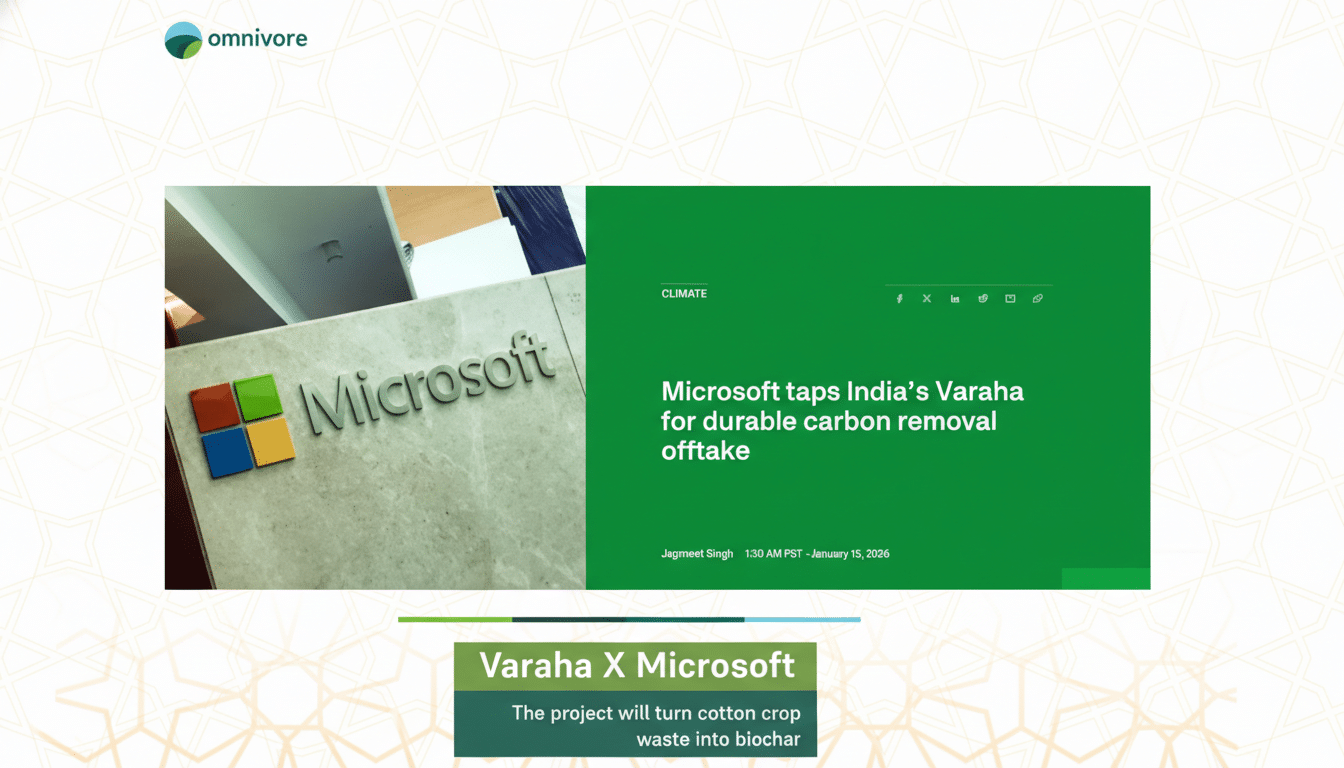
Microsoft has signed an offtake with India’s Varaha to buy more than 100,000 tons of carbon removal credits through 2029, backing a biochar program that converts cotton crop waste into long-lived carbon stored in soils. The deal adds an Asia-based, agriculture-linked project to Microsoft’s expanding carbon removal portfolio as its AI and cloud footprint grows.
Why Varaha and why now in Microsoft’s carbon strategy
Varaha, founded in 2022, focuses on durable removals that can be verified and delivered at scale—an area where many early-stage projects have stumbled. The company says its edge comes from execution in farm supply chains and rigorous measurement, reporting, and verification, supported by a team with deep agronomy experience. That is increasingly attractive to corporate buyers seeking certainty in both permanence and delivery timelines.

The agreement centers on India’s cotton belt, initially in Maharashtra, where open-field burning of stalks remains common. Varaha plans 18 industrial reactors with 15-year operating lives, targeting lifetime removals above 2 million tons of carbon dioxide. The project is expected to engage roughly 40,000–45,000 smallholder farmers at the outset, creating a predictable feedstock pipeline and channeling co-benefits back to fields.
Inside the biochar model and its durability claims
Biochar is produced via high-temperature pyrolysis that stabilizes carbon in a solid form with 100+ year permanence when applied to soil under accepted methodologies. By diverting crop residues from burning, the process both avoids particulate pollution and transforms waste into a soil amendment that can improve water retention and nutrient efficiency—important gains for smallholder systems with thin input margins.
Varaha’s first reactor in this program will sit next to its 52-acre cotton research farm in Maharashtra, enabling field trials on biochar application rates and soil responses. The company processed about 240,000 tons of biomass in 2025, yielding roughly 55,000–56,000 tons of biochar and around 115,000 credits, up sharply from the prior year. With new capacity, Varaha aims to at least double throughput in 2026 to roughly half a million tons of biomass, with a corresponding rise in carbon sequestered.
Balancing scale versus footprint in Microsoft’s portfolio
Microsoft has set a 2030 goal to be carbon negative, but its FY2024 Sustainability Report shows total emissions at 15.5 million metric tons CO2e, up 23.4% from its 2020 baseline—largely from value-chain impacts tied to AI and cloud growth. Against that backdrop, this Varaha deal is modest in volume but strategically valuable: it diversifies geography, technology, and feedstock risk while locking in durable tonnes that complement nature-based reductions.
The company contracted about 22 million metric tons of removals in FY2024 and has since struck a series of large agreements, including backing a Louisiana facility from AtmosClear targeting 6.75 million tons over 15 years and a 3.6 million-ton arrangement tied to a biofuels plant owned by C2X. Portfolio breadth matters as supply of high-durability credits remains tight and delivery risk is nontrivial.
Regional impact and market signals for Asian biochar
India offers a large, relatively low-cost residue base and a dense network of smallholder farms. That makes it a compelling testbed for biochar at scale, provided logistics and farmer incentives are aligned. Varaha currently works with roughly 150,000 farmers across 20 projects in India, Nepal, and Bangladesh spanning regenerative agriculture, biochar, agroforestry, and enhanced rock weathering. The company estimates that, across project lifetimes of 15–40 years, its pipeline could sequester up to 1 billion tons of CO2, subject to buildout and verification.
The Microsoft commitment also validates a trend among major tech buyers toward engineered or hybrid removals with strong monitoring frameworks. Google previously agreed to purchase 100,000 tons of Varaha’s biochar credits as its largest biochar deal, signaling growing demand for high-quality, durable tonnes in Asia alongside North American and European projects.
Verification, Durability And Farmer Economics
In carbon markets, the bottleneck is not just building reactors—it is proving carbon stays put, year after year. Biochar credits are typically issued under recognized standards with permanence safeguards, conservative accounting, and on-site audits. Microsoft’s program has emphasized exacting MRV requirements; Varaha’s track record in delivering durable credits at volume helped it rise to the top tier of suppliers.
For farmers, the model can unlock new income streams for residue collection and processing while returning biochar to fields to improve soil performance and reduce dependence on chemical fertilizers. By cutting open burning, the project also contributes to cleaner harvest seasons in regions where agricultural smoke has been a stubborn air-quality challenge. If the reactors ramp as planned and credits continue to clear verification, this offtake could serve as a template for scaling durable removals across South Asia’s agriculture corridors.
