


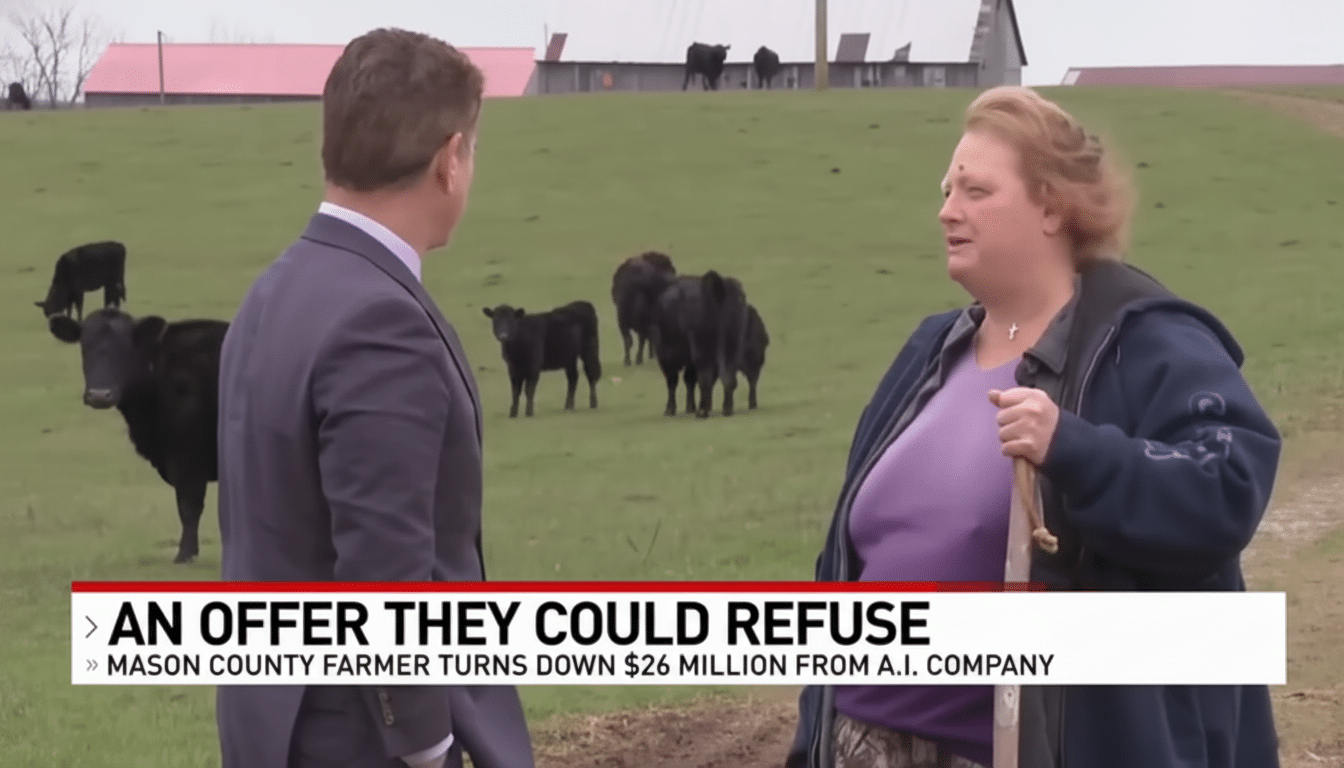
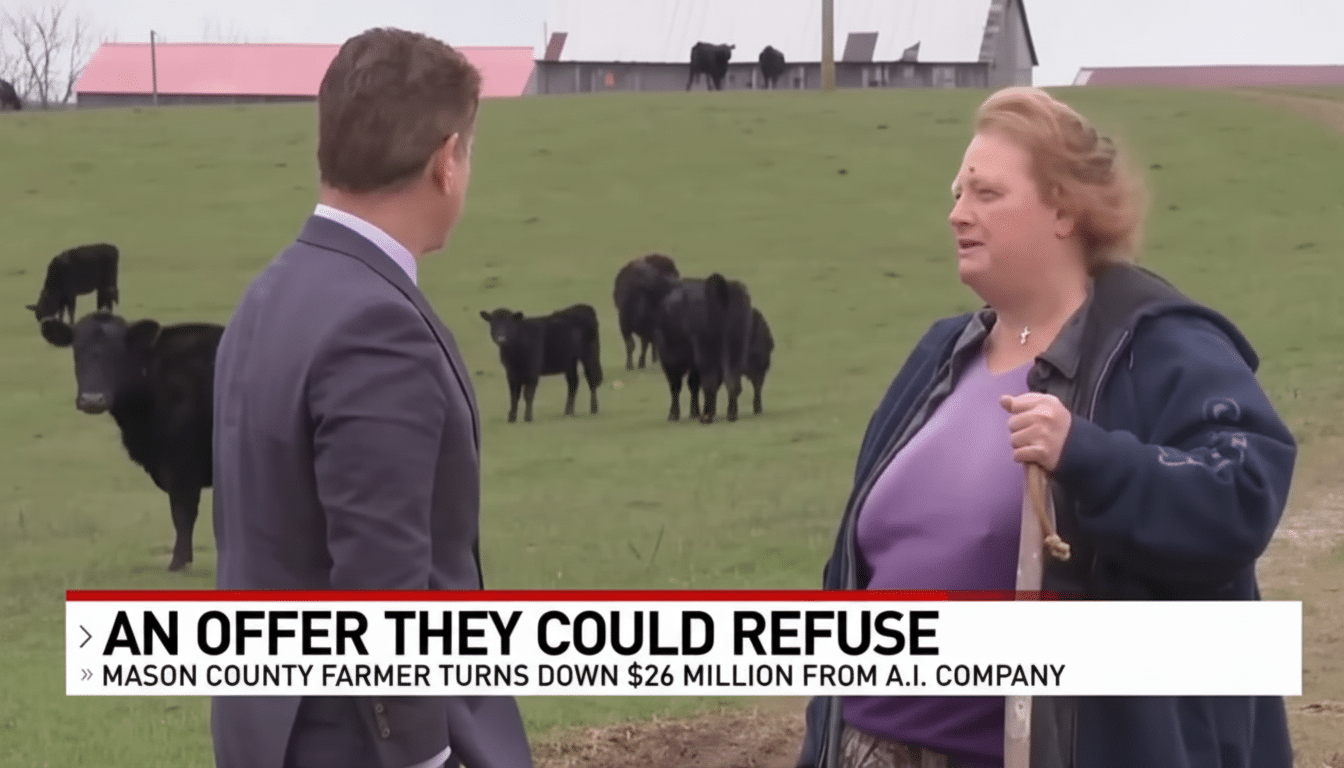
An 82-year-old landowner in Mason County, Kentucky, has turned down a $26 million offer from a major AI company seeking to convert part of her family’s farm into a data center, a decision that spotlights the growing tension between the AI infrastructure boom and rural communities guarding farmland, water, and way of life.
The owner, Ida Huddleston, told a local television station that her family would not sell any of their roughly 1,200 acres near Maysville. Despite the rejection, filings to rezone more than 2,000 acres in northern Kentucky indicate the project could still move forward adjacent to the Huddleston property, according to local reporting.
Why One Kentucky Farm Said No to a Massive Data Center Bid
Huddleston’s stance is rooted in concerns that resonate widely in farm country: water availability, potential contamination, constant mechanical noise, round-the-clock lighting, and limited permanent jobs relative to the land and utility footprint. She questioned whether the promised economic gains would reach local residents, voicing a skepticism that many communities have expressed as server campuses proliferate across exurban parcels.
Protecting a multigenerational operation is also central. Families like the Huddlestons often carry low leverage and thin margins, making large cash offers tempting. But they also prioritize stewardship and continuity—keeping productive ground in crops, not concrete. American Farmland Trust has warned that the U.S. is losing prime agricultural land at an alarming clip, underscoring a broader unease about paving over fields that feed regional economies.
AI Data Centers Chase Cheap Power And Space
Developers flock to regions like northern Kentucky for a mix of low electricity costs, available parcels, and proximity to fiber routes and cloud hubs around Cincinnati and Columbus. Recent data from the U.S. Energy Information Administration shows Kentucky’s industrial power rates remain among the lowest in the country—an attractive draw for energy-intensive AI workloads. Local cooperatives and transmission providers, including East Kentucky Power Cooperative and Fleming-Mason Energy, add to the area’s grid appeal.
Meanwhile, the AI surge is adding urgency. Real estate firms tracking the sector report record-low vacancy in primary data center markets and multi-gigawatt pipelines under construction that still can’t keep pace with demand. As Northern Virginia, Phoenix, and Silicon Valley strain under constraints, second-wave markets in the Midwest and Southeast are rising. Kentucky’s incentive toolkit—often including industrial revenue bonds and payment-in-lieu-of-taxes agreements—further sweetens bids to land hyperscale campuses.
Water Use And Community Impacts Drive Pushback
Water remains the flashpoint. Many large data centers rely on evaporative cooling that can draw millions of gallons per day during peak heat; even with recycling and alternative cooling strategies, community water systems feel the strain. Microsoft disclosed a 34% year-over-year jump in water consumption in a recent environmental report, a spike analysts linked partly to AI training. Google has also reported billions of gallons of annual water use across its footprint. Academic work led by researchers at the University of California, Riverside estimated that training a single large AI model can consume hundreds of thousands of liters of clean water when accounting for power plant cooling and on-site needs.
Other impacts add up. Cooling equipment and backup generators create steady ambient noise, often likened to living near a highway. Traffic increases during years of phased construction. And while local officials tout new tax revenue, permanent headcount is typically modest: filings for hyperscale facilities often project roughly 30–60 full-time operations roles per site, with the largest campuses reaching into the low hundreds. For many farm families, that math does not outweigh the land and water trade-offs.
A Zoning Fight With Regional Ripples in Kentucky
The rezoning request in northern Kentucky signals the proposal is far from dead. Standard steps would include planning commission review, public hearings, utility capacity studies, noise and traffic analyses, and potential environmental assessments. Community feedback—especially on groundwater, aquifer recharge, and river drawdowns—often shapes conditions placed on any approval, such as mandated sound dampening, alternative cooling technologies, or water offsets.
For Mason County, the debate now turns on whether AI-era infrastructure can be sited and operated in a way that respects working lands. Some jurisdictions have steered such campuses toward brownfields, closed industrial sites, or areas with reclaimed mine land and strong grid interconnects. Others require dry or hybrid cooling to cut water draw, alongside stricter landscaping and setback rules to buffer neighbors.
Huddleston’s decision puts a human face on a national dilemma: how to meet explosive compute demand without sacrificing the very landscapes and resources rural America depends on. Whether this Kentucky project advances or not, the outcome will be watched by communities across the Ohio River Valley weighing similar offers—and deciding what, in the long run, their land is worth.

