


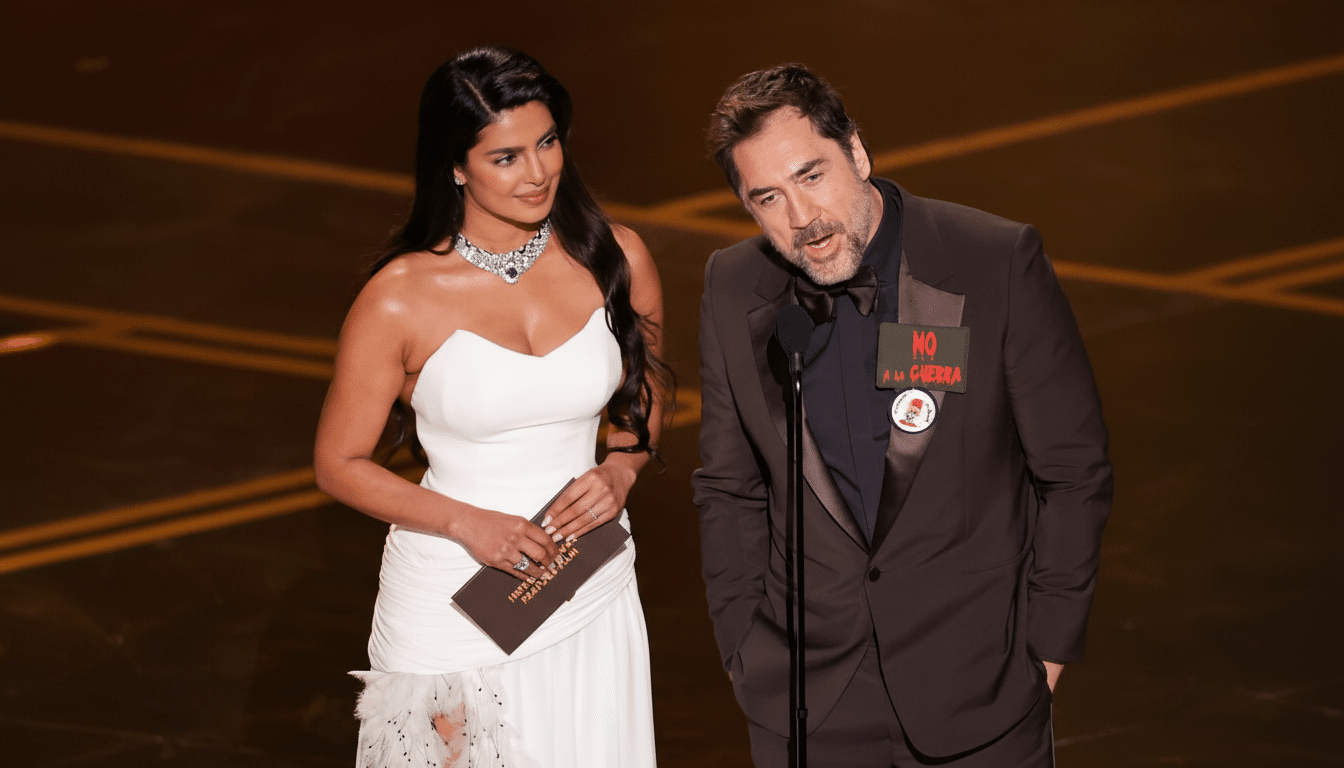
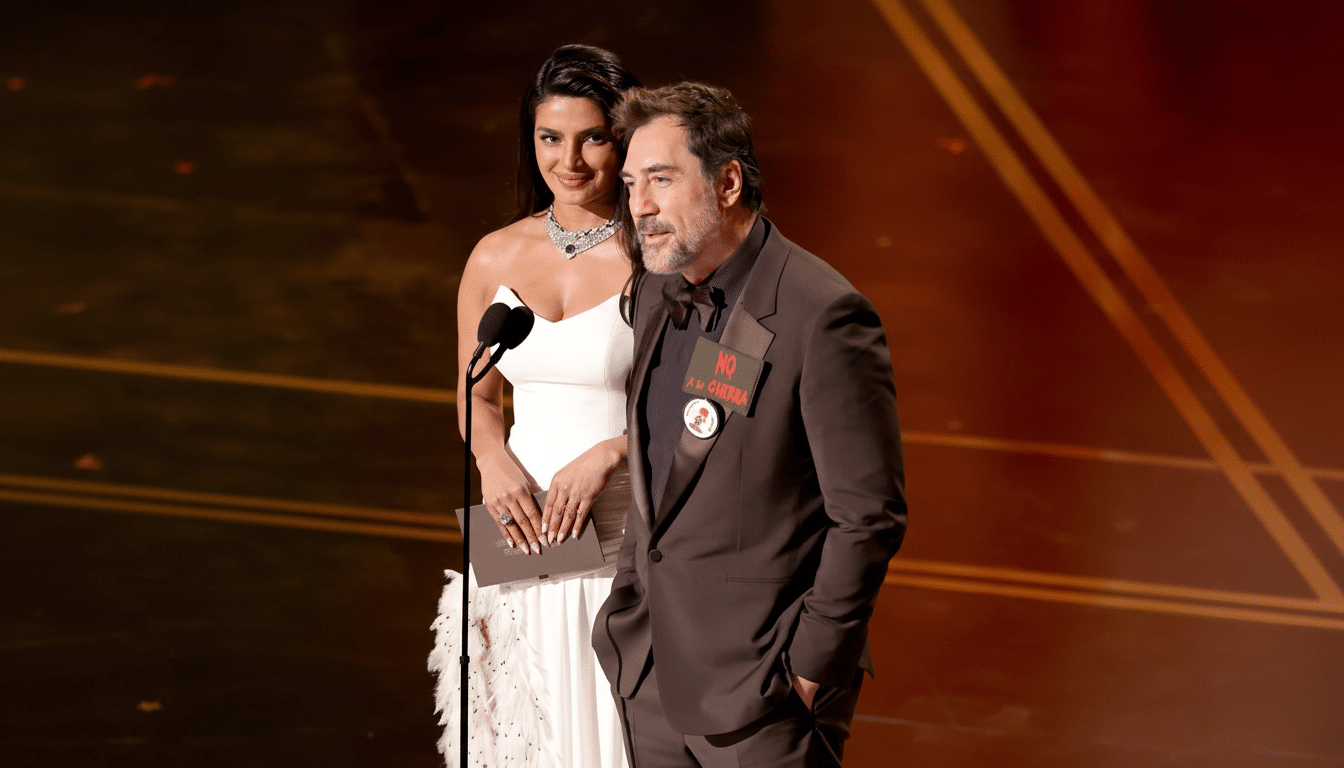
Javier Bardem used one crisp sentence to turn a glittering broadcast into a moment of protest, saying “No to war and free Palestine” on the Oscars stage while presenting Best International Feature Film. The remark instantly cut through the ceremony’s pageantry, drawing swift attention across newsrooms and social platforms and cementing one of the night’s most overtly political statements.
What Javier Bardem Said On Stage And Why It Mattered
The Spanish actor, an Oscar winner himself, spoke just before announcing finalists, delivering six words that required no further context. The directness echoed a long tradition of artists leveraging live television to articulate humanitarian concerns, especially when conflict and civilian suffering dominate global headlines.
Symbolism On The Red Carpet And The Pins He Wore
Bardem arrived with two pins that telegraphed his message before he ever reached the microphone. One read “No a la guerra,” a bold reprise of the same antiwar pin he wore at the Oscars in 2003 to protest the Iraq invasion. The other featured the word “Palestine” alongside Handala, the barefoot child created by Palestinian cartoonist Naji al-Ali in 1969 and widely recognized as a symbol of steadfast resistance and the refugee experience.
Speaking to the Associated Press on the carpet, Bardem explained that the “No a la guerra” pin is a personal throughline spanning decades—a way to restate a simple principle in a moment when the largest stages can amplify it. That context made his brief onstage declaration feel less like an outburst and more like the culmination of a deliberate, visual argument.
A Long Tradition Of Oscars Night Activism And Protest
Awards nights have long doubled as platforms for political speech. Michael Moore’s condemnation of the Iraq War during his Best Documentary win, Sacheen Littlefeather’s appeal on behalf of Marlon Brando to protest Hollywood’s portrayal of Native Americans, and numerous #MeToo and Time’s Up remarks all illustrate the ceremony’s porous border between culture and politics. Bardem’s words fit neatly into that lineage, signaling that the international stage remains fertile ground for conscience-driven interventions.
Industry producers typically do not pre-screen live remarks, though they control timing and transitions. That leaves space for artists to speak to a global audience—one that, in recent years, has numbered in the high teens of millions in the U.S. alone according to Nielsen—while accepting the risks and rewards that come with being unmistakably heard.
Why The Message Resonates With A Global Audience
The phrase “free Palestine” carries weight amid mounting humanitarian alarms. The UN Office for the Coordination of Humanitarian Affairs has reported mass displacement in Gaza exceeding 1.7 million people, while local health authorities have cited death tolls surpassing 30,000. Major aid organizations, including the International Committee of the Red Cross and UNICEF, have warned of catastrophic shortages of food, medical care, and safe shelter.
In entertainment circles, advocacy around the conflict has grown more visible. Artists4Ceasefire, a coalition of film and music professionals, said more than 400 signatories backed its call for an immediate ceasefire and the release of all hostages. Ceasefire pins and statements have appeared at multiple high-profile events this season, suggesting a sustained willingness among some performers to inject geopolitical urgency into pop culture’s marquee nights.
What Javier Bardem’s Stand Signals For Awards Shows
Bardem’s brief, unambiguous line underscored how international awards shows can serve as bridges between art and accountability. As a Spanish star with a decades-long record of antiwar advocacy, his choice to foreground a universal plea—“no to war”—alongside a specific call for Palestinian freedom tied personal conviction to a cause that is both immediate and globally contested.
Whether the moment galvanizes further on-air statements this season or fades into the ceremony’s fast-moving highlights reel, it has already achieved one aim: ensuring that a global audience encountered a moral argument in the middle of a celebratory broadcast. In a year when symbolism and speech carry unusual stakes, six words were enough to make the point.

