


Federal immigration agents were filmed detaining travelers inside major U.S. airports as the administration moved to deploy Immigration and Customs Enforcement to help manage swelling security lines during a partial government shutdown. The rare blending of immigration enforcement with checkpoint operations quickly stoked questions about safety, legality, and whether the move would actually speed screenings.
Videos shared by passengers showed at least one arrest near a pre-security area, with officers questioning individuals and escorting them away from crowded terminals. Officials framed the ICE deployment as a stopgap to ease bottlenecks, but civil liberties advocates warned the approach could chill lawful travel and escalate encounters in already tense spaces.
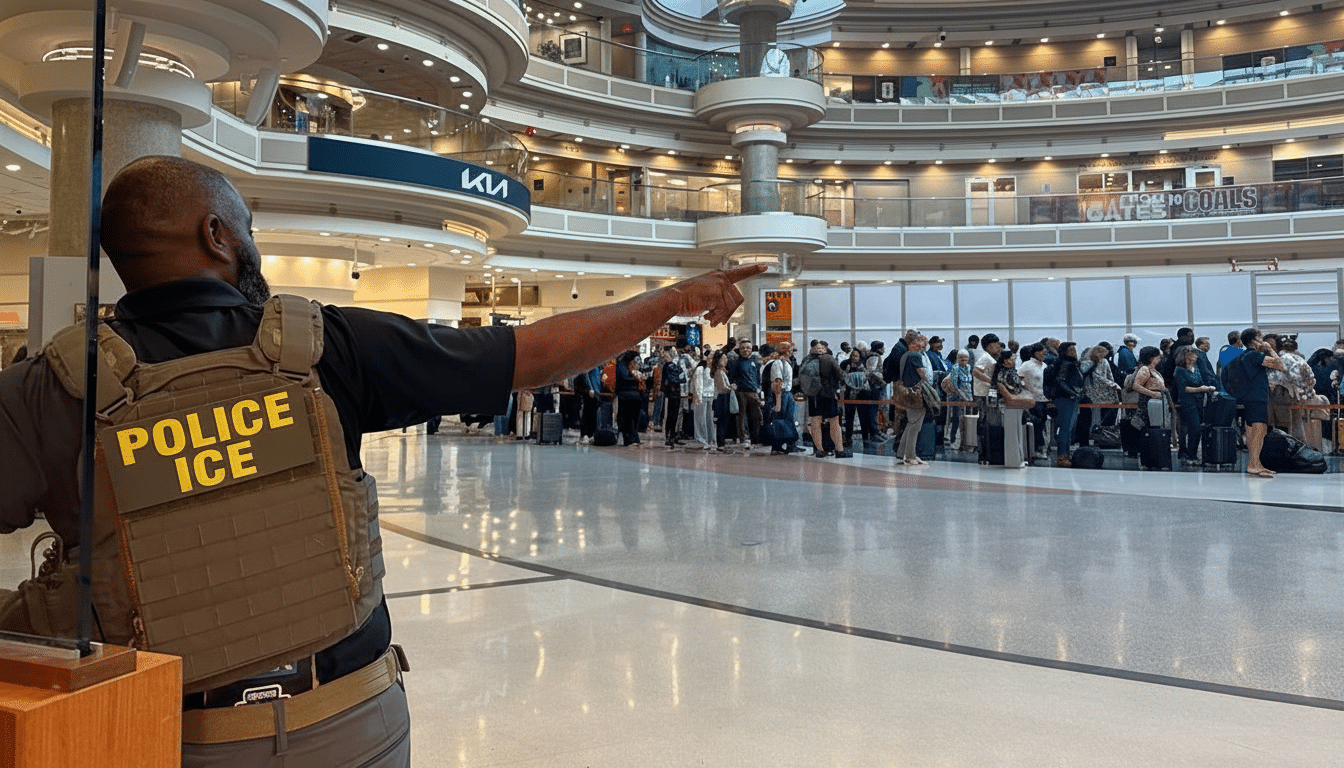
ICE Sent to Airports With the Longest Waits
The administration’s border adviser Tom Homan said ICE personnel would be dispatched to airports with the longest lines, acknowledging details were still in flux. Security queues have stretched for hours in some hubs as Transportation Security Administration officers, part of the Department of Homeland Security workforce, continue reporting to duty without pay during the funding lapse.
According to reporters with the Associated Press, agents were seen at Hartsfield–Jackson Atlanta International Airport. The Guardian reported sightings in Newark, New Orleans, and New York’s John F. Kennedy. CNN said ICE has also been present in Chicago, Cleveland, Houston, Phoenix, and San Juan. A spokesperson for ICE did not respond to questions about the filmed arrest.
Security Versus Immigration Enforcement Roles
Airport security is typically the domain of TSA, which screens passengers and baggage, while ICE focuses on interior immigration enforcement and investigations. U.S. Customs and Border Protection handles customs and immigration inspections for international arrivals. Blurring those lines, experts say, risks confusing travelers and complicating the legal standards that govern different types of searches.
Industry groups have long maintained that crowd control and passenger facilitation should be handled by trained screening staff to keep lanes efficient and predictable. Former security officials caution that visible immigration enforcement near checkpoints can raise fear among mixed-status families, potentially provoke confrontations, and make it harder to maintain orderly queues.
Traveler Impact and the Operational Reality
On a typical day, TSA screens well over two million passengers nationwide. When staffing is constrained, each additional minute per passenger compounds into cascading delays, missed flights, and gate-area crowding. Whether ICE’s presence reduces wait times will depend on precise tasks assigned and how seamlessly agents integrate with airport operations.
Airports and airlines prize predictability at checkpoints, where small inefficiencies ripple across departure banks. Without clear guidance, having non-TSA agents near lanes could introduce new friction points, from ad hoc document checks to congestion around secondary inspections, even as some travelers avoid terminals altogether out of concern about encounters with immigration officers.

Technology Use Raises the Privacy Stakes
ICE is known to use facial recognition tools, mobile device forensics capable of unlocking phones, and commercial location data sourced from apps and data brokers. Investigations and reports by the ACLU, the Georgetown Center on Privacy & Technology, and federal oversight bodies have documented these capabilities and the gaps in transparency that surround them.
Bringing those tools into crowded terminals increases the privacy and civil liberties stakes, advocates argue. They are urging DHS to disclose what data, if any, will be collected in airport settings, what triggers an encounter, how long information is retained, and what redress mechanisms exist for travelers who believe they were profiled or wrongly detained.
Political and Legal Scrutiny Builds Further
Democratic lawmakers called for changes to federal immigration operations following reports of abuse by agents, including the killings of two U.S. citizens earlier this year. The filmed airport arrests are likely to intensify oversight demands, with committees expected to probe the scope, authority, and outcomes of deploying immigration agents inside domestic terminals.
Legal analysts note that while TSA operates under an administrative search regime tailored to aviation security, immigration arrests require distinct legal thresholds that do not automatically apply in pre-security areas. Clear rules of engagement will be essential to avoid constitutional challenges and ensure travelers understand which agency is asking questions and why.
What to Watch Next for Travelers and Airports
Key indicators will be whether average wait times fall, missed-flight rates improve, and traveler complaints decline at airports with ICE deployments. Equally important is transparency: which tasks ICE will handle, how agents are trained for airport roles, and how incidents, including arrests, are documented and reviewed.
With passengers already on edge, success may hinge less on the number of agents and more on clarity. Airports will need unambiguous signage, distinct uniforms and lanes, and consistent protocols to keep screening focused on security while ensuring immigration enforcement, when necessary, meets legal standards and public expectations.

