


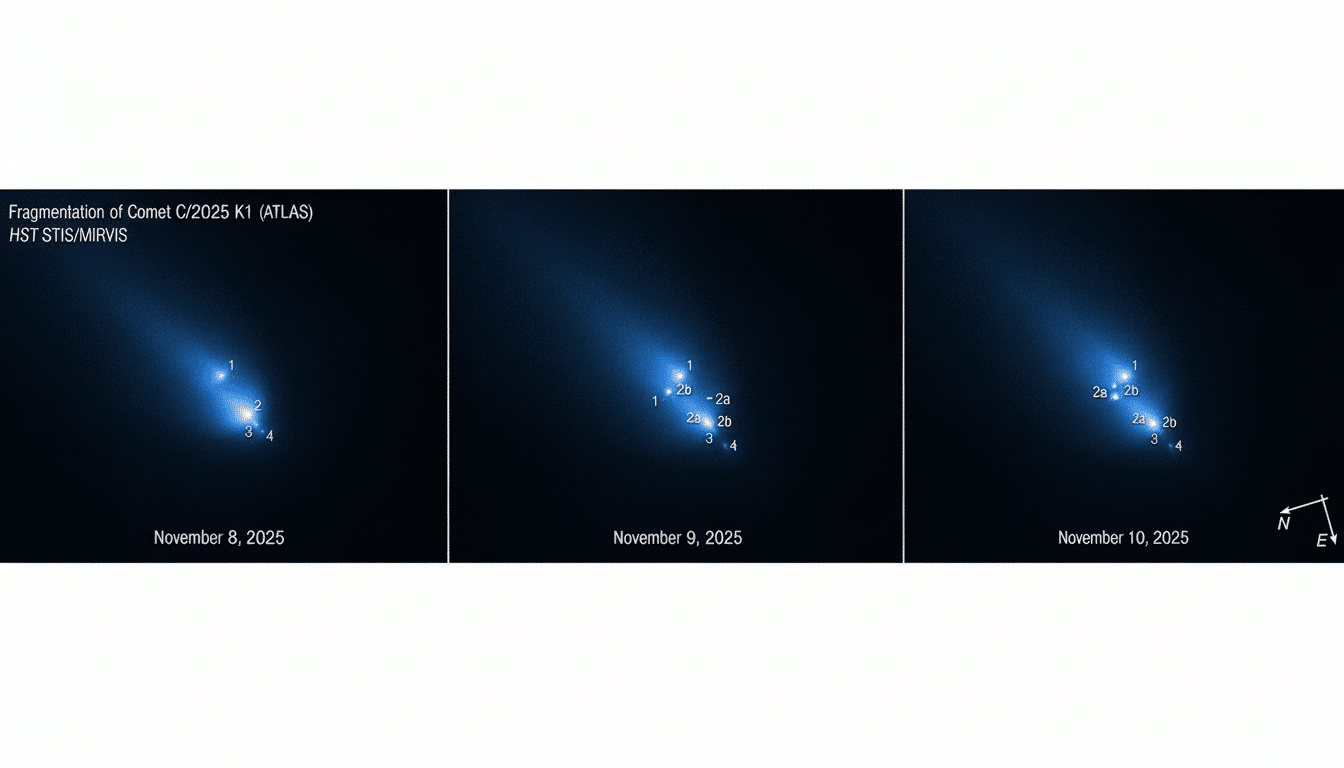
Sometimes the most revealing discoveries arrive unplanned. NASA’s Hubble Space Telescope, after an unexpected change in observing plans, happened to image comet C/2025 K1 (ATLAS) at the exact moment it was tearing itself apart — a serendipitous catch that delivered the kind of data comet scientists have been chasing for years.
The images show multiple pieces of the comet’s nucleus separating and evolving in real time, a fleeting phase that is extraordinarily hard to predict and even harder to study. For planetary scientists, it’s the next best thing to cracking open a time capsule from the solar system’s youth.
A Rare Catch In Deep Space: Hubble’s Timely Observation
Researchers pivoted to observe K1 after their original target became impractical, turning a scheduling hiccup into a breakthrough. When the first Hubble frames arrived, the team saw not one compact “dirty snowball,” but multiple fragments — each surrounded by its own halo of gas and dust, or coma.
Hubble tracked the evolving debris over consecutive sessions, resolving structures that ground-based telescopes blur together. Before the disruption, K1 was likely larger than an average comet nucleus, with estimates comparable in footprint to Key West or Los Angeles International Airport. The breakup occurred after the comet skimmed inside Mercury’s orbit, where intense solar heating can stress fragile, porous ice.
What The Images Reveal About Comet ATLAS’s Breakup
Each fragment appears to be an active mini-comet, venting jets as fresh surfaces meet sunlight. The team reports that the comet’s overall brightness surged later than models predicted, a clue that what we see is dominated by sunlight reflecting off dust rather than immediate gleaming ice. In other words, the showiest part of a breakup may arrive only after newly exposed ice warms, pressure builds beneath the surface, and dust clouds expand enough to catch the light.
Early measurements also hint that K1 may be unusually depleted in carbon-bearing compounds compared with many comets. If confirmed, that chemistry would underscore how diverse these objects are — and how their natal neighborhoods in the early solar system left distinct chemical fingerprints. The research team has submitted detailed analyses to the journal Icarus and is coordinating follow-up observations to pin down the composition more precisely.
Why Fragmenting Comets Matter For Planetary Science
Most comet studies probe sun-baked surfaces shaped by countless solar passes. A breakup exposes interior material that can remain relatively unchanged since the solar system formed about 4.6 billion years ago. It’s the planetary science equivalent of a fresh geological core sample — except the core is flying through space and disintegrating as you watch.
There are more than 4,000 known comets cataloged by the Minor Planet Center, with many more suspected in the distant Kuiper Belt and the even more remote Oort Cloud. Yet catching one in the act of fragmenting, at high resolution, is rare. Hubble has documented shattered comets before, but this dataset captures the process with timing and clarity that could recalibrate models of how and why these icy bodies fail.
Serendipity And Scientific Payoff From Hubble’s Shift
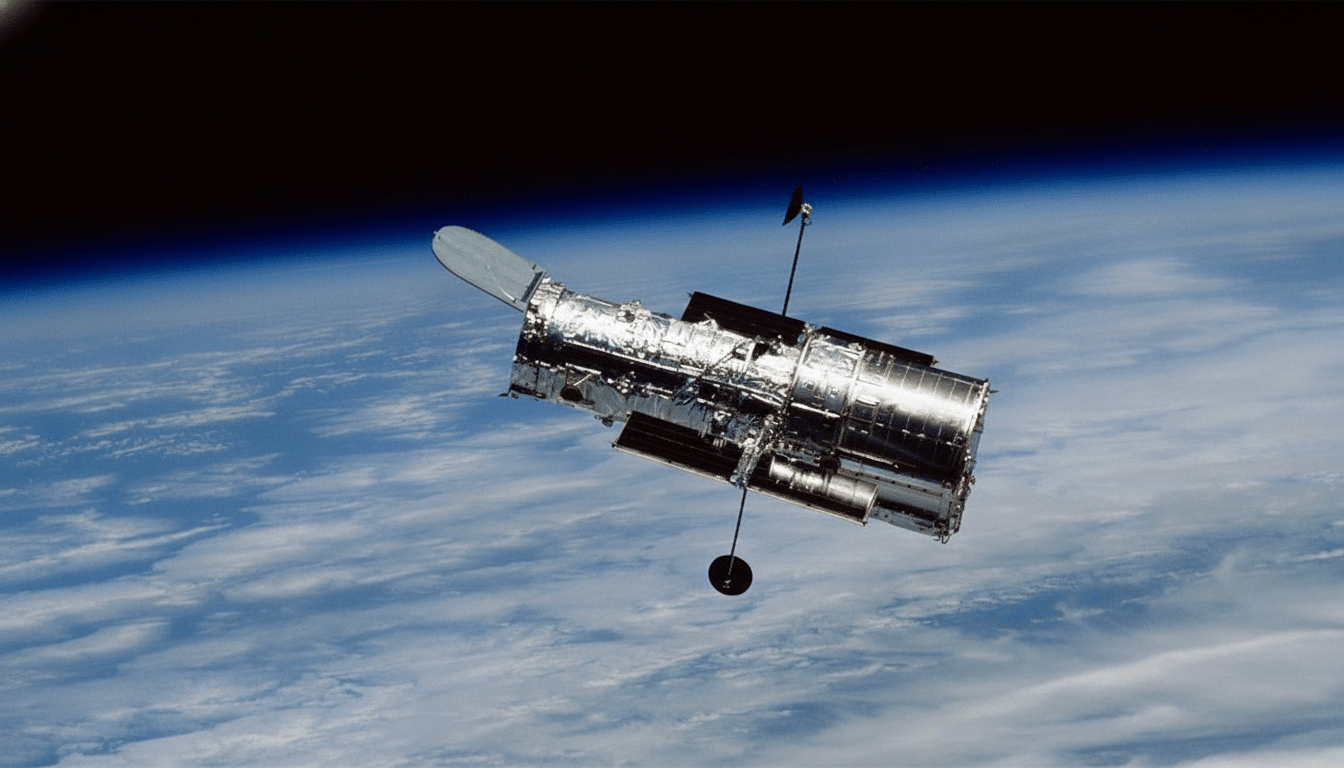
Hubble’s good fortune was matched by nimble operations. The observatory, a joint project of NASA and ESA and operated by the Space Telescope Science Institute, can pivot to time-sensitive targets when science merits it. In this case, a mundane scheduling workaround — not a dedicated campaign — put the telescope in the right place at the right moment, an outcome the lead investigators at Auburn University describe as an astronomical lucky break with outsized scientific dividends.
The images provide a rare laboratory for stress-testing theories of comet strength, internal layering, and heat transport. They also offer ground truth for survey teams that track brightness and morphology from Earth, refining how we interpret light curves when we cannot resolve tiny fragments directly.
What Comes Next For Observations Of Comet C/2025 K1
K1’s remnants are now drifting away from the inner solar system, about 250 million miles from Earth and fading as their dust disperses. A combination of large ground-based telescopes and space assets will keep watch as long as the signal holds, hunting for changes in fragment activity and chemistry that could reveal how the breakup evolved from the inside out.
The results will ripple into mission planning. ESA’s Comet Interceptor, designed to ambush a pristine comet on a first approach to the Sun, will benefit from better models of volatile release and fragmentation risk. Laboratory studies of comet analog materials can be tuned to match K1’s observed behavior, closing the gap between simulations and reality.
For now, the takeaway is simple: fortune favored preparation. A telescope famed for precision met a cosmic accident in progress, and the payoff is a sharper, deeper view into the raw ingredients that built the planets — captured, almost unbelievably, by chance.

