


Lighting is often treated as a finishing detail, but its placement can have a direct effect on how comfortably and efficiently a room operates. Under cabinet lighting is a particularly useful example because it delivers illumination close to the surfaces where people prepare food, complete detailed work, organize belongings, or display objects. Instead of relying entirely on ceiling fixtures, it places light between the user and the working surface, reducing the shadows that overhead fixtures frequently create. That difference can make counters easier to navigate and small objects easier to distinguish, especially in spaces with deep cabinets or limited natural light. It also gives homeowners, designers, and business operators greater control over where illumination is concentrated rather than flooding an entire room unnecessarily. As a result, under cabinet lighting serves both a practical and architectural role in kitchens, offices, workshops, retail spaces, and display environments.
The effectiveness of this lighting comes largely from proximity. A ceiling fixture may provide strong general illumination, but cabinets, shelves, equipment, and even the user’s body can interrupt the path between the fixture and the surface below. Lighting mounted underneath cabinetry bypasses many of those obstacles by positioning the source directly above the counter or work area. This makes it possible to achieve useful task lighting without dramatically increasing the brightness of the entire room. It can also reduce the need for portable lamps that occupy valuable counter or desk space. In compact environments, where every usable inch matters, eliminating additional fixtures from the working surface can improve organization as well as visibility. The result is a cleaner and more deliberate lighting arrangement that responds to the actual activities taking place in the space.
- Choosing Lighting That Matches the Application
- Better Kitchen Lighting Improves Everyday Tasks
- Workspaces Benefit From More Precise Task Illumination
- Display Areas Gain Depth, Focus, and Visual Hierarchy
- LED Technology Expands Efficiency and Design Flexibility
- Installation Details Determine the Quality of the Result
- Color Temperature, Brightness, and Control Shape the Experience
- Thoughtful Under Cabinet Lighting Adds Long-Term Value
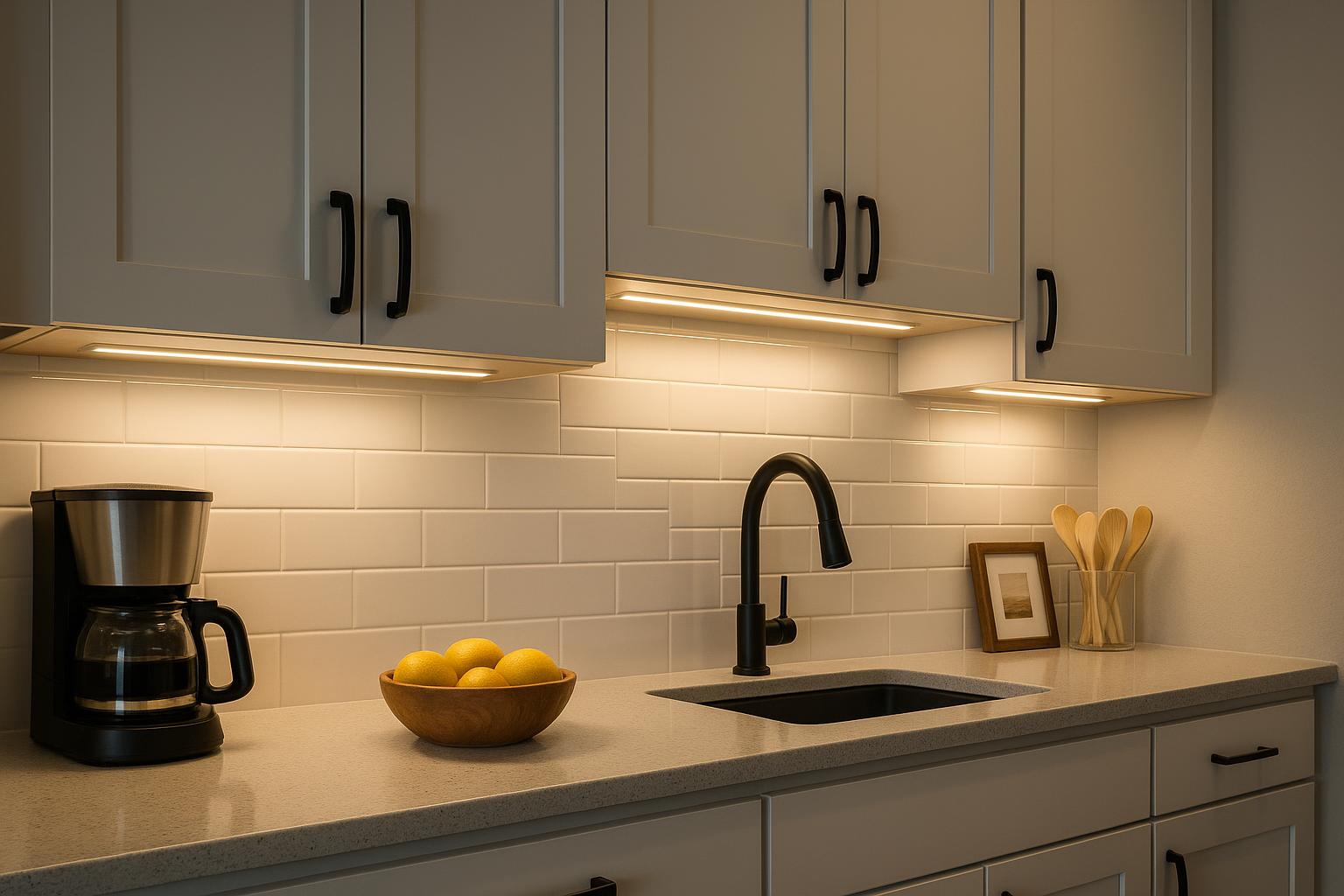
Modern under cabinet systems also make layered lighting easier to achieve. Rather than expecting a single ceiling fixture to perform every role, a room can combine ambient, task, accent, and decorative lighting according to need. Overhead fixtures can establish general visibility, while under cabinet fixtures concentrate light precisely where detailed activities occur. Pendant lights, wall sconces, or decorative fixtures can then contribute character without being responsible for all of the functional illumination. This layered approach allows a room to feel comfortable during ordinary use while remaining adaptable for cooking, cleaning, entertaining, reading, merchandising, or technical work. It also helps explain why under cabinet lighting has moved beyond being a specialty kitchen upgrade and has become a useful design tool across residential and commercial spaces.
Choosing Lighting That Matches the Application
The right under cabinet lighting system depends on what the illuminated surface is expected to accomplish. A kitchen countertop used for food preparation has different lighting requirements from a bookshelf displaying collectibles or a workstation used for assembling small components. Task-oriented areas generally benefit from broad, even illumination with few dark gaps, while display applications may call for more controlled brightness and visual emphasis. Fixture dimensions, beam spread, color temperature, color rendering, and mounting position can all influence how useful the finished installation feels. Controls also deserve attention because a space used for several purposes may need bright working light during the day and lower output in the evening. Defining these requirements before shopping makes it easier to narrow the field and avoid selecting a fixture based on appearance or brightness alone.
Once lighting requirements are clear, product sourcing becomes the next practical step. Under cabinet systems can differ in fixture depth, voltage, wiring method, dimming compatibility, color temperature, and installation needs, so purpose-built products often provide a better fit than generic light strips. Specialized lighting and electrical retailers can simplify the search by offering several fixture styles, components, and established brands. For example, BuyRite Electric, which carries lighting, electrical supplies, and tools, has a dedicated selection of sleek, high-performance LED under cabinet lighting for counters, cabinets, shelves, and work surfaces. Reviewing a focused product category can help buyers compare dimensions, installation methods, electrical requirements, controls, and overall compatibility before selecting a system suited to a particular space and application. This approach also helps narrow choices based on brightness, placement, energy use, and the intended visual effect.
Fixture type is another important consideration because different formats create noticeably different lighting effects. Linear bars and strips are often well suited to long counters because they can produce a more continuous band of illumination rather than a series of isolated bright spots. Puck lights create more concentrated pools of light and can work effectively for display cabinets, shelving, and decorative emphasis where focused illumination is desirable. Flexible LED tape can accommodate unusual dimensions, corners, and shallow mounting locations, although the quality of the finished result depends heavily on compatible channels, diffusers, drivers, and connectors. Hardwired fixtures can provide a cleaner, more integrated appearance, while plug-in products may simplify installation in spaces where permanent electrical work is not practical. Comparing these formats against the actual dimensions and use of the space helps ensure that the selected system performs well rather than merely fitting beneath the cabinet.
Better Kitchen Lighting Improves Everyday Tasks
The kitchen is one of the clearest examples of why under cabinet lighting can materially improve a room. Upper cabinets often extend over the very counters where people chop ingredients, read recipes, inspect food, wash produce, and handle sharp tools. When illumination comes mainly from ceiling fixtures, the person standing at the counter can cast a shadow across the working area. Under cabinet fixtures introduce light from a position that is much closer to the work and less vulnerable to those obstructions. Ingredients, utensils, measuring marks, and surface conditions become easier to see without requiring excessively bright overhead lighting. For households that cook frequently, this improvement affects daily function rather than simply changing the room’s appearance.
Visibility can also influence precision. Measuring ingredients, checking whether food is fully cleaned, reading appliance controls, and identifying spills are all easier when the countertop is evenly illuminated. This is particularly relevant on dark stone, patterned tile, or highly reflective surfaces where subtle objects and liquids may otherwise be difficult to distinguish. Good task lighting can reveal crumbs, grease, water, and other residue that general lighting may leave unnoticed. It can also make knife work and other detailed food preparation easier because the user can see edges, textures, and cutting surfaces more clearly. While lighting does not replace safe habits, it supports them by reducing unnecessary visual uncertainty. In that sense, under cabinet fixtures become part of the kitchen’s working infrastructure alongside counters, appliances, ventilation, and storage.
The same lighting can improve the kitchen after active food preparation ends. Dimmable under cabinet fixtures can provide low-level illumination when full overhead lighting feels excessive, such as during early mornings, late evenings, or casual entertaining. A softly illuminated counter can make it easier to retrieve a glass of water, prepare a snack, or move through the room without activating every major fixture. It can also emphasize backsplash materials, cabinet finishes, and countertop textures that disappear under flat general illumination. Because the fixtures themselves are usually concealed from normal sightlines, the viewer experiences the effect of the light rather than seeing a prominent lamp. This combination of utility and visual restraint is one reason under cabinet lighting can feel like an architectural improvement rather than an added accessory.
Workspaces Benefit From More Precise Task Illumination
Under cabinet lighting can be equally valuable outside the kitchen, particularly in home offices, workshops, craft rooms, laboratories, utility areas, and commercial workstations. Many of these environments include shelving or wall-mounted storage above a desk or bench, creating the same shadow problems found beneath kitchen cabinets. Installing lighting below those structures delivers illumination directly to documents, tools, components, fabrics, drawings, or other materials being handled. This can make fine details easier to distinguish and reduce dependence on desk lamps that consume working space. In settings where a large surface must remain clear for tools or materials, freeing the desk from additional fixtures is a practical advantage. The lighting therefore supports both visibility and spatial efficiency.
Uniformity is especially important in work environments. A fixture that creates intense bright spots beside noticeably darker zones can force the eyes to adapt repeatedly as the user looks across the surface. Linear under cabinet systems can help provide more continuous illumination, particularly when the fixtures are sized and spaced according to the dimensions of the work area. Diffusers may also soften individual LED points and reduce harsh visual transitions. For close work, the quality of the light can matter as much as the amount of light being produced. A well-planned installation seeks to provide enough illumination for the task without introducing unnecessary glare or uncomfortable reflections from screens, polished tools, glass, or glossy surfaces.
Color characteristics deserve additional attention when the work involves visual judgment. Artists, designers, craftspeople, technicians, collectors, and anyone comparing colors or finishes may benefit from lighting with strong color-rendering performance. The color temperature should also complement both the task and the surrounding ambient light so that the workspace does not appear strangely blue or yellow by comparison. Someone assembling small components may prioritize clarity and contrast, while a person working with textiles may care more about accurate color relationships. In a shared office, adjustable brightness can help accommodate different activities and individual preferences throughout the day. Under cabinet lighting is most effective when it is treated as a task-specific tool rather than merely an extra source of brightness.
Display Areas Gain Depth, Focus, and Visual Hierarchy
Lighting can determine which objects people notice first in a display. Shelves, glass cabinets, retail counters, bookcases, art niches, and collectible cases may all contain items worth seeing, but those objects can disappear visually when the illumination is flat or poorly directed. Under shelf or under cabinet fixtures introduce contrast that separates displayed objects from their surroundings. Properly positioned lighting can reveal textures, edges, colors, and materials while giving the overall arrangement more depth. It can also guide attention toward selected areas without requiring a room to become uniformly bright. For residential interiors and commercial merchandising alike, this ability to establish visual hierarchy is a significant design advantage.
Retail environments can use the same principle strategically. Products placed beneath illuminated shelves may appear more defined because light reaches labels, packaging, materials, and surfaces that overhead fixtures might leave in partial shadow. Jewelry, electronics, decorative objects, cosmetics, glassware, and specialty merchandise can particularly benefit from focused illumination when glare is carefully controlled. The objective is not simply to make products brighter but to make them easier for customers to examine. A thoughtfully illuminated display can improve visual clarity while helping different categories or focal products stand apart from the surrounding environment. Lighting can therefore contribute to merchandising without changing the physical inventory or footprint of the display. In competitive retail settings, presentation quality can influence how carefully shoppers inspect what is in front of them.
Residential display areas benefit from a more subtle version of the same approach. Lighting beneath shelves can highlight books, ceramics, photographs, artwork, or collections without turning the room into a retail showcase. The intensity can be kept relatively low so the light supports the atmosphere instead of overwhelming it. Concealed fixtures are especially useful because they allow attention to remain on the objects rather than on the lighting hardware. Dimming can further adjust the effect for different times of day or occasions, allowing a display to serve as both a visual feature and a source of gentle background illumination. When integrated carefully, the lighting makes cabinetry and shelving appear more intentional while adding another layer of depth to the room.
LED Technology Expands Efficiency and Design Flexibility
The growth of LED technology has made under cabinet lighting easier to integrate into a wider range of spaces. LEDs can produce useful illumination from relatively compact fixtures, allowing them to fit beneath shallow shelves or cabinets without drawing attention to themselves. Their low-profile construction is particularly useful in contemporary interiors, where visible hardware may conflict with clean architectural lines. LEDs also convert a greater proportion of electrical energy into useful light than older incandescent technologies, reducing wasted energy in the form of heat. That efficiency becomes more meaningful when lighting is used for long periods each day in kitchens, offices, retail displays, or work areas. For designers and property owners, the combination of compact dimensions and lower operating demand has expanded the practical applications for under cabinet systems.
Long operating life is another reason LEDs suit difficult-to-access installations. Replacing lamps beneath cabinets, inside shelving systems, or behind display components can be inconvenient, particularly when fixtures are integrated into built-in furniture. A well-designed LED system can reduce the frequency of that maintenance compared with older lamp technologies, although actual longevity still depends on component quality, operating temperature, power supplies, and installation conditions. Proper heat management remains important because LEDs and their electronic drivers can deteriorate faster when operated in excessive temperatures. Ventilation, compatible components, and correct electrical loading should therefore be considered during planning rather than after installation. Efficiency is most valuable when the system is also reliable and appropriately specified.
LED technology also makes sophisticated control more accessible. Many systems can be paired with dimmers, occupancy sensors, door switches, timers, or smart-home controls depending on the equipment being used. In a kitchen, brighter settings may support food preparation while lower settings provide evening ambience. In a display cabinet, lighting can activate when doors open or during designated hours. A workspace can use occupancy controls to reduce unnecessary operating time when no one is present. These features allow energy use and light output to respond more closely to actual behavior, which is more efficient than leaving fixed-output fixtures running regardless of need. Control flexibility also makes a single lighting installation useful across a wider range of activities.
Installation Details Determine the Quality of the Result
Even a high-quality fixture can perform poorly if it is installed in the wrong position. Under cabinet lighting generally works best when the placement accounts for fixture beam spread, cabinet depth, counter dimensions, reflective materials, and the user’s normal sightline. Mounting a fixture too close to the wall may overemphasize the backsplash while leaving the front portion of the counter comparatively dark. Installing it too close to the front edge can make the source visible or create uncomfortable glare for seated users. The ideal position varies by product and cabinet geometry, which is why installation instructions and mockups are useful before permanent mounting. Small adjustments in location can produce surprisingly large differences in perceived brightness and uniformity.
Electrical planning matters just as much as physical placement. Hardwired systems require appropriate circuits, wiring methods, drivers, transformers, or junction arrangements depending on the specific fixture. Plug-in products may be simpler, but cords and receptacles still need to be positioned so they do not interfere with the appearance or function of the space. Low-voltage LED tape systems require compatible power supplies and must be sized according to the connected load and manufacturer requirements. Dimmers must also be compatible with the fixture and driver if smooth brightness control is expected. Poor component matching can result in flickering, limited dimming ranges, noise, premature failure, or inconsistent output. When electrical modifications are beyond the scope of straightforward consumer installation, using a qualified professional can help ensure the system is installed correctly and in accordance with applicable requirements.
Attention should also be paid to how the installation looks when the lights are turned off. Visible wires, exposed connectors, uneven tape, poorly positioned drivers, and mismatched fixtures can undermine an otherwise attractive renovation. Channels and diffusers can help create a finished appearance for LED tape while also making the light look more continuous. Cabinet trim or recessed mounting can conceal fixtures where the cabinetry allows it. Planning wire routes before installation may prevent the need for awkward surface-mounted cables later. In new construction or major remodeling, coordinating the lighting design with cabinetry and electrical work provides the greatest opportunity for seamless integration. In existing spaces, careful measurement and product selection can still produce an installation that appears deliberate rather than improvised.
Color Temperature, Brightness, and Control Shape the Experience
Brightness is one of the most obvious specifications in lighting, but more light is not automatically better light. Under cabinet fixtures should provide enough output to make the intended surface comfortable to use without producing excessive contrast with the rest of the room. A brightly illuminated countertop beneath a very dark ceiling can feel harsh, just as weak task lighting may have little practical benefit. Dimming is valuable because it allows users to adjust that relationship as surrounding conditions change. Daylight, overhead fixtures, decorative lighting, and evening conditions all affect how bright an under cabinet system appears. A controllable installation gives the user flexibility instead of forcing one level of illumination to work in every circumstance.
Color temperature has a similarly strong influence on perception. Warmer light often complements traditional interiors, wood cabinetry, hospitality settings, and relaxed residential environments. Neutral or somewhat cooler light can create a crisp appearance that works well in contemporary kitchens, offices, workshops, and certain retail applications. The best choice depends on the materials in the space, the work being performed, and the temperature of surrounding light sources. Large differences between adjacent fixtures can make one part of the room appear visually disconnected from another. Consistency is therefore useful when several lighting layers operate at the same time. Some modern systems offer adjustable color temperature, giving users additional flexibility when a single area serves several purposes.
Color rendering should not be overlooked either. Two light sources with similar brightness and color temperature can make food, artwork, fabrics, wood, merchandise, and finishes look noticeably different. In kitchens, strong color rendering can help ingredients and prepared foods appear more natural. In retail displays, it can help shoppers evaluate product colors more confidently. In studios and workshops, it may improve the user’s ability to compare materials or identify subtle differences between components. Selecting light based only on wattage or basic brightness can therefore miss characteristics that have a significant effect on visual quality. A successful under cabinet installation considers output, temperature, rendering, glare, and control as parts of the same lighting experience.
Thoughtful Under Cabinet Lighting Adds Long-Term Value
The strongest argument for under cabinet lighting is that it solves several problems at the same time. It can make working surfaces easier to see, strengthen the visual hierarchy of a room, highlight architectural materials, and provide lower-level illumination when overhead fixtures are unnecessary. Unlike some decorative upgrades, its usefulness is not limited to a particular design trend. Kitchens will continue to require safe and visible preparation areas, workspaces will continue to benefit from focused task lighting, and displays will continue to depend on illumination for visual emphasis. That functional foundation gives the upgrade relevance even as cabinet styles, finishes, and decorative preferences change. When thoughtfully selected, the lighting becomes part of how a space works rather than an accessory added solely for appearance.
The investment can also improve the perceived completeness of a room. A renovated kitchen with attractive counters and cabinetry may still appear visually flat if important surfaces remain in shadow. A carefully designed office can feel less effective when the working plane receives inadequate illumination. Display cabinetry can lose much of its impact when its contents are difficult to see. Under cabinet lighting addresses these issues without occupying additional floor, wall, or counter space, which makes it unusually efficient from a design standpoint. It makes use of an area beneath cabinetry or shelving that would otherwise contribute little to the room. That combination of space efficiency and functional improvement helps explain its continuing appeal in both renovations and new construction.
The best results come from treating the lighting as an integrated system rather than purchasing fixtures as an afterthought. The intended activity should guide fixture type, output, color characteristics, mounting location, electrical design, and control strategy. Kitchens may emphasize broad, consistent task lighting, while display areas may require carefully directed illumination and workspaces may prioritize clarity and color accuracy. Proper installation then ensures that wiring and hardware remain unobtrusive while light reaches the correct surfaces. When these decisions are coordinated, under cabinet lighting can improve usability during demanding tasks and atmosphere during quieter moments. Its value ultimately lies in that flexibility, providing focused illumination exactly where conventional room lighting often fails to reach.

