


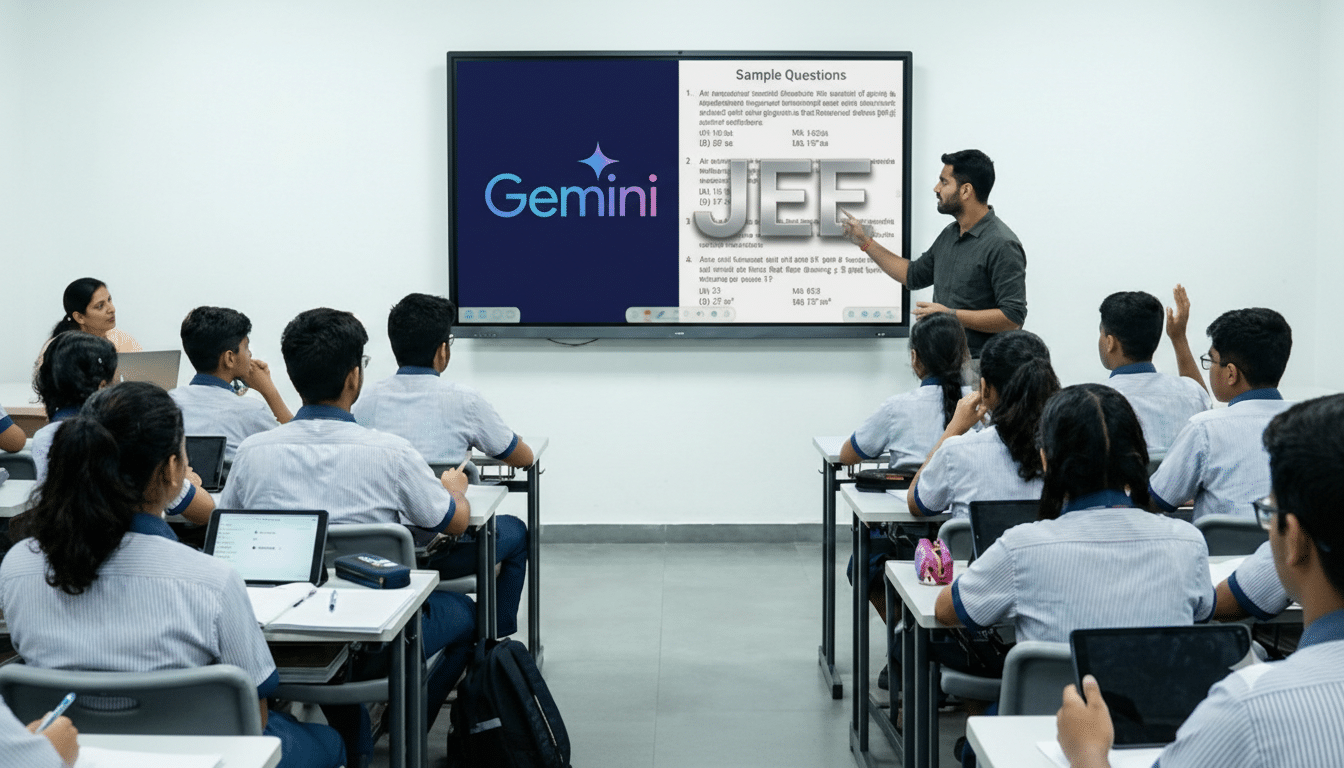
Google is turning its flagship AI into a full-fledged exam coach for India’s toughest engineering entrance, rolling out full-length Joint Entrance Examination (JEE) practice tests inside Gemini with instant feedback, explanations, and personalized study plans. It’s the clearest sign yet that Gemini is being positioned not just as a chatbot, but as a structured preparation companion for one of the world’s most competitive academic filters.
What Gemini Adds To JEE Preparation And Practice
Within Gemini, students can now sit full-length mock exams that mirror the format and rigor of JEE Main. After submission, the AI highlights strengths and gaps, breaks down correct approaches, and proposes a tailored revision plan. The experience is designed to reduce time spent on guesswork—what to study next, which chapters to revisit—and increase the cadence of targeted practice.

The move follows Google’s recent test-prep experiments for the SAT and expands a broader AI study toolset. In AI Mode in Search, a Canvas workspace lets students drop in class notes and automatically generate study guides, flashcards, and interactive quizzes. For those organizing material across sources, NotebookLM can turn readings into question banks and summaries, including audio or video formats.
Local Partnerships And Ensuring Content Quality
To address the perennial credibility question in AI tutoring, Google says JEE practice content in Gemini is vetted and sourced from Indian education firms PhysicsWallah and Careers360. That matters in a high-stakes context where one ambiguous question can throw off an entire strategy. By leaning on established exam-prep providers, Google is signaling that quality and syllabus alignment—not just novelty—will define its education push.
The JEE ecosystem demands that discipline. According to the National Testing Agency, over a million candidates attempt JEE Main annually, competing for roughly 17,000 undergraduate seats across the Indian Institutes of Technology and additional seats across National Institutes of Technology and other centrally funded institutions. In that environment, accuracy, difficulty calibration, and up-to-date patterns are not optional features.
Language Access And Equity In JEE Preparation
A notable piece of the rollout is multilingual support. Google says its AI tools are accessible in multiple Indian languages, a practical step given JEE Main’s availability in more than a dozen languages and the geographic spread of test-takers. For first-generation learners and students from non-metro regions, parity in explanations and feedback across languages can reduce friction that often goes unaddressed by one-size-fits-all prep materials.
Voice-based reading aids and AI-powered English learning coaches under the company’s broader education initiatives are aimed at similar access gaps. When combined with mock tests and adaptive feedback, these tools promise a more inclusive pipeline to competitive exams—assuming connectivity and device access are in place.
Backing Educators And Strengthening Public Platforms
The student-facing features arrive alongside an educator strategy. Google plans to partner with government agencies on a nationwide program to help teachers and support staff use AI for lesson design and administrative work. A pilot with the Ministry of Skill Development and Entrepreneurship and Chaudhary Charan Singh University seeks to build an “AI-enabled state university,” with a framework spanning vocational and higher education.
On the public-good side, Google.org is funding Wadhwani AI with an ₹850 million grant to integrate AI into government-run education platforms—including national online learning portals and state systems—to personalize content and ease paperwork. The initiative has reportedly reached about 10 million learners and educators to date and aims to scale to 75 million students, 1.8 million educators, and 1 million early-career professionals by the end of 2027.
Guardrails And Safeguarding Exam Integrity
Google emphasizes that the new features are built for structured preparation, not shortcuts. That distinction is critical as education regulators globally grapple with AI misuse, from solution scraping to exam-time malpractices. The effectiveness of Gemini’s JEE mode will hinge on how well it confines itself to explanations, guided practice, and metacognitive support—while avoiding answer dumping that undermines learning or fairness.
Clear provenance of questions, visible reasoning steps, and controls that nudge students into attempting problems before revealing methods will be the differentiators. If implemented well, those design choices can help institutional acceptance, especially in schools that worry about AI blurring the line between help and dependency.
What To Watch Next As Google Expands JEE Prep
The JEE launch puts Google squarely into India’s multi-billion-dollar test-prep arena, long dominated by coaching institutes and increasingly by hybrid edtech models. Adoption will likely hinge on consistency—do the mock tests stay aligned with the latest NTA patterns, and does feedback translate into measurable score gains over multiple attempts?
If Gemini can become the daily practice layer—anchored by trusted content, adaptive plans, and multilingual clarity—it may shift student behavior away from static PDFs and scattered video playlists toward integrated, analytics-driven prep. For millions of aspirants, the promise is simple: fewer blind spots, faster iteration, and a clearer path through India’s most demanding engineering gateway.
