


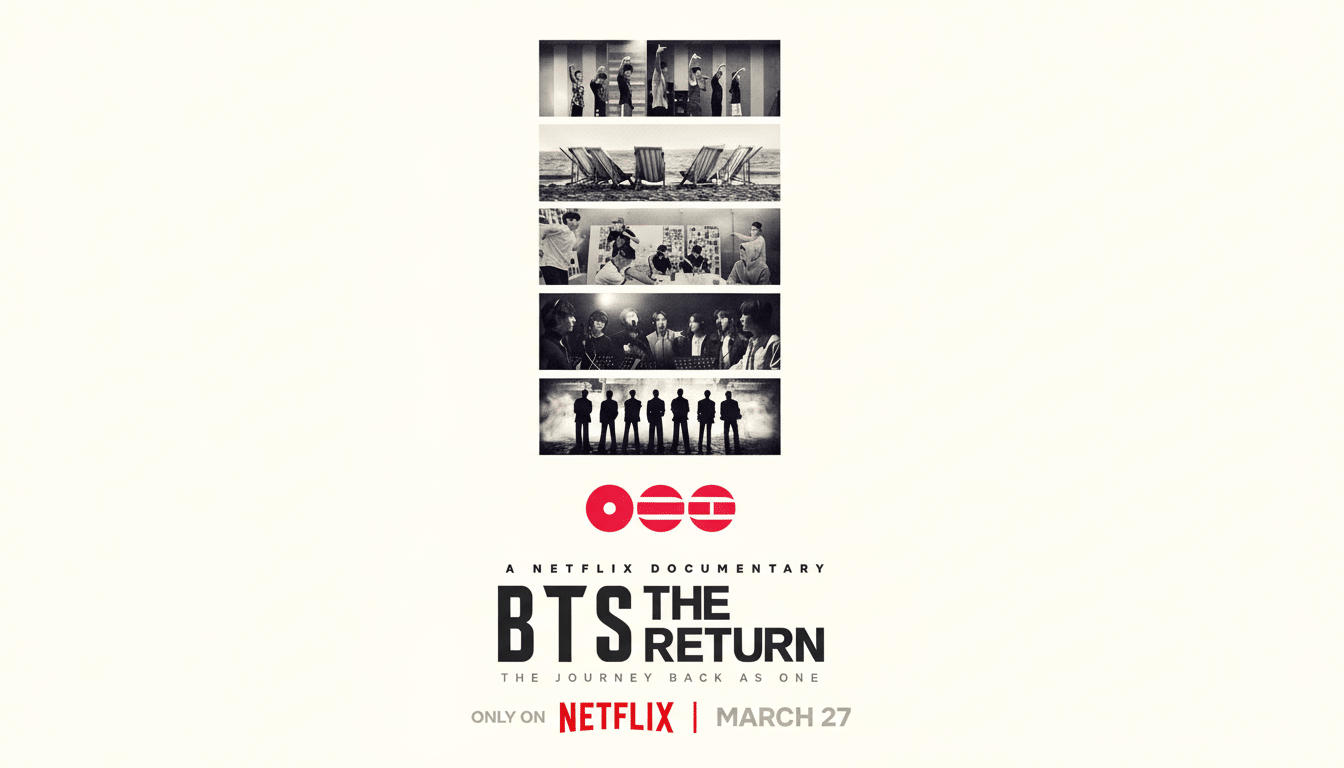
Netflix’s BTS The Return isn’t a victory lap so much as a stop at a crossroads. The world’s most successful boy band opens the studio door to reveal a project in search of a thesis, a comeback without a compass. What emerges is a rare, unvarnished portrait of seven artists wrestling with legacy, language, and the weight of being BTS now.
Instead of fan-service spectacle, director Bao Nguyen leans into process. The result is both engrossing and uncomfortable: a film that documents how difficult it is for a global juggernaut to pick a single path when every choice signals who they are next.
Inside the Creative Stall: BTS Struggles to Define an Album
The Return embeds with the group during a two-month stretch in Los Angeles, where the members live together and grind through a nearly finished yet stubbornly undefined album. There are plenty of songs on the board, but no organizing idea. In meeting rooms and makeshift studios, RM and Suga, the group’s chief architects, keep circling the same problem: not how to make tracks, but how to make them cohere.
HYBE leaders give the quandary shape. Executive creative director Boyoung Lee talks about sustaining legacy as an active practice; chairman Bang Si-hyuk pushes them to define that legacy in real time. The conversation lands on Arirang, the centuries-old Korean folk standard recognized by UNESCO’s Intangible Cultural Heritage list. Could it become a conceptual anchor rather than a sample tossed on top?
The film wisely refuses to rush these scenes. Takes stack up. Notes pile in. Decisions are made, then unmade. Producer Pdogg keeps the room moving through the fog, reframing false starts as progress. It’s not stagnation; it’s the price of trying to name an era.
The Language of Global Pop and the Tension of Authenticity
Language becomes the second axis of uncertainty. BTS know how to dominate in English—Dynamite, Butter, and Permission to Dance all shot to No. 1 on the Billboard Hot 100—and the commercial logic is clear. Company reports have long noted that the vast majority of the group’s audience is outside Korea, often above 90% on platforms like YouTube. But what’s expedient isn’t always what feels right.
Nguyen’s camera sits with the friction: rap verses that feel overstuffed with English, hooks that sound less like expression and more like accommodation, the painstaking work of sanding pronunciation until it gleams. Suga worries the language balance is off. RM wonders aloud what “authentic” means when fluency itself can bend a melody. The debate is refreshingly unsentimental—less nationalism than craft. Global, here, isn’t a trophy; it’s a daily calibration.
Arirang Between Heritage and Pop: Finding the Right Balance
The Return’s most intriguing thread is how Arirang passes from boardroom metaphor to studio experiment. Folded into a track provisionally titled Body To Body, the motif quickly becomes a litmus test. How overt is too overt for Korean listeners, who might hear patriotic heaviness rather than pop fluency? How subtle is too subtle for global audiences who could miss the reference entirely?

Bang argues at times for a more forward sample; the members test versions that gently tuck it into the production. A playthrough with a bolder treatment earns RM’s wry analogy about familiar flavors served in a mismatched setting—apt, pointed, and emblematic of the entire album’s tightrope walk. This is heritage as living material, not museum glass, and the film shows just how hard it is to get that balance to click.
Process Over Spectacle: Intimacy and Momentum in Creation
To offset the claustrophobia of indecision, Nguyen hands the members camcorders. The texture shifts. Domestic footage—grilling meat, poolside teasing, late-night noodling on a sax—becomes the connective tissue that explains why the music still moves forward at all. In Los Angeles, proximity breeds momentum; back in Seoul, the intimacy frays, and Jimin’s quiet confessional about a life grown smaller lands with sobering clarity.
For a group often mythologized as a single organism, the film underscores how much BTS depend on literal togetherness to be BTS. That isn’t weakness; it’s their operating system.
What This Says About BTS Now and Their Next Chapter
The Return resists the tidy arc of struggle-to-triumph. It ends with questions open and the album’s center of gravity still elusive. But the ambiguity feels earned. BTS aren’t flailing; they’re interrogating. That distinction matters for a group whose commercial stakes remain towering. IFPI has twice named them the Global Recording Artist of the Year, and their ability to ignite platforms at scale remains singular. The brand is healthy. The direction is what’s contested.
If a radio-ready single like Swim ultimately leads the campaign, the documentary suggests it will arrive as a compromise forged in full view—between English clarity and Korean grain, between executive thesis and artist instinct, between heritage and hook. That’s a more honest portrait of pop’s top tier than any montage of screaming stadiums.
Verdict: BTS The Return is an unusually candid industry document and a thoughtful cultural study, capturing the exact moment when a global act asks what comes after conquering the world. The band may not have a clear direction yet, but the film’s willingness to sit in the uncertainty is its strength—and, perhaps, theirs.

