Amazon has agreed to buy proprietary software from Israeli artificial-intelligence startup Decart and hire its three founders along with its AI research and engineering staff, a transaction aimed at improving the economics and performance of Amazon’s homegrown AI chips. Multiple outlets put the value at $7.5 billion, though Amazon did not disclose the terms and the agreement has not closed.
The distinction between a purchase of Decart’s technology and an acquisition of Decart as a whole is more than semantic. CNBC’s account of Amazon’s announcement says Amazon agreed to purchase Decart’s proprietary technology and employ the company’s founders, researchers and engineers. That structure gives Amazon a critical software asset and much of the team that built it while avoiding a public claim that it is buying the entire startup.
Software is central to Amazon’s chip strategy
Decart’s Optimization Stack is designed to help developers synchronize AI models across different chips and move workloads between hardware more quickly, according to CNBC. In practical terms, such software can reduce the effort of adapting models to particular accelerators and help customers make better use of available computing capacity.
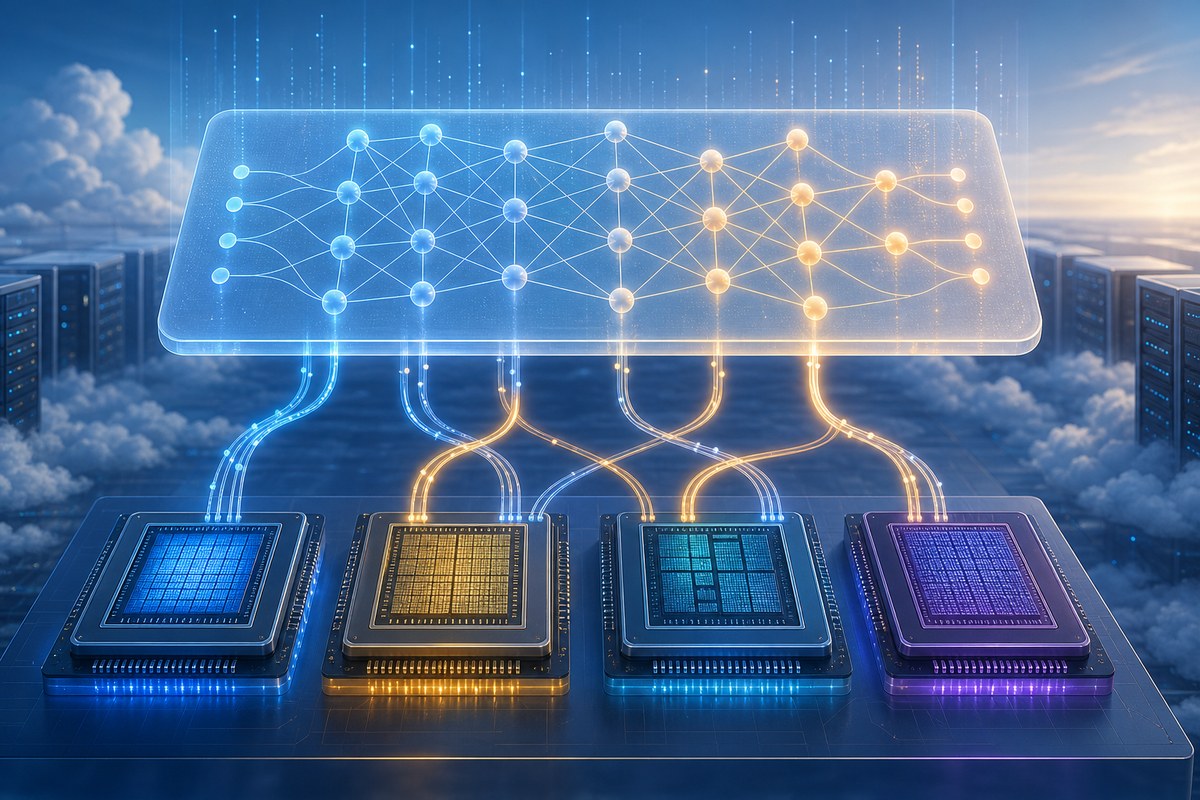
That puts the deal squarely in Amazon Web Services’ broader contest to make its Trainium chips, used for model training, and Inferentia chips, used for serving models, more credible alternatives for AI workloads that have largely run on Nvidia hardware. The cost of an AI system is not confined to the price of a chip: customers also absorb the expense of model development, deployment tooling, data movement and idle or poorly utilized capacity. Software that improves portability or chip utilization can therefore influence both performance and the total cost of running a model.
Amazon senior vice president Peter DeSantis said more efficient computing can support training, reinforcement learning and inference while lowering costs, according to Calcalist’s report on the agreement. Amazon’s stated purpose is to improve its custom-chip performance and AI inference, rather than simply add a consumer-facing AI product.
Reported $7.5 billion price remains unconfirmed by Amazon
The headline valuation requires a careful reading. Calcalist reported a $7.5 billion transaction, and CNBC said several outlets cited people familiar with the matter for that figure. But CNBC also reported that Amazon declined to comment on the deal’s terms. The price should therefore be treated as reported, not as a publicly confirmed purchase price.
Calcalist further reported that the consideration includes cash and stock paid in installments, with certain payments linked to performance and a substantial portion scheduled for the fifth year. It said the founders committed to remain at Amazon for five years. Those provisions, if accurate, would make the arrangement look partly like a long-duration retention and performance package, consistent with a technology-and-talent transaction. Amazon has not publicly confirmed those mechanics.
The agreement also remains subject to regulatory approval and other customary closing conditions. Describing it as completed would overstate what Amazon has announced. Likewise, broad descriptions of Amazon buying Decart outright go beyond the more precise public account: Amazon is acquiring a defined body of proprietary technology and bringing over the people most closely associated with it.
A fast rise and a prior Amazon relationship
Decart was founded in 2023 by Dean Leitersdorf, Moshe Shalev and Orian Leitersdorf. It began working with Amazon in 2025 to optimize Trainium performance, Calcalist reported. That history helps explain why Amazon would place a high strategic value on the software and the technical group: the parties had already worked on the problem the agreement is intended to address.
In May 2026, Decart raised $300 million at an approximate $4 billion valuation, according to Calcalist. The company had raised more than $450 million in total and employed about 100 people. A reported $7.5 billion deal value only months after that financing would represent a sharp step up in implied value, although the comparison is not exact because the reported Amazon arrangement includes technology rights, talent commitments and, according to Calcalist, contingent and deferred compensation.
Decart also appears to have drawn interest from another major AI buyer. CNBC reported that Bloomberg had said Anthropic considered acquiring Decart and completed due diligence. Calcalist reported that Anthropic withdrew from advanced negotiations in September. Neither account establishes why those talks ended, but they indicate that Decart’s software was viewed as strategically relevant beyond Amazon’s own chip program.
Why the deal structure fits the market
For cloud platforms, access to specialized chips is only one part of competing for AI spending. Nvidia’s advantage has been reinforced by its software ecosystem and developer familiarity, which can make switching costly even when alternative processors offer attractive pricing. Amazon’s ownership of a software layer that helps models operate across hardware could help reduce some of that friction for customers considering Trainium or Inferentia.
The deal also illustrates how AI companies are increasingly pursuing acquisitions that concentrate on scarce technical expertise and intellectual property without necessarily taking over every part of a target’s corporate structure. The approach can be appealing when the buyer primarily wants researchers, engineers and a narrow technology stack, while the target’s investors and employees need a way to monetize years of development.
Additional reporting from Yahoo Finance likewise described Amazon as obtaining Decart’s optimization technology and founding and technical teams, while attributing the $7.5 billion figure to Bloomberg. Until the closing conditions are satisfied and Amazon provides more detail, the confirmed core of the transaction is narrower but still consequential: Amazon is buying software intended to make its AI infrastructure more efficient and hiring the people who developed it.