


A new community project called Win8DE is reviving the tile-first Windows 8 interface on Linux, proving once again that open source can reconstruct almost any user experience — even one of Microsoft’s most divisive designs. It raises a sharper question than how: who actually wants it back?
What Win8DE recreates from the Windows 8 interface
Developed by a GitHub user known as er-bharat, Win8DE attempts a faithful re-creation of the Windows 8 desktop, including the full-screen launcher, large touch-friendly tiles, and the overall minimalist, chromeless look that was originally designed to bridge PCs and tablets. The project’s screenshots and demo clips show a surprisingly accurate facsimile, right down to the flat color palette and grid-based layout.
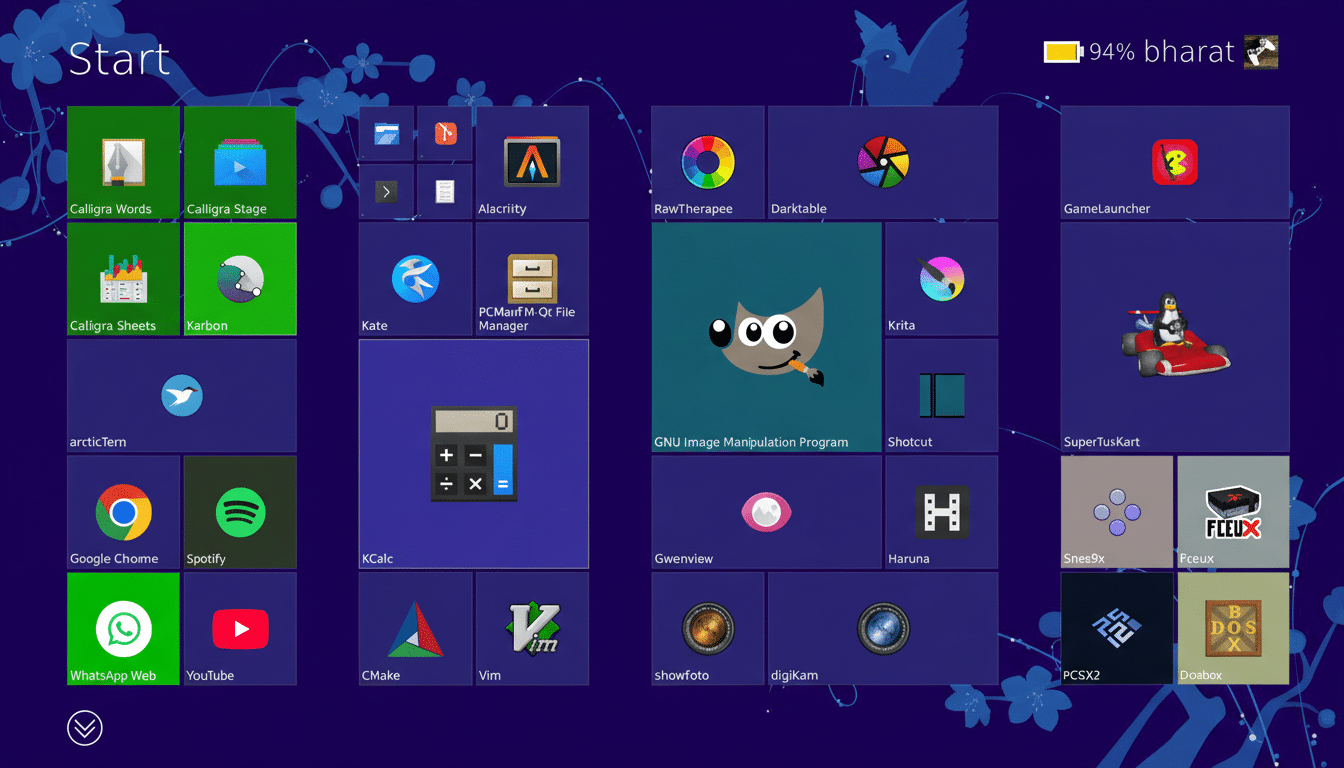
This is not a theme layered onto an existing environment; it’s a standalone desktop experience with its own logic and workflows. The current release is labeled v0.5.0, signaling active development and a long runway ahead before it can be considered stable or feature-complete.
Installation reality check for this early-stage project
As with many early-stage Linux projects, the first hurdle is simply getting it running. Users report dependency tangles and rough edges during setup — not surprising given the variety in Linux distributions, toolchains, and package managers. This is alpha software built by a single maintainer; expect manual steps, imperfect documentation, and a little “dependency archaeology.”
For tinkerers, a virtual machine or a spare device is the safest testbed. That isolates the project from your daily driver while making it easier to snapshot, roll back, and iterate. If you are used to polished one-command installs, you’ll need to recalibrate your expectations here.
Does anyone want Windows 8 back on the desktop?
Windows 8 split opinion from day one. It banished the traditional Start menu in favor of a tile wall built for touch, a move that thrilled a minority and baffled many. According to StatCounter’s historical data, Windows 8 and 8.1 together never overtook Windows 7 and peaked below 20% of desktop share globally. Enterprises in particular balked, and Microsoft later blended a familiar Start menu with live tiles before dropping the experiment entirely.
That history is why Win8DE’s arrival is more fascinating as a technical flex than a mainstream need. Nostalgia isn’t a product strategy, and Windows 8’s UX was controversial for reasons that haven’t changed: abrupt context shifts, hidden edge gestures, and a touch-first philosophy on predominantly non-touch hardware.
Where this Windows 8-style approach could make sense
There are niches where the tiled model still shines. Kiosks, smart displays, and classroom devices benefit from big, high-contrast targets and rigid layouts that reduce cognitive load. Some accessibility scenarios also favor large tiles and full-screen navigation over dense menus. In those contexts, Win8DE is less a throwback than a pragmatic, task-centric shell.
Because it’s open source, organizations could strip features, preload curated apps, and lock down the environment — something far harder with proprietary shells. That’s the story Linux tells best: tailor the interface to the job, not the other way around.
The bigger Linux lesson from this ambitious project
Win8DE underscores a core truth about the Linux desktop: it’s infinitely malleable. KDE Plasma and GNOME remain the power players, but one-off environments often act as idea labs that influence mainstream designs. Even if Win8DE never becomes daily-driver material, it demonstrates how a single developer can re-create a complex UX and spark new conversations about touch, accessibility, and task-focused computing.
It also highlights the cost of that freedom. Early projects invite dependency friction, transient bugs, and feature gaps. If you are comfortable trading stability for experimentation, Win8DE delivers a compelling proof of concept. If not, the takeaway is still valuable: Linux can bring back Windows 8 — it just can’t tell you why you should.
For now, consider Win8DE a living prototype and a reminder of what open ecosystems enable. Reinventing past interfaces may not rewrite Linux’s future, but it showcases the ambition and agility that keep the platform evolving.
