


Unemployment claims can become a growing administrative challenge for HR teams as organizations expand, employee separations increase, and workforce operations become more complex. Each claim may involve reviewing notices, gathering employment and wage records, documenting separation details, meeting response deadlines, and communicating with state unemployment agencies. Multi-state requirements, scattered records, manual processes, and potential unemployment insurance costs can make the process even more difficult to manage efficiently. Since each state administers its own unemployment insurance program within the broader federal-state system, requirements and procedures can vary by location. Centralized data, streamlined processes, and automation can help reduce repetitive work, improve deadline visibility, and give HR teams greater control over unemployment claims.
Why Are Unemployment Claims So Difficult for HR Teams?
Unemployment claims involve considerably more than responding to a notice. Depending on the circumstances, HR teams may need to verify an employee’s separation information, gather wage and employment records, provide supporting documentation, prepare a response, and monitor the claim through subsequent stages. When claim volume is low, these tasks may be manageable through spreadsheets, email, or paper records. As volume increases, however, those methods can make information harder to locate and create more repetitive administrative work.
- Why Are Unemployment Claims So Difficult for HR Teams?
- Can Unemployment Claims Increase Costs for Employers?
- Why Are HR Teams Struggling to Keep Up With Claim Deadlines?
- What Role Does Data Play in Better Unemployment Claims Management?
- How Can Automation Make Unemployment Claims Easier to Manage?
- How Can HR Teams Handle the Growing Unemployment Claims Workload?
- Why Does Unemployment Claims Management Matter More as Companies Grow?
- What Does an Effective Unemployment Claims Process Look Like?
- Conclusion

The complexity can increase further for employers operating across multiple states. Unemployment insurance procedures are not uniform across the country, so employers may need to follow different filing processes, documentation requirements, and response timelines depending on where a claim is handled. HR teams may also need to monitor pending claims, respond to additional requests, handle disputes or appeals, and maintain supporting records. Without a structured workflow, notices can be overlooked, deadlines can become difficult to track, and important employee information may remain scattered across different systems.
Common tasks involved in managing unemployment claims include:
- Reviewing claim notices and separation details
- Gathering and verifying employment and wage records
- Collecting supporting documentation
- Tracking response deadlines and claim status
- Preparing and submitting responses to agencies
- Monitoring disputed claims or appeals
- Maintaining records for future reference
As these tasks multiply, the administrative burden can quickly become significant. A process that works for a small number of claims may become difficult to maintain when an organization has hundreds or thousands of employees. A more organized and scalable claims management process can help HR teams maintain accuracy, respond on time, and reduce the effort required to manage fragmented administrative tasks.
Can Unemployment Claims Increase Costs for Employers?
Unemployment claims can create financial implications in addition to administrative work. In many states, unemployment insurance tax rates are influenced by employer experience rating, which considers an employer’s history of unemployment and benefit charges under applicable state rules. The U.S. Department of Labor describes experience rating as a system that is used to determine individual employer unemployment tax rates based on the employer’s unemployment experience.
This makes accurate claim handling relevant to both HR operations and employment-related costs. Reviewing separation records, wage information, and supporting documentation can help ensure that agencies receive complete and accurate information. Centralized claims data and regular reporting can also give HR and finance teams better visibility into claim activity and potential unemployment insurance costs. Unemployment tax planning can provide another layer of visibility by helping organizations evaluate their UI tax rates and identify potential cost-saving opportunities.
Why Are HR Teams Struggling to Keep Up With Claim Deadlines?
Unemployment claims often require employers to respond within specific timeframes, making deadline management an important part of the process. HR teams may need to review a notice, gather supporting records, verify employee information, prepare a response, and submit it within a limited period. The U.S. Department of Labor notes that states establish their own deadlines for employer responses to requests for unemployment claim information.
The challenge becomes greater when notices are distributed across email inboxes, paper files, or disconnected systems. A centralized claims process can help keep claim information, required actions, and response dates organized in one place. Clear workflows and timely notifications can make pending tasks easier to identify before deadlines approach, reducing the risk of missed responses and making claims management more consistent.
What Role Does Data Play in Better Unemployment Claims Management?
Unemployment claims contain information that can provide value beyond the handling of individual cases. When claims are organized and analyzed collectively, HR teams can identify patterns across locations, departments, job types, separation reasons, and time periods. These patterns may reveal recurring workforce issues, changes in turnover, or areas that require additional attention.
What Can Unemployment Claims Data Reveal?
| Data Point | What to Analyze | What It May Help Identify |
|---|---|---|
| Claim Volume | Number of claims over time | Changes in workforce turnover or separation activity |
| Separation Reasons | Recorded reasons for employee separation | Recurring separation patterns or areas requiring management attention |
| Location | Claims by state, branch, or facility | Geographic differences in claim activity |
| Department | Claim frequency across departments | Teams or functions experiencing higher separation levels |
| Job Type | Claims by role or employment category | Roles with recurring turnover or workforce challenges |
| Time Period | Monthly, quarterly, or annual patterns | Seasonal or recurring changes in claim activity |
| Claim Outcomes | Approved, denied, disputed, or appealed claims | Patterns that may warrant closer review |
| Potential Cost Impact | Claim activity alongside unemployment insurance costs | Areas where claims may have greater financial implications |
Analyzing these patterns can help HR leaders move beyond handling claims individually and develop a broader understanding of workforce activity. The same workforce data can support related HR processes, such as employee verification and WOTC administration, helping organizations make better use of information already collected across the employee lifecycle. For example, repeated claims from a particular location or job category may warrant closer examination, while changes in claim volume over time can provide useful context for workforce planning.
Better access to claims data can also support decisions around workforce trends, process improvements, and potential unemployment insurance costs. Connecting unemployment claims information with broader workforce analytics gives HR teams greater visibility into what is happening across the organization and where additional attention may be needed.
How Can Automation Make Unemployment Claims Easier to Manage?
HR Automation can make unemployment claims management more efficient by connecting employee data, claim workflows, documentation, and deadlines in one structured process. Automated HR solutions can handle routine administrative steps while HR professionals focus on claim review, exceptions, disputes, and decisions that require human judgment.
- Centralized claim management: Keep claim details, employee records, documents, deadlines, and status updates organized in one system.
- Automated workflows: Route claims, assign actions, track progress, and send deadline reminders without relying on manual follow-ups.
- Connected HR data: Integrating payroll, employment, and Verification of Employment information can reduce duplicate data entry and make relevant records easier to access during the claims process.
- Automated documentation: Organize supporting records and make required information easier to retrieve during claim reviews.
- Real-time visibility: Use reporting to monitor claim volume, status, outcomes, and emerging trends without manually compiling data.
- Human oversight: Automated claims management handles routine processes while HR teams remain involved in complex claims, disputes, appeals, and final decisions.
By combining Walton Management’s automated HR solutions with automated unemployment claims management, organizations can create a more consistent and scalable process that reduces administrative effort, improves deadline management, and gives HR teams better visibility into unemployment claims.
How Can HR Teams Handle the Growing Unemployment Claims Workload?
Managing a growing volume of unemployment claims requires a process that can remain accurate and consistent as an organization expands. Instead of treating each claim as an isolated task, HR teams can establish standardized procedures for collecting information, reviewing claims, tracking deadlines, and monitoring outcomes. A structured approach can reduce unnecessary administrative work while making it easier to identify issues requiring closer attention.
Practical Steps HR Teams Can Take
- Maintain accurate employee and separation records so relevant information is available when a claim is received.
- Track every claim and response deadline to ensure required actions are completed on time.
- Standardize documentation and review procedures across departments and locations.
- Review disputed or questionable claims carefully using relevant employment records and supporting documentation.
- Monitor claim activity and unemployment insurance costs to identify changes and recurring patterns.
- Use automation as claim volume increases to reduce repetitive tracking, notifications, and data-entry tasks.
- Regularly evaluate the claims process to identify bottlenecks, unnecessary manual steps, and opportunities for improvement.
A scalable unemployment claims management process allows HR teams to handle increasing claim activity without simply adding more administrative work. Combining consistent procedures, accessible data, and appropriate automation can make unemployment claims management more organized while giving HR teams greater visibility and control as the organization grows.
Why Does Unemployment Claims Management Matter More as Companies Grow?
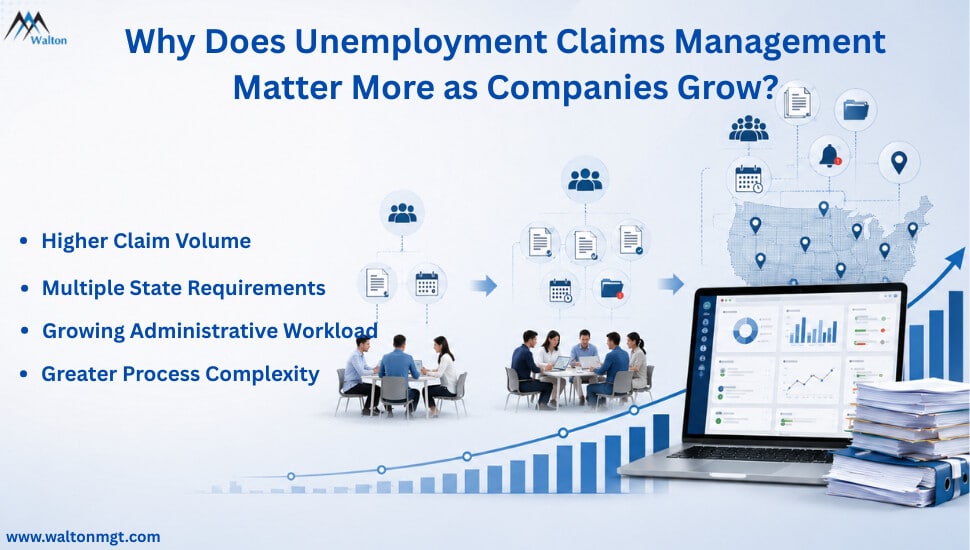
As a company grows, unemployment claims management can become more difficult because processes that work for a small workforce may not scale effectively. More employees can mean more separation records, claim notices, deadlines, documentation, and potential disputes. Expanding into additional states can introduce another layer of complexity because unemployment insurance programs are administered separately by each state.
Small Processes Can Become Big Problems
A manual process may be manageable when only a few claims need attention each month. As claim volume increases, however, spreadsheets, email reminders, and paper records can become harder to maintain. Small gaps in tracking or documentation can create larger administrative problems when they occur across dozens or hundreds of claims.
HR Needs Better Visibility, Not Just More People
Adding administrative staff may increase capacity, but it does not necessarily address inefficient processes or fragmented information. Centralized claim information, standardized workflows, and reporting can give HR teams a clearer view of pending claims, deadlines, outcomes, and recurring trends. Better visibility can help teams manage a larger workload more consistently without relying solely on additional manual effort.
What Does an Effective Unemployment Claims Process Look Like?
An effective unemployment claims process should give HR teams a clear way to receive, review, respond to, and monitor claims from start to finish. The goal is not simply to process individual claims faster, but to create a consistent system that keeps information organized, supports timely responses, and provides visibility into potential costs and recurring trends.
From Unemployment Claims Challenges to Better Processes
| Challenge | Better Approach | Potential Benefit |
|---|---|---|
| Scattered claim information | Centralized claim management | Easier access to records and claim details |
| Missed response deadlines | Deadline tracking and automated alerts | More timely and consistent responses |
| Manual data collection | Connected employee and payroll information | Less repetitive administrative work |
| Inconsistent claim reviews | Standardized review workflows | More consistent claim handling |
| Limited visibility into claim trends | Claims reporting and analytics | Better understanding of workforce patterns |
| Difficulty monitoring potential costs | Unemployment insurance cost tracking | Greater financial visibility |
| Growing claim volume | Scalable workflows and automation | Better capacity without relying entirely on manual effort |
An effective process should be accurate, organized, timely, and scalable. Centralizing information can make records easier to access, while standardized workflows can help ensure that similar claims are handled consistently. Reporting and analytics can add another layer of visibility by helping HR teams understand claim activity and identify recurring patterns.
The goal is ultimately to give HR greater control over the entire claims process. By combining organized workflows, reliable data, deadline management, and appropriate automation, organizations can reduce unnecessary administrative effort while creating a process that can adapt as the workforce and volume of unemployment claims increase.
Conclusion
Unemployment claims can become a bigger challenge for HR teams as organizations grow, not simply because claim volume increases, but because each claim can involve documentation, deadlines, state-specific requirements, administrative work, and potential unemployment insurance costs. Processes that may work for a smaller workforce can become difficult to maintain as employee numbers, locations, and claim activity increase.
Better workflows, accurate employee data, centralized claim information, and automation can help HR teams manage this complexity more effectively. For organizations looking to streamline unemployment claims management, reduce administrative workload, and gain greater visibility into the claims process, www.waltonmgt.com provides workforce management solutions designed to support these needs.

