


Volvo’s EX60 arrives as a tech-forward electric SUV that checks three boxes EV shoppers care about: a native NACS charge port for seamless Supercharger access, an EPA-estimated range up to 400 miles, and a deeply integrated Google Gemini AI assistant. It slots into Volvo’s expanding all-electric lineup and signals where the brand is steering its next generation of software-defined vehicles.
NACS Port Opens Seamless Access to Tesla Superchargers
The EX60 is the first Volvo to ship with a North American Charging Standard (NACS) port from the factory, unlocking around 25,000 Tesla Superchargers across the US without an adapter. That matters for real-world ownership: fewer apps, fewer cables, and far more high-power stalls on major routes.
- NACS Port Opens Seamless Access to Tesla Superchargers
- Range and Charging Performance Target Long-Haul Trips
- Gemini AI in the Cabin Brings Natural, Context-Aware Help
- Variants and Market Rollout Span Trims and Regions
- Safety and Sound Tech Refine Protection and In-Cabin Audio
- Why the EX60 Matters for Everyday Electric Car Buyers
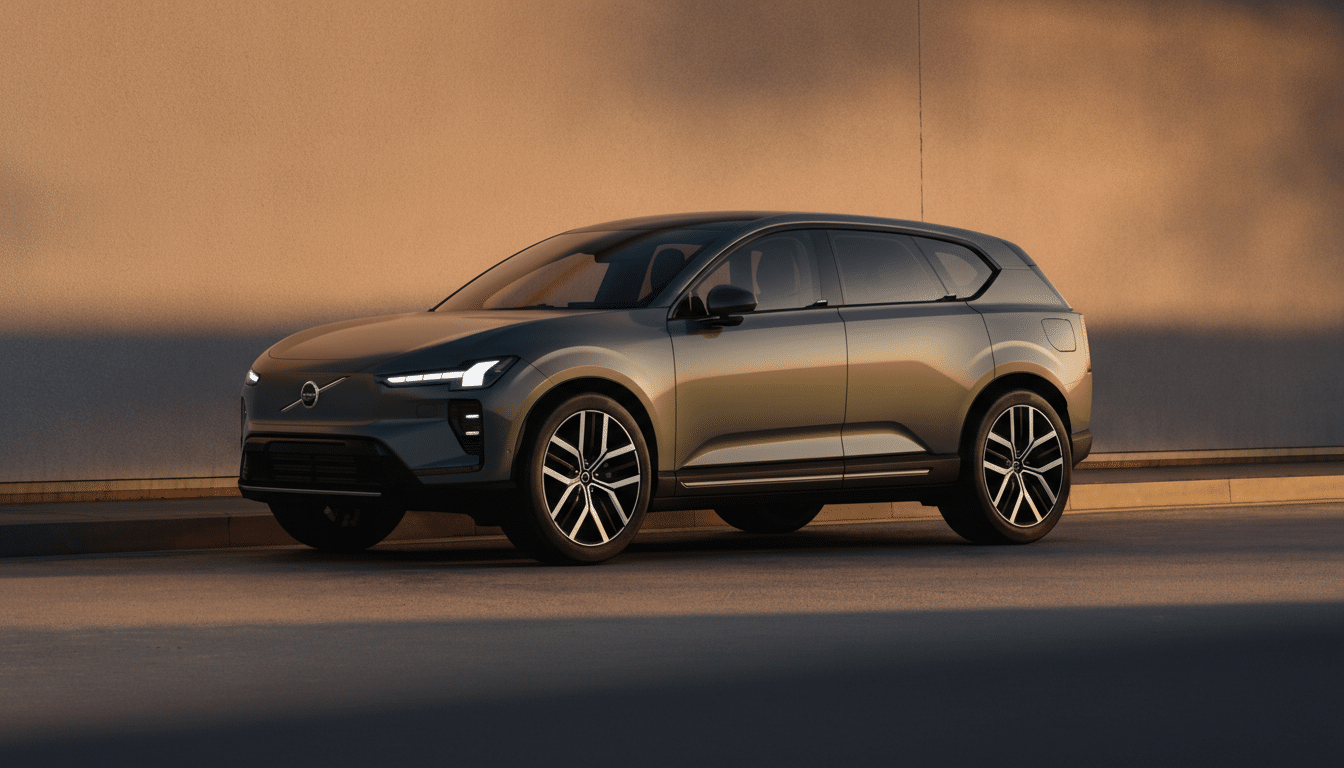
Standardization is also moving in Volvo’s favor. SAE International has formalized NACS as J3400, giving suppliers and charging networks a common spec to build around. As Ford, GM, and other global brands migrate to the same connector, charging becomes less of a brand-specific guessing game and more like plugging in a laptop.
Range and Charging Performance Target Long-Haul Trips
Headlining the lineup is a configuration rated up to 400 miles on the EPA cycle, a threshold that reshapes long-haul planning. That figure puts the EX60 squarely against long-range rivals and narrows the gap with top endurance leaders, while keeping Volvo’s emphasis on efficiency and safety intact.
Volvo says the EX60 can add about 173 miles in 10 minutes on a 400kW fast charger. The caveat: peak rates are just that—peaks. The US Department of Transportation notes most public high-power units today top out around 350kW, and real-world speeds depend on temperature, state of charge, and the car’s charge curve. Even so, triple-digit mile replenishment in the span of a coffee stop is the kind of improvement that smooths road trips.
The EX60 rides on Volvo’s SPA3 platform, designed to cut mass and boost energy efficiency. That architecture underpins the range numbers and should help maintain consistent performance across climates and driving styles, historically a pain point for larger EVs.
Gemini AI in the Cabin Brings Natural, Context-Aware Help
Inside, the EX60 advances Volvo’s collaboration with Google. Built on Android Automotive OS, it layers in a Gemini-powered assistant for more natural, context-aware interactions—think “find me a fast charger near the next rest stop and add 10 minutes of buffer” rather than memorizing rigid commands.
Volvo highlights faster load times for maps and apps and reduced interface lag, the kind of refinement that matters every single drive. The assistant’s tight integration with navigation, media, and vehicle settings positions it as a daily co-pilot, not a novelty. It also puts Volvo in direct contention with the AI-heavy infotainment pushes from Mercedes-Benz, BMW, and Hyundai’s group, where voice and predictive systems increasingly define the user experience.
Variants and Market Rollout Span Trims and Regions
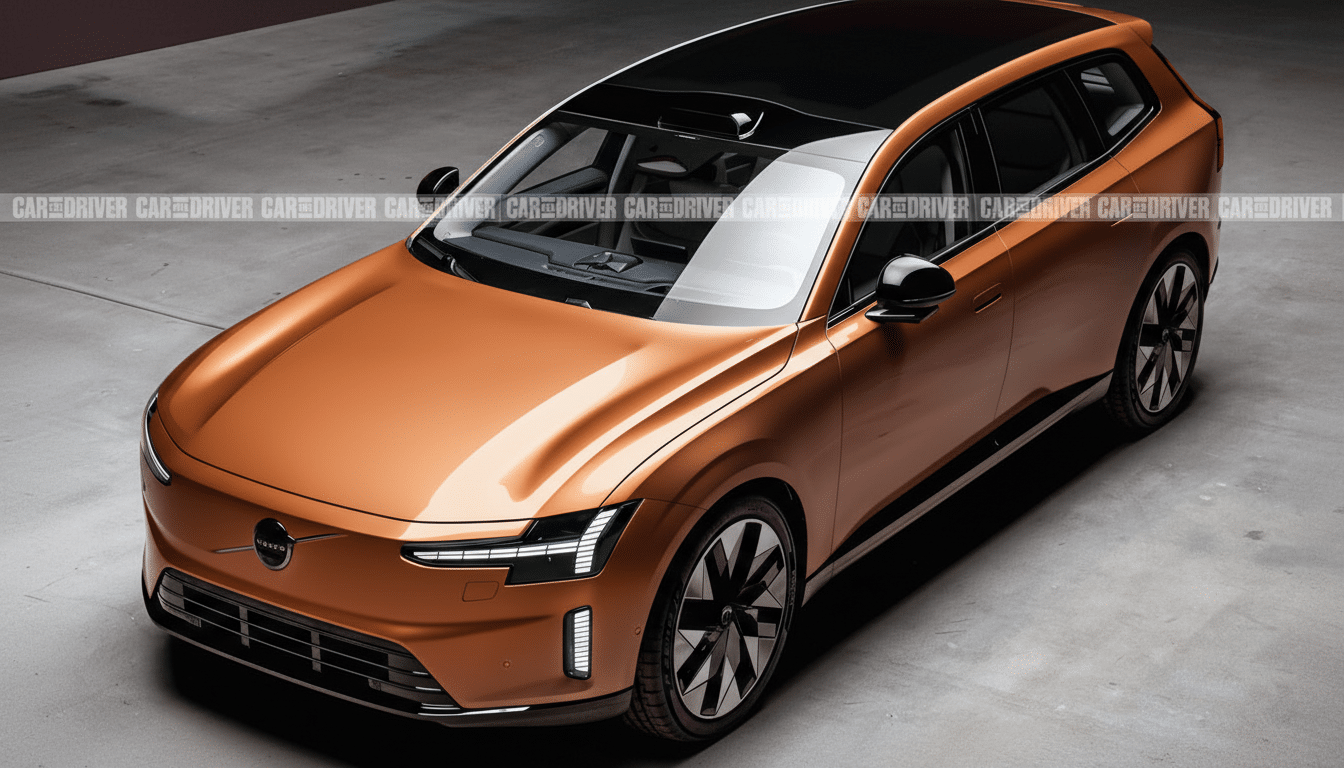
Volvo will offer multiple EX60 variants from launch. The range-topper is the P12 AWD at up to 400 miles, arriving after the initial waves. First to reach customers are expected to be the P10 AWD with up to 320 miles and the rear-drive P6 with up to 310 miles, giving buyers a spread of performance and price points.
All versions are backed by a 10-year battery warranty, aligning with the longest coverage tiers in the segment. Orders are open in select European markets, with broader availability to follow in additional regions, including the US.
Volvo also previewed a Cross Country take on the EX60, drawing on the brand’s heritage of all-road wagons and SUVs. Expect familiar, upright proportions with a higher seating position, tailored for drivers who value visibility and light off-pavement poise without jumping to a full-size utility.
Safety and Sound Tech Refine Protection and In-Cabin Audio
Safety remains the brand’s calling card. The EX60 introduces adaptive seatbelts designed to fine-tune restraint forces across scenarios. That kind of incremental safety engineering rarely grabs headlines but pays dividends in crash performance—an area where Volvo historically performs well in evaluations from organizations like IIHS and Euro NCAP.
Cabin tech goes beyond screens and microphones. Speakers embedded in all four headrests enable an immersive spatial audio experience while allowing lower overall volumes, an approach that can reduce fatigue on long highways and sharpen phone call clarity. It’s a clever way to make luxury tangible in everyday use.
Why the EX60 Matters for Everyday Electric Car Buyers
The combination of native NACS, credible highway range, and an AI-first interface tackles the three choke points that keep many shoppers on the fence: charging access, trip confidence, and tech usability. With SAE’s J3400 standard maturing and federal programs funding thousands of additional high-power ports, the charging landscape is improving, but in-car execution still separates the great from the merely good.
If Volvo delivers the promised charge speeds and Gemini integrations with the polish shown here—and keeps pricing competitive—the EX60 could be the brand’s most persuasive EV yet for mainstream buyers. The headline features are right; now it’s about consistent performance when the map is zoomed out and the battery icon is ticking down.
