


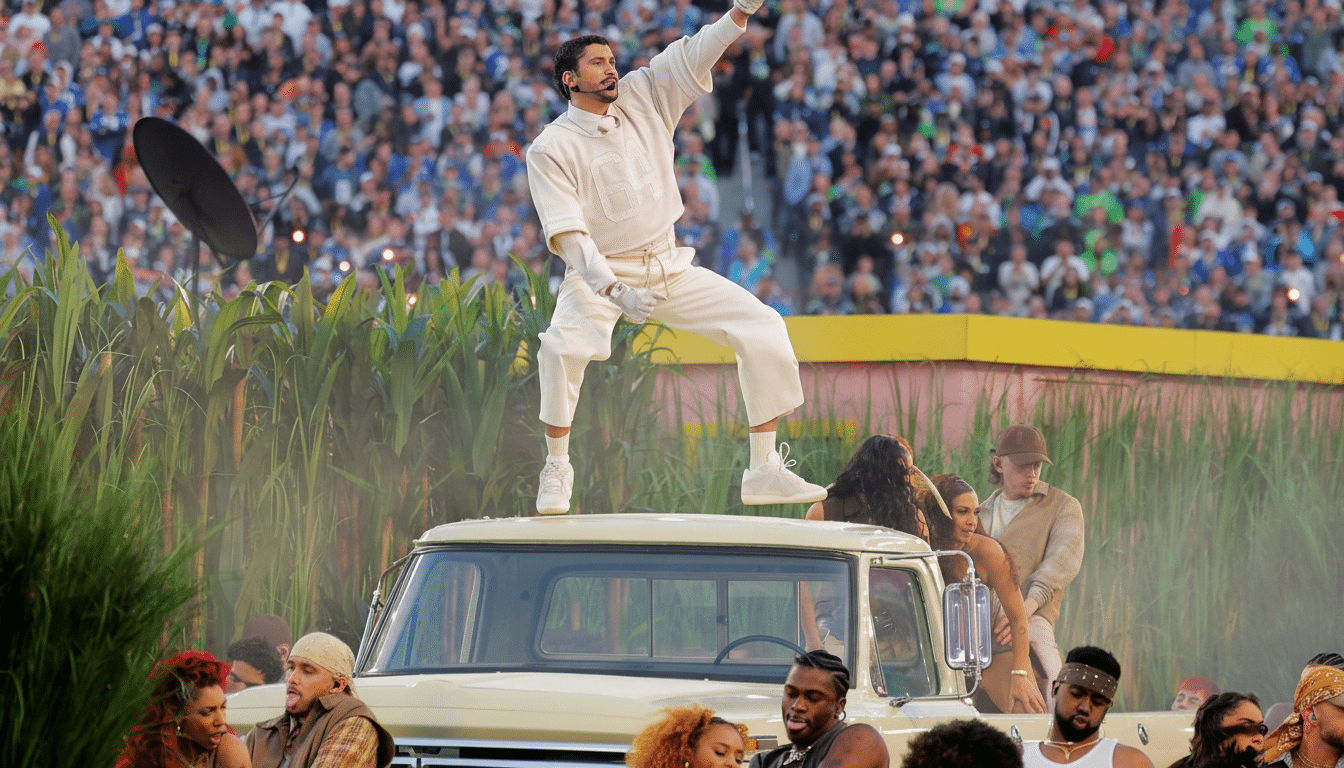
Donald Trump weighed in on Bad Bunny’s Super Bowl Halftime Show with a blistering review, denouncing the performance and igniting a fresh round of culture-war sparring just as clips from the spectacle ricocheted across social platforms.
While the Puerto Rican superstar used the stage to deliver a brief message about unity across the Americas, Trump framed the show as out of step with what he considers American values. His remarks landed amid wide online praise for the artist’s high-wattage production and guest cameos.
- What Trump Said About the Halftime Show and Why It Matters
- How Online Backlash and Support Split After the Show
- Bad Bunny’s Global Clout And Halftime Stakes
- Why the Halftime Stage Became a Culture-War Flashpoint
- The NFL’s Balancing Act on Music, Marketing, and Politics
- The Political Angle and the Stakes with Latino Voters
- What to Watch Next as Reactions and Metrics Roll In
What Trump Said About the Halftime Show and Why It Matters
In posts on his platform, Trump called the halftime set “absolutely terrible” and “one of the worst,” arguing it failed to reflect national “eXcellence” and even labeling it a “slap in the face.” The language mirrors his past broadsides against high-profile pop performances, a recurring tactic that reliably galvanizes supporters and dominates a news cycle.
His critique wasn’t limited to taste. It telegraphed a broader argument about cultural representation on America’s biggest broadcast stage, where the halftime show routinely draws an audience that rivals or exceeds the game’s average viewership.
How Online Backlash and Support Split After the Show
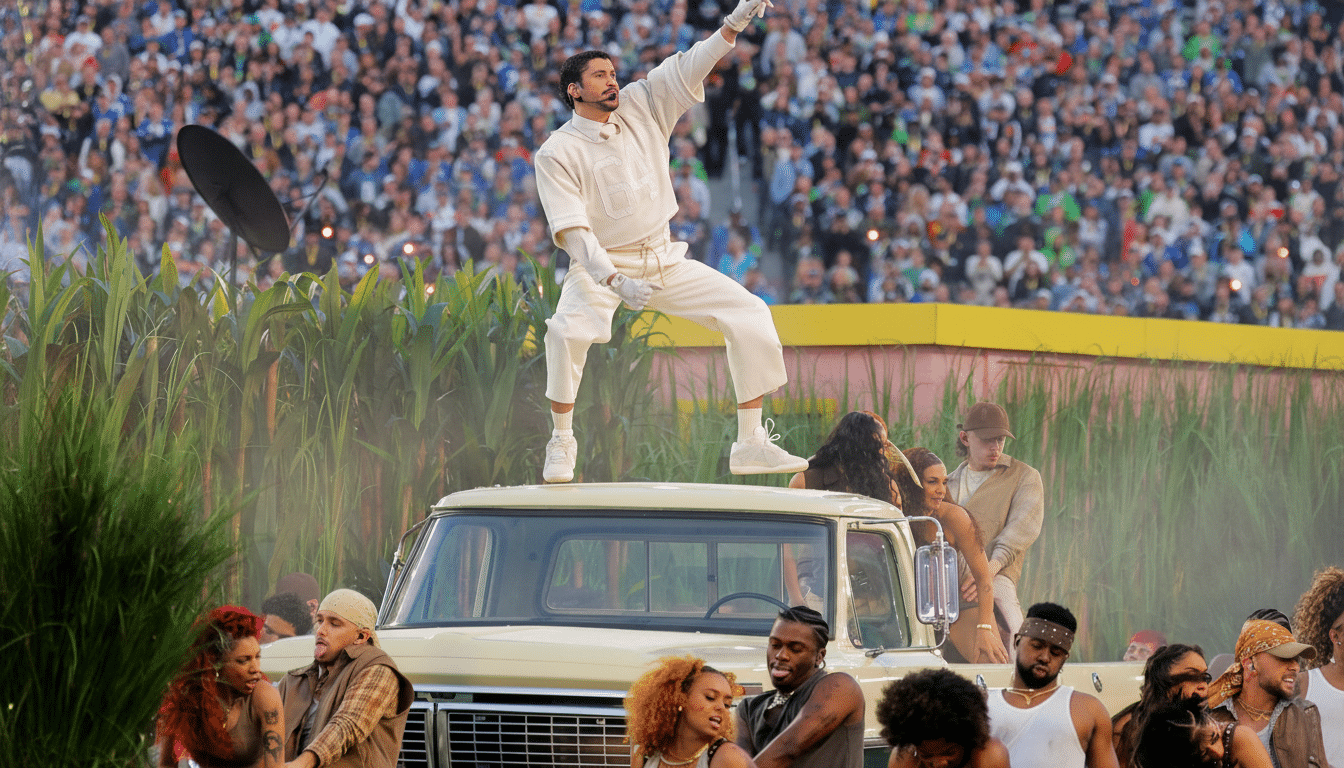
Reaction was immediate. Fans hailed Bad Bunny’s set design and choreography as a benchmark moment for Latin music, while conservative commentators echoed Trump’s disapproval and questioned a Spanish-language headliner at the center of a national telecast. The performance and Trump’s comments trended across X, Instagram, and TikTok within minutes, underscoring how the halftime stage now doubles as a real-time cultural referendum.
Bad Bunny’s Global Clout And Halftime Stakes
From an industry standpoint, Bad Bunny’s booking was hardly surprising. Spotify has ranked him among the most-streamed artists on the planet for multiple consecutive years, and Billboard Boxscore has credited him with one of the highest-grossing tours ever, spanning stadiums across the Americas and Europe. That scale translates to the Super Bowl, where halftime segments have become marketing juggernauts, typically drawing more than 100 million viewers in the U.S. alone, according to Nielsen.
The Recording Industry Association of America has also reported sustained, double-digit streaming growth for Latin music, with the genre hitting record revenue in the U.S. That momentum has reshaped radio programming, festival lineups, and brand partnerships—exactly the terrain where a halftime booking exerts outsized influence.
Why the Halftime Stage Became a Culture-War Flashpoint
The halftime stage has been a magnet for political crossfire before. The Federal Communications Commission received more than a thousand complaints after the Shakira and Jennifer Lopez show, and Rihanna’s set later drew conservative criticism, including from Trump himself. The pattern is familiar: star-led pop spectacle triggers partisan commentary, which then shapes how the performance is remembered beyond the music.
The NFL’s Balancing Act on Music, Marketing, and Politics
The league has leaned into mainstream pop and hip-hop curation—partnering with Roc Nation to broaden the talent pipeline—while trying to steer clear of overt partisanship. That tightrope is delicate. Brands, performers, and the NFL all have different risk thresholds, and once politics enters the chat, creative choices get reframed as statements, invited or not.
The Political Angle and the Stakes with Latino Voters
Trump’s response also lives in the context of an electorate where Latino voters make up a fast-growing share nationwide, according to Pew Research Center. Spanish-first and bilingual storytelling is now woven into prime-time entertainment, sports marketing, and campaign messaging. For strategists on both sides, a halftime show headlined by a global Latin artist is less a niche bet than a snapshot of where mass culture already sits.
What to Watch Next as Reactions and Metrics Roll In
Expect more reaction videos, think pieces, and brand analyses as media firms parse sentiment and view-through data. Watch whether Trump keeps the issue alive with additional posts, whether Bad Bunny addresses the criticism directly in interviews, and whether the NFL or sponsors weigh in on the broader debate.
- Whether Trump keeps the issue alive with additional posts
- Whether Bad Bunny addresses the criticism directly in interviews
- Whether the NFL or sponsors weigh in on the broader debate
Regardless, the clash underscores a simple reality: the halftime show is no longer just a concert—it’s a proxy stage for competing visions of American culture, and this year’s headliner put that tension front and center.
