


The U.S. Treasury Department on Aug. 24 launched Operation Economic Outcast, a new Iran-focused sanctions campaign that immediately broadened the sectors in which foreign businesses can face U.S. sanctions exposure. The action covers digital assets, technology, gold, aviation and shipping, alongside nearly 60 new designations of Iran-linked entities, people and vessels.
For companies and financial institutions, the important distinction is between measures already in force and the administration’s promised next steps. Treasury has expanded its authority to target foreign persons operating in or providing services to the five sectors, but it has not announced penalties against particular countries or disclosed country-specific deadlines. U.S. officials said governments would receive defined periods to end Iran-related activity identified by Washington before further action.

Five sectors added to potential sanctions exposure
The Treasury announcement said the Office of Foreign Assets Control issued new determinations under Executive Order 13902 for the five sectors of Iran’s economy. The executive order provides authority for sanctions against foreign persons determined to operate in specified Iranian economic sectors or provide material assistance, goods or services in support of them.
The determinations are consequential because they extend potential secondary-sanctions risk beyond entities specifically named on an OFAC sanctions list. They do not mean every foreign transaction connected to Iranian shipping, aviation, gold, technology or digital assets is automatically prohibited. Rather, they give Treasury a stated basis to sanction non-U.S. persons whose conduct meets the applicable criteria, subject to OFAC’s decisions in individual cases.
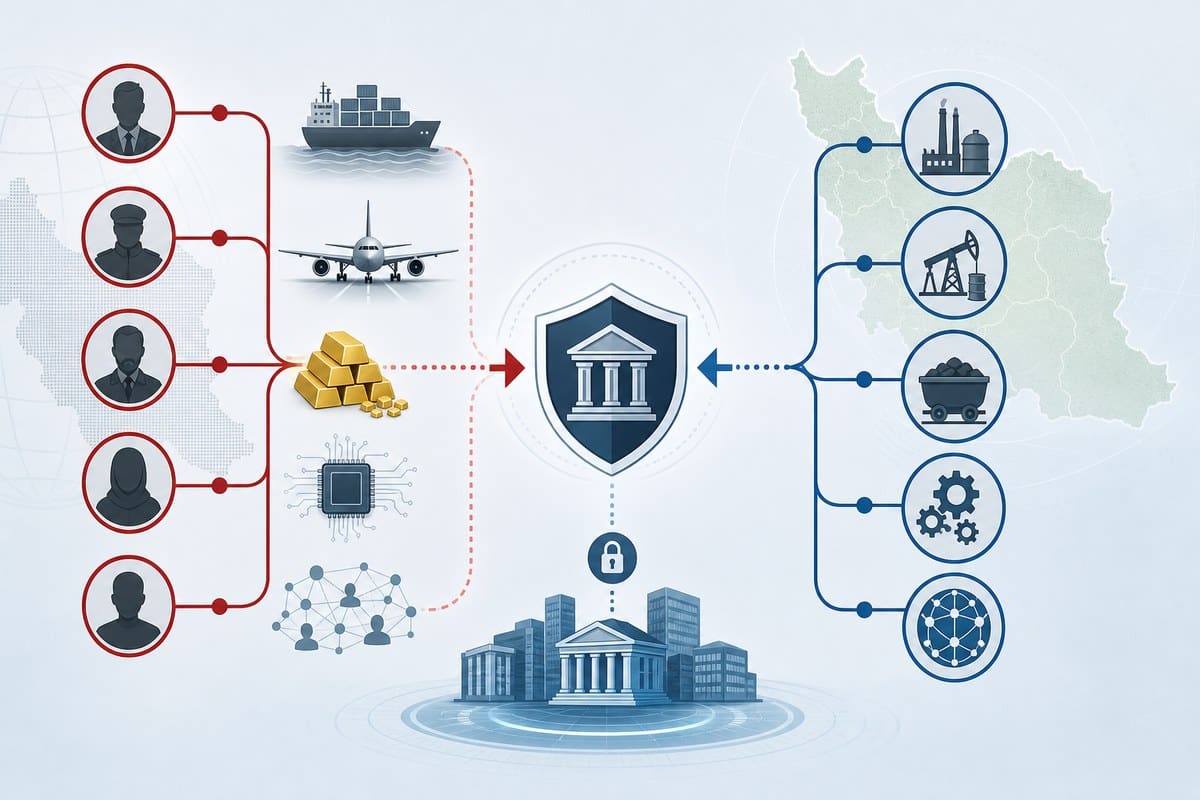
That framework places a wider range of commercial activity under scrutiny. Shipping and aviation businesses can face questions over services tied to Iranian transport networks; gold traders and technology providers must assess connections to covered Iranian sectors; and digital-asset businesses now appear explicitly within the sectoral determination. Treasury said parties facilitating money laundering or sanctions evasion for Iran risk being cut off from the U.S. financial system.
OFAC’s Iran sanctions program page lists the new five-sector determination as effective Aug. 24. The page also records another immediate regulatory change: the suspension of Iran General Licenses F and G, which had authorized certain sports-related and academic-exchange activities. Those licenses were suspended effective the same day.
Designations focus on procurement, cyber activity and oil networks
Treasury said the campaign included sanctions against nearly 60 entities, individuals and vessels across multiple jurisdictions. The department linked the targets to networks it alleges have supported nuclear and missile procurement, cyber activity and Iranian oil-revenue channels, as well as activity connected to Iran’s Islamic Revolutionary Guard Corps.
The target total should not be treated as a settled precise count. Treasury’s formal announcement describes nearly 60 sanctioned parties, while Secretary Scott Bessent, in prepared remarks released later that day, referred to over 60. Without relying on an underlying consolidated designation list to reconcile the difference, nearly 60 is the more cautious description of the announced action.
Designation-based sanctions and sectoral determinations have different effects. A designation generally identifies a person, company or vessel for blocking sanctions and can trigger restrictions on dealings involving U.S. persons and the U.S. financial system. A sectoral determination, by contrast, identifies a category of Iranian economic activity in which Treasury says foreign persons may become sanctionable. Companies therefore need to screen named parties while also evaluating whether their services could support a newly covered sector.
Treasury described Operation Economic Outcast as a broad effort against Iran’s economic lifelines. Those allegations and the department’s characterization of the targeted networks are assertions by the U.S. government; the announcement does not independently establish that each targeted party engaged in the conduct alleged.
Foreign governments face an unspecified timetable
The campaign’s largest commercial implications may depend on enforcement that has not yet been detailed publicly. Bessent said in his prepared remarks that U.S. teams were engaging foreign counterparts and that each country would be given a defined timeline to end Iran-related activity identified by the United States. He said Washington could act unilaterally where cooperation was not forthcoming.
Neither Treasury’s announcement nor the prepared remarks named the countries involved, described the activity each government was expected to halt, or set public deadlines. The lack of those details means the Aug. 24 action should not be read as an immediate sanctioning of countries that trade with Iran. It is an expansion of legal exposure and a warning of potential follow-on actions, with the precise enforcement sequence still undisclosed.
That distinction has implications for banks, commodity traders, carriers and other firms that operate across jurisdictions. Their exposure is not determined solely by whether a country continues commercial relations with Iran; it turns on the particular counterparties, services, sectoral links and any future U.S. enforcement determinations. Treasury’s warning about possible loss of access to the U.S. financial system raises the stakes for firms that depend on dollar clearing or relationships with U.S.-connected financial institutions.
Independent reporting underscored the uncertain path from announcement to international compliance. NBC News reported that Alan Eyre of the Middle East Institute said countries were unlikely to sever ties with Iran solely because of the U.S. announcement, absent follow-up. The report also cited Iranian Economy Minister Ali Madanizadeh as saying Iran was prepared for an economic conflict and would retaliate if Washington acted.
Bessent also indicated that a major financial-institution action could arrive by the end of the week, according to AML Intelligence. No institution was identified in that report, and the Aug. 24 Treasury materials do not document such a designation. For now, the concrete changes are the five sectoral determinations, the suspension of two general licenses and the new set of nearly 60 announced sanctions targets.

