


Prime Video’s Scarpetta closes its first season with a brutal confession, a blood-spattered reversal, and one last knock at the door that resets the board. The mystery stretches across two timelines, two killers, and a biotech conspiracy, yet the finale still finds room for a stinger that all but guarantees a tense Season 2. Here’s what the ending really says—and what it pointedly refuses to answer.
Who The Finale Actually Names As The Killers
The show resolves its past-and-present structure with a split answer. In 1998, the murderer stalking women by the sound of their voices is Roy McCorkle, a 911 dispatcher hiding in plain sight. His fixation on vocal timbre explains the trail of seemingly disconnected victims and ties back to the series’ earliest scenes of misdirection.
- Who The Finale Actually Names As The Killers
- Why The Pennies And Biosynthetic Skin Grafts Matter
- The Reddy Problem And Maggie’s Strategic Pivot
- Benton Wesley’s Creepy Fake-Out And Sudden Divorce
- Matt Peterson And The Red Herring Pattern Test
- Who Is At The Door In The Final Cliffhanger Shot
- What The Ending Sets Up For Scarpetta Season 2

In the present, the copycat taking lives is Officer August Ryan—the braces-wearing patrol cop who has hovered around Kay Scarpetta’s cases for decades. The finale confirms Ryan staged the crime scenes for Gwen Hainey and Cammie Ramada, “found” the key evidence that sent investigators astray, and ultimately admitted the motive no profiler wants to hear: he did it to impress Scarpetta. That chilling line reframes years of deference as predation.
Why The Pennies And Biosynthetic Skin Grafts Matter
The Thor Labs thread isn’t window dressing; it’s the connective tissue. Both 2026 victims carry biosynthetic skin grafts produced by the company’s program. Late in the finale, a call reveals a third participant in that graft test group. The twist: it’s Ryan, who suffered a childhood burn while witnessing his uncle commit an assault. Suddenly the pennies left at scenes make grim sense—his trauma began with a coin distraction on a hot rail track, and he ritualizes that memory at his murders and even on Scarpetta’s table.
For viewers questioning plausibility, the sci-tech spine is grounded in reality. NASA has supported microgravity bioprinting research on the International Space Station, and industry players like Redwire Space have flown a BioFabrication Facility to test printing complex tissues off-Earth. The show’s “Orbiter” concept is a dramatized version of a serious research frontier, which is why it believably draws in federal agencies and corporate secrecy.
The Reddy Problem And Maggie’s Strategic Pivot
Dr. Elvin Reddy emerges as the institutional antagonist, the kind of career bureaucrat who can tilt a verdict with a raised eyebrow. He’s linked to evidence tampering in the past and to pressuring a medical examiner to call Cammie Ramada’s death an accident. Maggie Cutbush, long positioned as a nuisance, flips the script in the finale by offering Scarpetta the receipts to expose Reddy—on the condition she’s insulated. It’s less redemption than leverage, but it sets a clear Season 2 axis: science versus power, truth versus career survival.
Complicating matters, Reddy knows Scarpetta’s deepest professional secret: she killed McCorkle in self-defense decades ago, and Marino helped cover it. That buried file isn’t just backstory; it’s a pressure point that could collapse Kay’s credibility if weaponized.
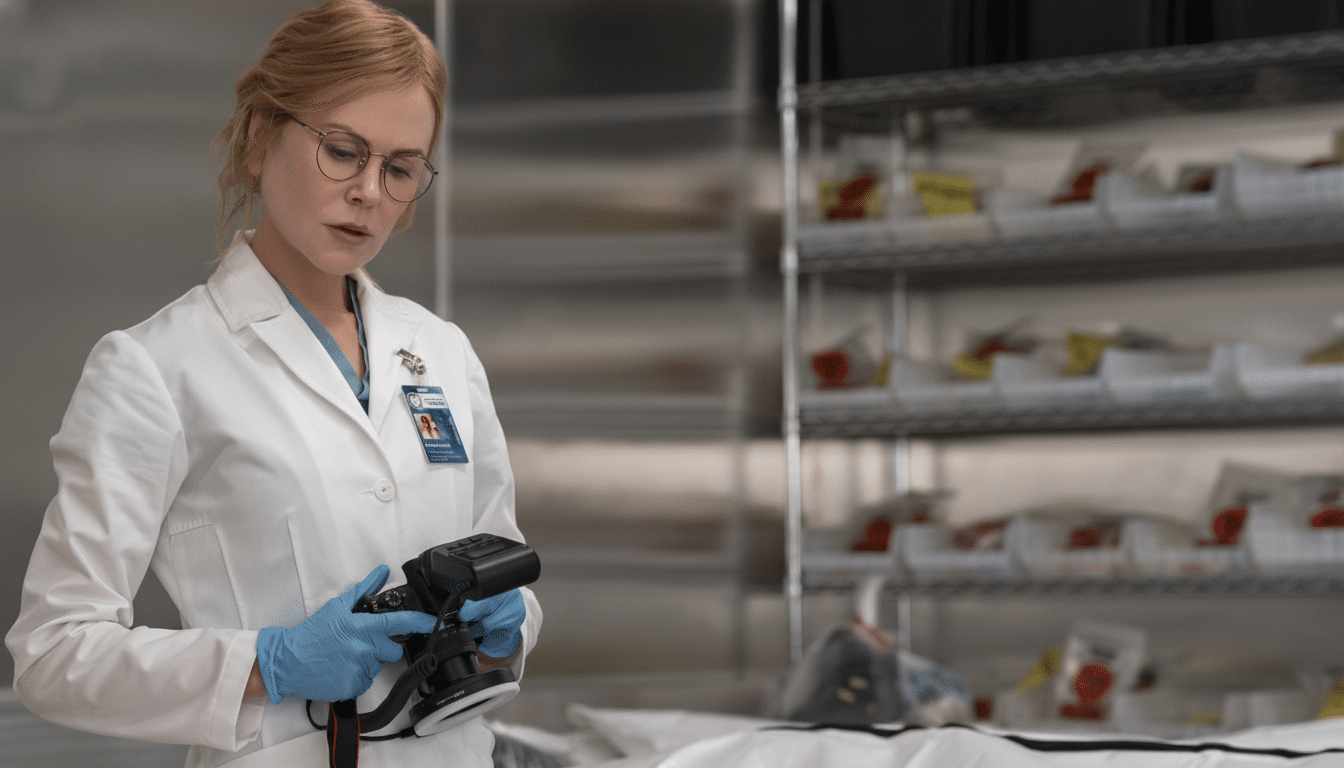
Benton Wesley’s Creepy Fake-Out And Sudden Divorce
Benton’s late-episode monologue toys with expectations. He edges toward a confession of darker impulses, only to retreat into bureaucratic menace—warning Kay off the Thor line and shipping hacker Jinx to jail to quarantine an FBI operation. Then he asks for a divorce. The moment reads like a profiler’s misdirection: he’s not the killer, but he’s dangerous to the truth. In real life, law enforcement “profiling” is an investigative tool, not a diagnosis of character; the show leans into that gap to keep Benton morally murky.
Matt Peterson And The Red Herring Pattern Test
Matt Peterson, widower of an early victim, bears all the genre markers of culpability—grief turned cultish, proximity to new victims, a fetish for voices that mirrors McCorkle’s selection method. Yet the finale stops short of attaching him to the new killings. He functions as a decoy, a reminder that pattern recognition can be a trap. In forensic literature, false pattern matches are a known risk when investigators over-trust narrative symmetry; Scarpetta forces the audience to confront that bias too.
Who Is At The Door In The Final Cliffhanger Shot
After Kay bludgeons Ryan to stop him, a figure appears at her door. Her “Oh no” lands like a cliff. The shortlist is small and consequential: Lucy returning from a grief spiral; Marino, whose history with Kay turns any discovery into a legal and personal time bomb; Officer Blaise Fruge tracking her partner’s GPS; or a federal presence closing ranks around Thor. Each choice sends Season 2 down a different path—domestic fallout, procedural cover-up, or a federal siege of the truth.
What The Ending Sets Up For Scarpetta Season 2
Amazon has already greenlit another season, and the finale lays out its docket: Maggie’s dossier on Reddy, the legal aftermath of Ryan’s death in Kay’s home, the buried McCorkle cover-up, and the unresolved deletion of Janet—the AI version of Lucy’s late wife—which hints at a separate sabotage subplot. Expect Thor Labs to remain central; corporate-science thrillers are sticky with audiences, and Patricia Cornwell’s decades-spanning Scarpetta universe has long fused meticulous forensics with institutional rot.
Cornwell’s books have sold well into nine figures worldwide according to industry estimates, and that built-in fandom explains why this show can sustain a slow-burn mystery and still deliver a finale jolt. Scarpetta’s last shot doesn’t just chase a gasp; it widens the aperture. The killer is unmasked, but the system that enabled him—the bosses, the badges, the labs—remains the larger suspect.

