


OpenAI has released a native macOS app for Codex designed for agentic coding, bringing multi-agent orchestration and automation to the desktop. The move squares up directly against emerging agent-first tools like Claude Code and Cowork, and it pairs the new interface with GPT-5.2-Codex, the company’s most capable coding model to date.
The app aims to compress the distance between an idea and running software by letting several specialized agents work in parallel, integrate their skills, and hand off tasks fluidly. It adds scheduled automations that run in the background and queue results for review, plus adjustable “personality” modes so teams can tune tone and behavior to their working style.
Inside the Agentic Mac Experience for Developers
At its core, the macOS app coordinates multiple Codex agents simultaneously. One might draft modules, another write tests, a third refactor or document code—each operating in parallel and synchronizing changes through a shared plan. The workflow is built for long-running tasks, letting users step away while agents execute jobs and deposit outcomes into a review queue.
OpenAI also leans into customization. Users can select agent dispositions—pragmatic for terse, decision-driven output or more empathetic for collaborative explanations—without changing the underlying model. For teams experimenting with AI pair programming, these knobs help align responses with team norms and codebase expectations.
Benchmarks Put in Context for Real-World Coding
Early signals from coding benchmarks are mixed but noteworthy. GPT-5.2-Codex is currently leading TerminalBench, which evaluates command-line programming tasks, while agents powered by Gemini 3 and Claude Opus post near-parity scores—lower, but often within the benchmark’s margin of error. On SWE-bench, an academic benchmark focused on fixing real-world bugs, results similarly show no decisive winner across leading models.
Benchmarks capture raw capability under controlled conditions; agentic systems layer on planning, tool use, and human oversight. In practice, the difference often hinges on interface design and error recovery. OpenAI’s bet is that a native Mac workflow will surface the strengths of 5.2 while minimizing the friction that traditionally comes with powerful, complex models.
Why a Native Mac App Matters for Agentic Coding
Running agentic tooling natively on macOS reduces context switching compared with browser-based chat or plug-ins stitched across terminals and editors. The app can respect macOS permissions for local files and projects, make heavy use of keyboard shortcuts, and slot into developers’ everyday window management and notifications—small but compounding advantages during rapid iteration.
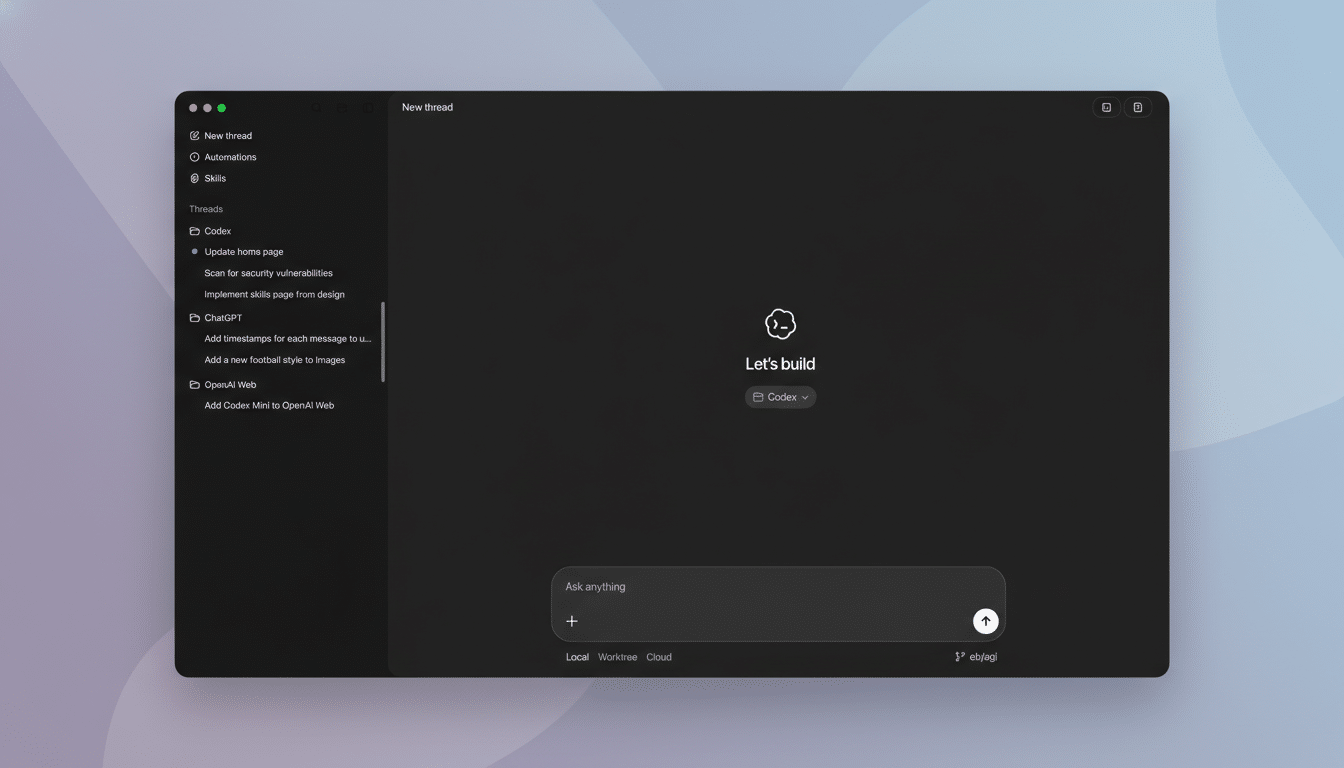
The net effect is tighter loops: agents propose edits, tests, or commands; users approve or redirect; automations continue in the background. Latency-sensitive steps still occur in the cloud, but closer integration with the operating system often trims the overhead around each model call, improving perceived speed.
Productivity Stakes and Real-World Fit for Teams
Developers have clear incentives to try agentic tooling. Prior research from GitHub reported task completion time improvements around 55% with AI pair programming, and industry surveys consistently show broad willingness to adopt AI assistants in daily work. The new Codex app extends that promise by coordinating not one assistant, but a small team of specialists that can run tests, file issues, or draft patches while you move on to the next task.
Critically, OpenAI bakes in oversight. Background automations don’t merge changes by default; they line up outputs for human review. That queue-based design reflects the current best practice for agentic coding: let AI explore broadly and work quickly, while maintaining human checkpoints before code hits critical paths.
Competitive Pressure and What Comes Next
The launch lands in an intensely competitive moment. Anthropic’s Claude Code and the Cowork apps helped popularize agent-first development, while Google’s Gemini 3 agents, IDE-native assistants like Cursor, and incumbents such as GitHub Copilot Chat and JetBrains AI Assistant continue to expand their feature sets. With GPT-5.2-Codex in the cockpit and a native Mac shell, OpenAI is signaling it intends to be the default choice for agentic workflows on Apple’s platform.
Adoption will hinge on day-to-day reliability—how well agents understand large codebases, recover from failed plans, and cleanly present diffs and test results. If the app’s multi-agent scheduling and review queue meaningfully compress build cycles, it could shift the center of gravity for macOS developers toward agent-led coding. Watch for deeper IDE integrations, enterprise guardrails, and team management features as the next wave of differentiation.
