


The developer behind Notepad++, one of the world’s most widely used open-source text editors, says Chinese state-linked hackers covertly hijacked its update mechanism for months, pushing malicious packages to a narrow set of targets while avoiding broad detection.
What Notepad++ Reported About the Update Attack
Notepad++ creator Don Ho said attackers compromised infrastructure tied to the project’s website and abused an update flow to deliver tainted releases selectively. According to Ho, the site ran on shared hosting and was hit via a vulnerability that allowed traffic redirection to a server the attackers controlled. Logs show attempts to re-exploit after fixes were applied, but those later attempts failed. Ho urged users to install the latest version and treat any suspicious activity on systems that fetched updates during the window as potentially related.
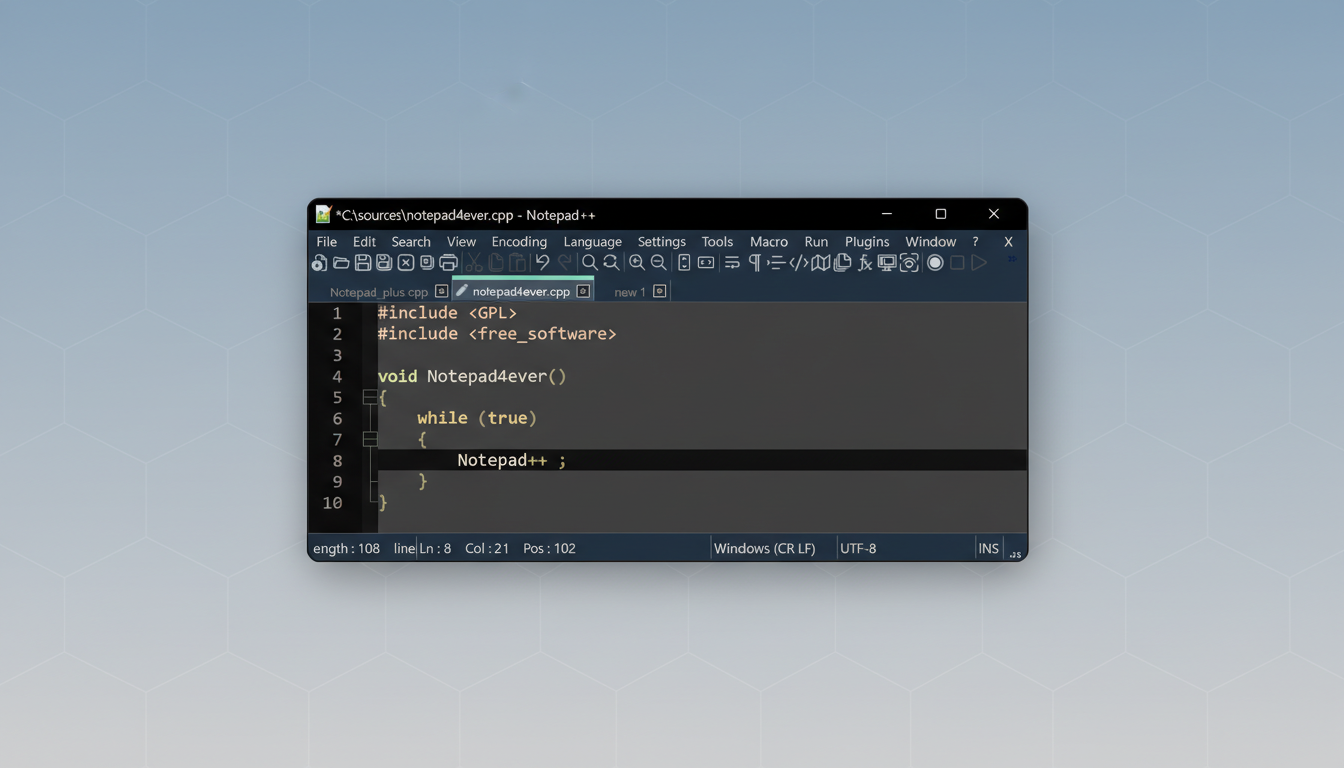
Security researcher Kevin Beaumont, who first detailed the incident, reported that the campaign targeted a small number of organizations with interests in East Asia. He said victims who installed the rigged builds experienced “hands-on” intrusions, suggesting the update channel was used as an access vector rather than a mass malware spray.
Selective Targeting and Tradecraft Used in Attack
The operation’s restraint is telling. Instead of poisoning every update check, the threat actors appear to have gated delivery, which is consistent with espionage-focused tradecraft designed to reduce noise and avoid reputation-killing blowback. That approach mirrors past supply-chain intrusions where adversaries limited payloads to high-value environments after staging access through a popular tool.
Notepad++ has tens of millions of downloads and sits on developer and analyst workstations across the globe. That ubiquity makes it a potent stepping stone, even if only a fraction of users were presented with malicious updates. In practice, selective delivery also makes incident response harder: the vast majority of endpoints will look clean, increasing the risk that affected machines go unnoticed without targeted telemetry review.
How the Update Channel Was Abused to Target Users
Ho’s account indicates the attackers didn’t need to tamper with source code repositories. Instead, they exploited the web domain to redirect update requests—likely the step where clients check for new versions or retrieve an update manifest—toward a rogue server. From there, the adversary could serve binaries of their choosing to specific requesters.

This route exploits a common weak point: the perimeter around update orchestration, including DNS, web apps, and content delivery paths. Even when projects sign releases, implement HTTPS, and publish checksums, gaps can appear in how clients verify signatures, how manifests are fetched, or how redirections are handled. Modern defenses include hardened hosting, strict transport security, certificate pinning for update endpoints, independent signature verification at the client, and frameworks like The Update Framework (TUF) or Sigstore for verifiable provenance.
A Broader Pattern of Software Supply-Chain Risk
This incident fits a well-established pattern of supply-chain abuse. The SolarWinds compromise showed how a single trusted update could open doors across government and enterprise networks. Earlier, the CCleaner and Asus Live Update cases demonstrated how attackers weaponize popular utilities to reach specific victims. More recently, the 3CX intrusion highlighted how downstream software vendors themselves can become conduits for intrusion into targeted environments.
Industry metrics reinforce the trend. Sonatype’s State of the Software Supply Chain has documented triple-digit growth in software supply-chain attacks in recent years, and ENISA has warned that adversaries are increasingly shifting from direct victim compromise to upstream infiltration. Security firms including Mandiant and Microsoft have repeatedly linked state-backed groups to campaigns that privilege stealth, persistence, and data access over immediate monetization.
What Users and Teams Should Do Now to Mitigate Risk
- End users should install the newest Notepad++ release from the official source and verify the integrity of the download using published signatures or hashes.
- If an endpoint performed update checks during the exposure period, treat it as potentially at risk: run a full EDR sweep, review persistence locations, examine scheduled tasks and startup entries, and check outbound connections for unusual destinations.
- Network teams should search proxy, DNS, and web gateway logs for anomalous requests to nonstandard update servers and pivot from any hits to find related activity.
- Developers and maintainers should audit update pipelines end-to-end and isolate update infrastructure from general web hosting.
- Enforce least privilege on deployment credentials.
- Implement artifact signing with mandatory client-side verification.
- Adopt TUF or Sigstore for provenance and enable reproducible builds.
- Require internal allow-listing for update domains and deploy certificate pinning for critical software to reduce downgrade or redirection risk.
Attribution and Accountability for the Intrusion
Attribution to Chinese government–aligned operators in this case relies on overlap in tooling, infrastructure, and targeting described by independent researchers. While formal government statements were not cited, the profile—narrow victim selection, East Asia focus, and post-compromise hands-on activity—aligns with long-running intelligence collection efforts rather than purely criminal monetization.
The immediate priority is containment and transparency. Clear post-mortems, indicators of compromise from trusted researchers, and rigorous hardening of the update path will do more than any single patch to restore confidence. As this episode underscores, the software we trust most can become the sharpest tool in an adversary’s kit if its update lifeline is left exposed.
