Neuralink said it has received Food and Drug Administration approval to begin a pivotal U.S. study of its implanted brain-computer interface in people with severe paralysis caused by amyotrophic lateral sclerosis, or ALS. The planned LINK Pivotal Study is a later-stage clinical milestone for the company, but it is not an FDA approval to sell the implant or evidence that it has been shown to improve patients’ health or independence.
In a Nov. 25 announcement, Neuralink said enrollment was open for the multisite study. It said LINK would evaluate whether participants can use thought to control digital devices, along with functional measures related to daily independence, the system’s safety and its long-term reliability. The FDA had not published an event-specific notice confirming the authorization at the time of publication.

The distinction is consequential for a technology that has generated considerable public interest and hopes among people who have lost the ability to communicate or use computers independently. A pivotal study is intended to gather evidence that could support a later application to market a medical device. It does not establish that a device is safe or effective for general medical use.
What the planned study would examine
Neuralink describes LINK as a study of its investigational brain-computer-interface system for people with severe ALS-related paralysis. Such systems aim to record signals from the brain and use software to translate them into commands for external technology. In LINK, the relevant practical test is digital-device control: whether participants can reliably operate a computer or other digital interface through intended movement or thought.
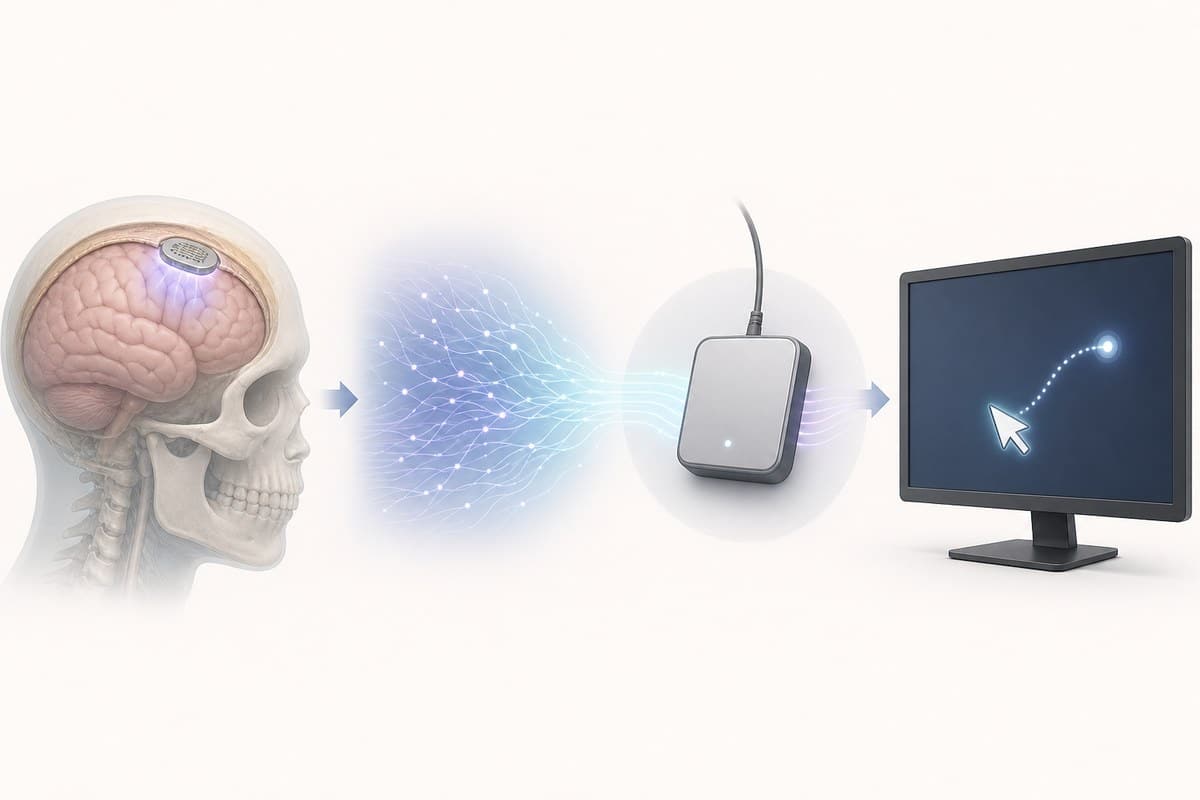
The company also says it will assess outcomes connected to daily independence. But it has not publicly specified the measures, the comparison method, the number of participants, how long they will be followed or what level of performance would be considered successful. Without those details, it is not possible to assess the study’s statistical power or determine how its functional findings would be interpreted.
Neuralink has called LINK the first pivotal U.S. trial of an implantable brain-computer interface. That is the company’s characterization, not a claim independently confirmed by the FDA in a public notice. Reports by Interesting Engineering and TechRadar similarly described the announcement as authorization to conduct a trial, rather than approval of a product for routine use.
Study authorization is not market authorization
The FDA’s regulatory framework for neurological devices draws a clear line between research and commercial distribution. For significant-risk investigational devices, an investigational-device exemption can allow clinical use of an unapproved device to collect safety and effectiveness information in support of a possible future marketing application, according to the agency’s regulatory overview of neurological devices.
That process allows researchers to study questions that are not answered by an early feasibility program: whether the hardware continues to function as intended over time, whether implantation and use produce device-related harms, and whether participants can consistently use the system for meaningful tasks. It does not amount to an FDA finding that an implant is clinically beneficial, reliable over the long term or ready for broad use.
No LINK results have been released. There are no published effect estimates, adverse-event totals, peer-reviewed findings or data showing that the device improves independence. Neuralink also has not stated a planned enrollment total in its announcement.
Questions about the public study record
Neuralink said more than 30 people implanted in its early feasibility studies in the United States, Canada and Britain have contributed thousands of hours of real-world brain-computer-interface use. Those figures are company-reported and do not provide independent evidence about safety, durability or effectiveness. The company did not release participant-level data or outcomes from those earlier studies alongside the LINK announcement.
A separate report by 2 Minute Medicine described a ClinicalTrials.gov entry it associated with the news as listing 15 participants and an active, not-recruiting status. It also said that record listed tetraplegia, tetraparesis, quadriplegia and cervical spinal-cord injury as conditions. The registry page was not available for direct review.
Those details do not plainly match Neuralink’s description of LINK as an ALS-focused study with enrollment open. Earlier coverage has identified a study called PRIME with a title resembling the registry entry described by 2 Minute Medicine, leaving unresolved whether the entry concerns LINK, PRIME or a related protocol. Until a directly verifiable registry record or a fuller protocol is public, the sample size, final eligibility criteria and recruitment status for LINK remain unclear.
For prospective participants and clinicians, the currently available information supports a narrower conclusion: Neuralink says it has been allowed to test its implanted system in a pivotal ALS study. Whether the system can perform reliably and safely enough to support a future marketing application will depend on evidence the study has not yet produced.