The Federal Communications Commission has reportedly authorized SpaceX to deploy up to one million satellites for Starmind, a proposed low-Earth-orbit network designed to process data in space and transmit results back to Earth. The decision would give SpaceX a regulatory foothold in AI-computing infrastructure as well as satellite broadband, but it does not mean a million satellites have been built, funded or scheduled for launch.
BBC reporting describes Starmind as a constellation operating at roughly 500 to 2,000 kilometres above Earth, with satellites using SpaceX’s existing Starlink network for communications. France 24 and AFP separately reported the one-million-satellite ceiling and said the authorization runs through 2040. The scale makes the decision unusual even in an industry accustomed to large constellation proposals.
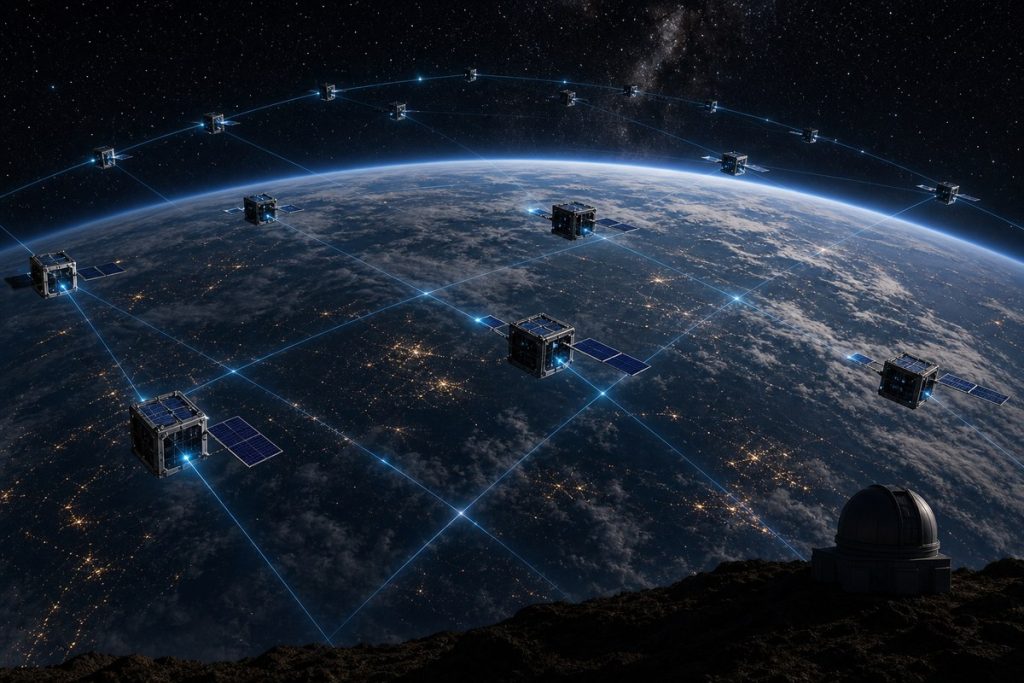
Reported milestones extend to 2040
The reported FCC action authorizes deployment of up to one million satellites, not a commitment to deploy the entire constellation. BBC noted that it remains unclear whether SpaceX will ultimately launch one million spacecraft.
BBC reported that SpaceX must begin deployment by November 2033, with 10% deployed by November 2035 and 50% by November 2038. If those percentages apply to the full authorized maximum, they would correspond to 100,000 and 500,000 satellites respectively. France 24 reported that the authorization extends to 2040, though the available accounts do not spell out every final condition attached to that endpoint.
How Starmind is meant to work
Rather than using satellites principally to connect users to the internet, the Starmind proposal is intended to run computing workloads in orbit. The satellites would process data and return results to Earth, with Starlink acting as the communications layer, BBC reported. The concept is adjacent to a data centre, but distributed across large numbers of spacecraft rather than housed in a terrestrial building full of servers.

SpaceX has argued that orbital data centres could meet AI-computing demand more cheaply and with better energy efficiency than Earth-based alternatives. The FCC has presented the proposal as infrastructure for the United States’ expanding AI economy. These are claims about a prospective system, not demonstrated results. No public performance figures in the reports establish how much computing capacity a Starmind satellite would provide, what workloads it could handle, or how its total energy and operating costs would compare with a conventional data centre.
Professor Sir Martin Sweeting, speaking to the BBC, said space-based data processing is technically feasible but questioned whether it makes sense at this scale. In particular, the high-volume laser communications needed to move data between Earth and orbit have not been demonstrated at the required level, he said.
France 24 reported further challenges for orbital data centres, including processors’ tolerance of radiation, extreme temperatures, debris and micrometeorites. The available reporting does not establish how SpaceX plans to address those issues for a constellation of this size.
Astronomy concerns
The American Astronomical Society objected to the authorization, BBC reported, arguing that a constellation on this scale could impair astronomical observations and public enjoyment of the night sky.
The published reports do not set out detailed plans for tracking, manoeuvring, replacement or removal of Starmind satellites. Such matters are general considerations for large orbital constellations, rather than documented Starmind-specific issues in the available reporting.
What happens next
SpaceX had previously indicated that it wanted to begin launching a Starmind satellite in the following year, BBC reported. France 24 separately cited an earlier Elon Musk commitment to a first orbital launch in the fourth quarter of 2027. The published accounts do not resolve whether those statements refer to the same planned mission or whether a launch date has changed.
Before the reported deployment milestones begin, SpaceX would need to show that its proposed computing hardware and communications links can support an orbital processing network at scale. The authorization does not itself establish that the system will be deployed or that its commercial case will succeed.