President Donald Trump is scheduled to travel to Arizona on Dec. 4 to speak at the start of construction for the fifth phase of Taiwan Semiconductor Manufacturing Co.’s expansion near Phoenix, placing a presidential spotlight on one of the largest manufacturing investment programs in the U.S. semiconductor industry.
The planned appearance, reported Nov. 25 by the Associated Press in an ABC News publication, comes as TSMC has described its broader U.S. manufacturing commitment as totaling $265 billion. The scale of that figure, and the role of TSMC’s factories in supplying chips for major technology companies, make the construction milestone more than a regional development event: it is part of the continuing effort to build advanced semiconductor capacity outside Asia.
A construction milestone, not a completed-factory opening
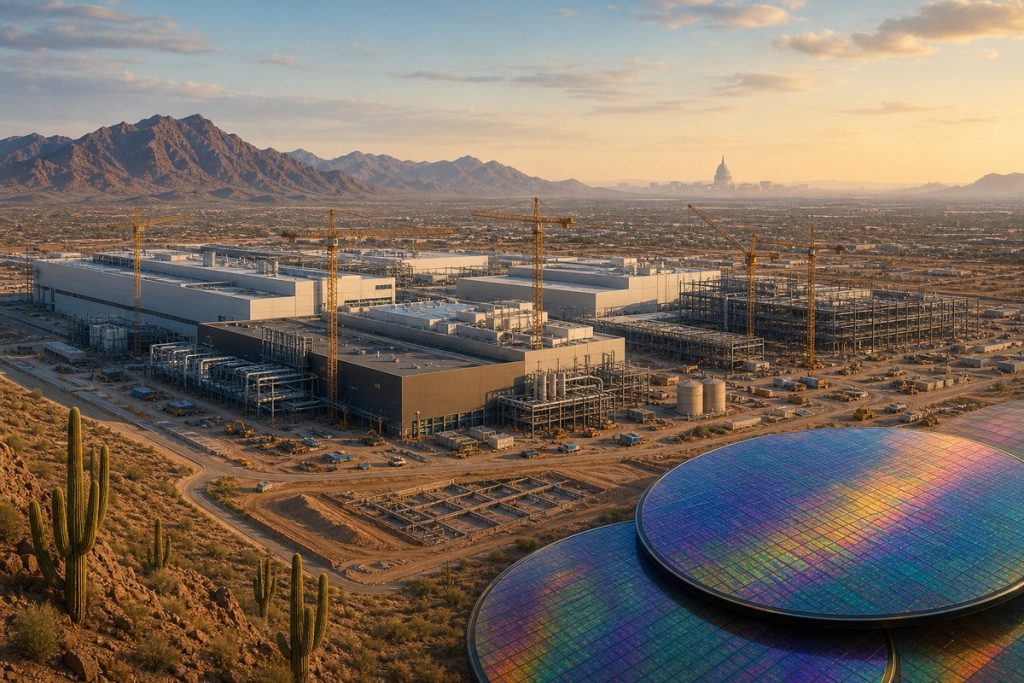
The most specific description available calls the Dec. 4 gathering a groundbreaking and the beginning of construction for TSMC Arizona’s fifth expansion phase. The White House and TSMC were cited by the AP as indicating that Trump would speak at the event.
That wording is important because another account describes the same planned visit differently. A Fox 10 Phoenix report, citing a Fox Business White House correspondent’s social-media post and saying the White House confirmed the trip, called the event an opening of a TSMC plant expansion in north Phoenix. The available reporting does not establish whether there will be another opening-related component or whether the description was shorthand for a new construction phase.
The AP’s characterization is the firmer basis for assessing the event: it is a planned start-of-construction ceremony for a further phase, rather than evidence that a fifth factory is already producing chips. That distinction affects how investors, suppliers and local officials should read the announcement. A groundbreaking marks a capital-commitment and execution stage; it does not itself establish when a facility will be completed, equipped or brought into volume production.
The $265 billion figure combines prior plans and new spending
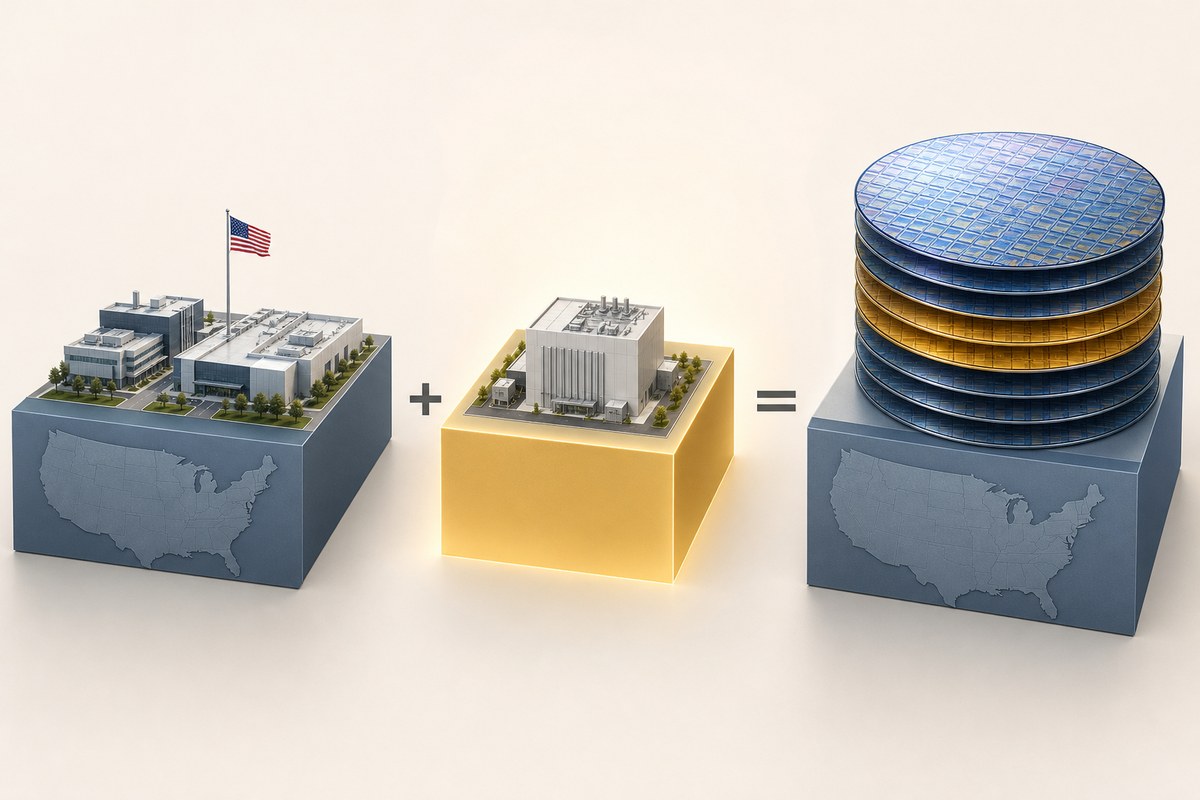
TSMC’s stated $265 billion U.S. commitment should also be read as an aggregate investment figure, not as the cost of the fifth Arizona phase alone. According to the AP report, the company announced in July that it planned a further $100 billion of U.S. manufacturing expansion. Adding that new plan brought the total commitment to $265 billion.
By implication, about $165 billion of the cited total reflected previously announced U.S. plans, while the additional $100 billion represents roughly 38% of the aggregate commitment. Neither the available report nor the local account provides a cost breakdown for the fifth phase, a timetable for its production start, or a separate financing plan for that particular construction step.
That limitation is material in the chip business. Headlines about multiyear semiconductor commitments often group announced factory construction, equipment purchases and future capacity plans into a single figure. The $265 billion number conveys the stated scale of TSMC’s U.S. strategy, but it should not be treated as a verified budget solely for the Phoenix-area site or for the Dec. 4 project.
The AP report identifies Nvidia, Apple, AMD, Broadcom and Qualcomm as customers of TSMC’s U.S. facilities. Their presence illustrates why additional domestic foundry capacity has strategic importance beyond TSMC’s own operations: TSMC manufactures chips designed by other companies, meaning its buildout can affect the supply chain for computing, consumer electronics, communications and artificial-intelligence systems.
Jobs claims are projections and construction counts are separate
The White House, as cited by the AP, said the expansion would create 10,000 direct jobs and 11,000 indirect jobs in the wider community. It also said the site currently accounts for more than 12,000 construction jobs.
Those figures describe different categories and should not be added indiscriminately. The 10,000 direct and 11,000 indirect positions are projected effects of the expansion, for a combined stated impact of 21,000 jobs. The more-than-12,000 construction figure refers to work at the site at present and is not an additional permanent-employment total. The reporting does not provide definitions for the indirect-job calculation, a schedule for when the projected jobs would be filled, or independent project documentation supporting the estimates.
For Phoenix, the short-term construction workforce and the longer-term operating workforce carry different economic implications. Construction activity can support contractors and related services during the building period, while a functioning foundry complex requires sustained hiring in engineering, manufacturing, facilities operations and supplier networks. The published accounts provide a high-level employment estimate, but not enough detail to determine the eventual mix of those roles or their timing.
Arizona project sits within a bipartisan industrial-policy push
TSMC’s Arizona project did not begin with the current administration. The AP report says construction began during the Biden administration and that the bipartisan CHIPS and Science Act supported the effort. Trump has promoted TSMC’s investment in connection with his tariff policies, but the available reporting does not support assigning the project to one administration alone.
The Dec. 4 appearance instead brings together several overlapping incentives: TSMC’s need to expand manufacturing capacity, technology customers’ interest in dependable supply, Arizona’s bid for high-value industrial employment and Washington’s effort to encourage more chip production in the United States. The announced ceremony will offer a visible marker of progress, while the more consequential measures for the company and its customers will be the pace of construction, equipment installation and eventual output from the new capacity.