


I put Netflix’s two mainstream options — Premium and Standard — head to head to see which plan actually delivers the best value for most households right now. With account sharing rules tightened and pricing reset across tiers, the “best deal” depends less on brand loyalty and more on how you watch, what you own, and who you share with.
For clarity, Netflix currently sells Standard with ads, Standard (ad-free), and Premium in the U.S., while the legacy Basic plan has been phased out for new members. Here’s how Premium stacks up against the Standard options when you factor in picture quality, concurrent streams, audio, downloads, and the real cost of living with ads.
- Plan Essentials at a Glance: Pricing and Perks
- Picture And Audio Differences That Matter
- Streams, Profiles, and the Realities of the Password Era
- Ads, Library Gaps, and the Realities of Offline Viewing
- Costs and Real-World Value for Different Netflix Users
- Bottom Line: Which Netflix Plan Offers the Best Value?
Plan Essentials at a Glance: Pricing and Perks
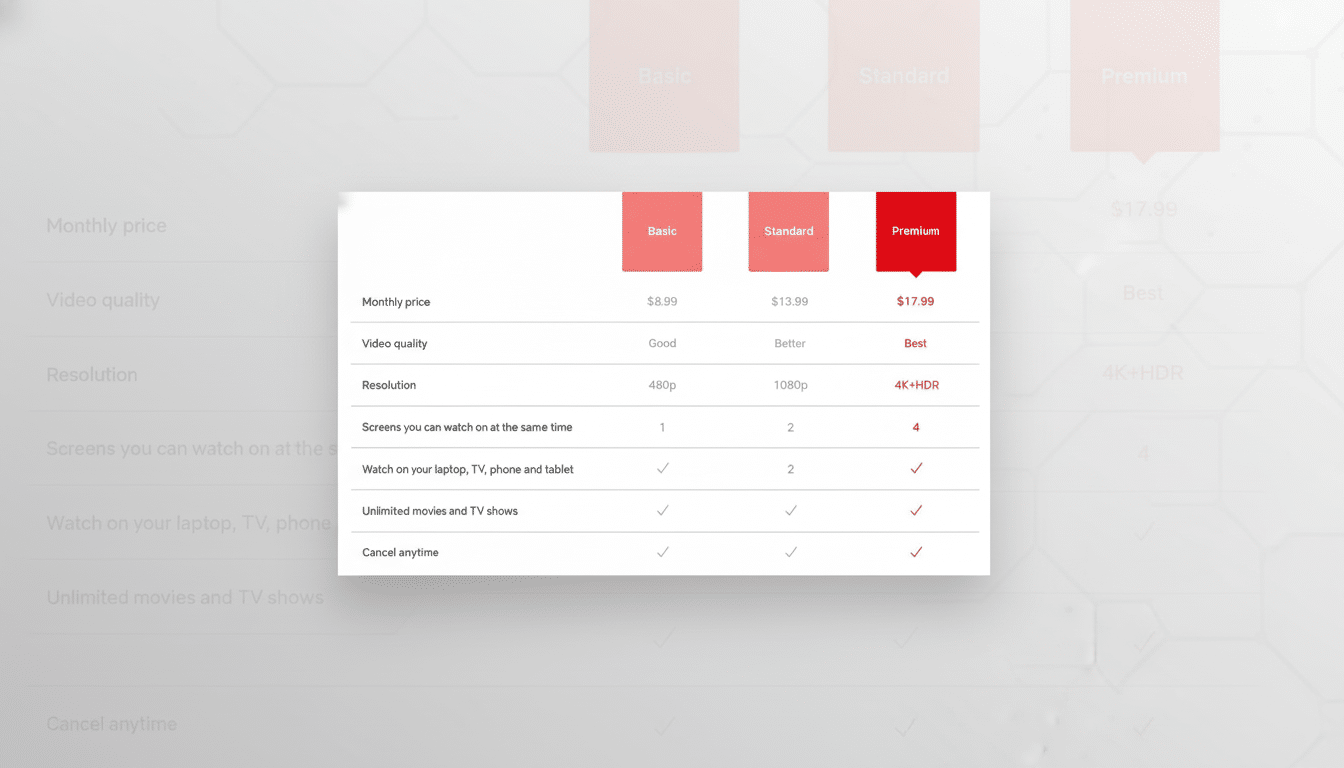
Pricing in the U.S. typically lands at about $6.99 per month for Standard with ads, $15.49 for Standard (ad-free), and $22.99 for Premium. While rates vary by market, the feature split is consistent: Premium is the only plan with 4K HDR and Dolby Atmos, plus the highest device and download limits.
Standard with ads streams at 1080p and allows two simultaneous streams. Standard (ad-free) also streams at 1080p with two simultaneous streams. Premium jumps to four simultaneous streams, 4K with HDR (including Dolby Vision on compatible titles), and Netflix Spatial Audio on supported titles.
Download rules are a big differentiator: ad-supported plans don’t allow downloads, Standard allows downloads on two devices, and Premium allows downloads on up to six devices. If you travel frequently or manage kids’ tablets, that offline cushion matters.
Picture And Audio Differences That Matter
Premium’s headline perk is 4K HDR, but it’s only a win if your hardware and internet can show it. Netflix recommends at least 15 Mbps for Ultra HD and 5 Mbps for HD according to the Netflix Help Center. Your TV must support 4K and, for HDR, formats like Dolby Vision, HDR10, or HDR10+ featured on many recent sets.
On the audio front, Premium unlocks Dolby Atmos on compatible titles and gear, and it includes Netflix Spatial Audio for a wider, more cinematic soundstage on stereo devices. If you have a 5.1 system or Atmos soundbar, effects-heavy series and big-budget films sound noticeably fuller on Premium.
If you mostly watch on a laptop, older TV, or a bedroom set without HDR, the leap from 1080p to 4K may feel modest. In that case, paying for Premium’s video and audio perks could be overkill.
Streams, Profiles, and the Realities of the Password Era
Simultaneous streams are straightforward: both Standard tiers allow two at once; Premium allows four. Profiles are capped at five per account regardless of plan, which helps keep recommendations tidy.
Netflix’s paid sharing policy adds another wrinkle. Standard can add one “extra member” outside your household for an additional monthly fee, while Premium can add two. The ad-supported Standard plan does not support extra members. This is the cleanest way to keep a college student or an out-of-state parent on your tab without account turbulence.
If your household tends to watch in shifts — for example, parents after kids’ bedtime — two streams may be plenty. If you regularly have three or four concurrent viewers, Premium’s headroom prevents nightly stream collisions.
Ads, Library Gaps, and the Realities of Offline Viewing
Netflix’s ad load is comparatively light by TV standards — major ad buyers and Netflix have pegged it around 4–5 minutes per hour, typically split pre-roll and mid-roll. You still get 1080p quality on the ad tier, and many originals carry the same production values you’d see on higher tiers.
Library differences are now relatively small. Independent trackers such as What’s on Netflix have found roughly 1–2% of the U.S. catalog locked on the ad tier due to licensing. You may occasionally see a lock icon on certain studio films; for many viewers, it’s a rare speed bump rather than a daily frustration.
Offline viewing is where ad-supported falls short. If you commute underground, fly often, or need kids’ shows on planes, Standard (ad-free) or Premium are meaningfully better — two download devices on Standard, six on Premium.
Costs and Real-World Value for Different Netflix Users
For a couple that rotates among several streaming services and isn’t allergic to limited ads, Standard with ads is the wallet winner. Versus Premium, you’re saving about $16 per month — roughly $192 a year — which can fund another major service.
For a family of four with a 4K HDR TV and an Atmos-capable soundbar, Premium earns its keep. You get the headroom of four streams, the best picture and audio, six download devices for road trips, and up to two extra members if your household extends beyond one address.
If you can’t stand ads but don’t have 4K gear, Standard (ad-free) is the pragmatic middle ground. You’ll keep 1080p quality, two streams, and downloads without paying for features you can’t use.
Bottom Line: Which Netflix Plan Offers the Best Value?
Pick Premium if you actively watch on a 4K HDR TV, have 3–4 concurrent viewers, or rely on Atmos and generous downloads. Choose Standard with ads if price trumps everything and you can tolerate brief ad breaks for nearly the same catalog and 1080p streams. Opt for Standard (ad-free) if you want quiet, dependable bingeing without ads or 4K frills.
That recommendation aligns with what the Netflix Help Center specifies on speeds and features, what Consumer Technology Association research shows about 4K TV penetration, and what third-party trackers report about ad-tier library gaps. The “best deal” is ultimately the one that matches how you actually watch — not just what’s on the spec sheet.

