


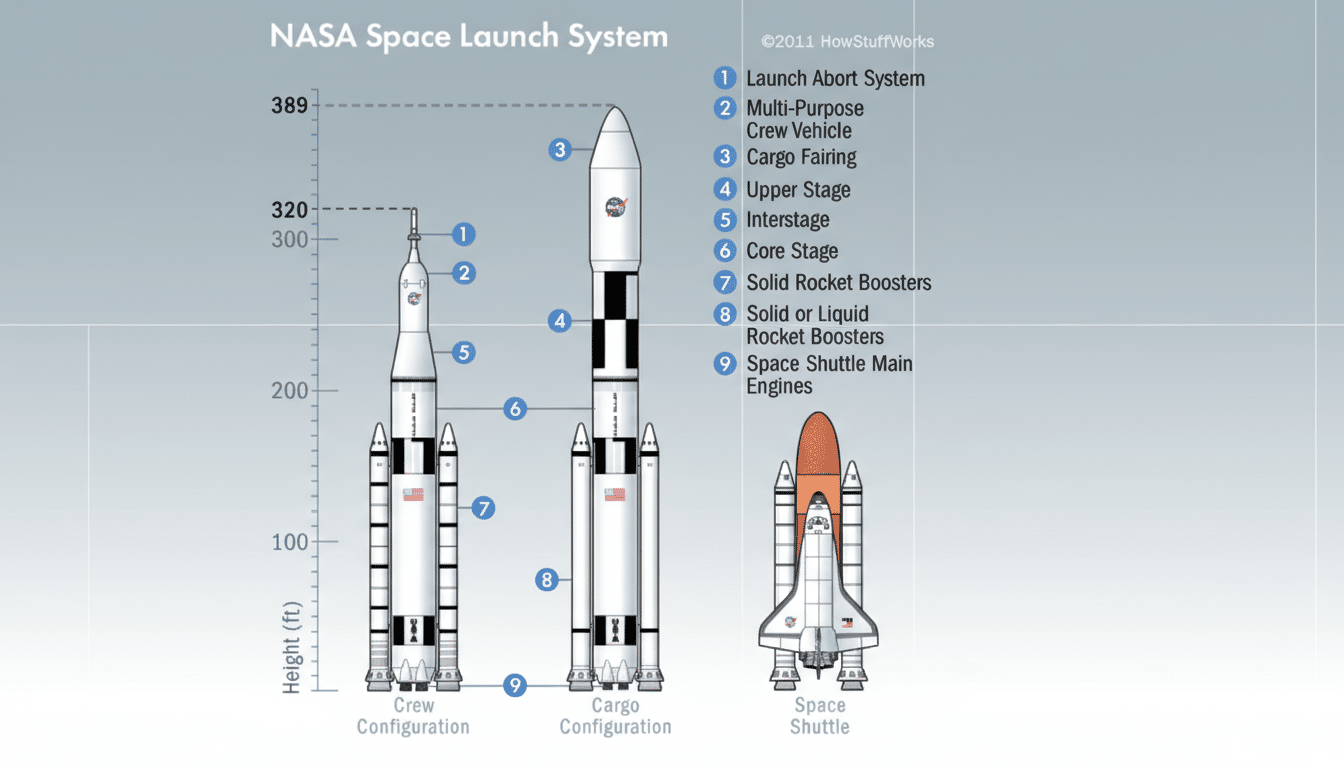
NASA is zeroing in on an April 1 launch target for Artemis II after resolving a helium flow anomaly that surfaced during a recent fueling test. With the fix verified, teams at Kennedy Space Center are preparing to return the 322-foot Space Launch System (SLS) to Launch Complex 39B for the first crewed lunar mission of the Artemis era—a sweeping flight test designed to validate Orion’s life support, navigation, and communications systems before a surface landing later in the decade.
Helium Fix Clears a Pivotal Launch Milestone
Engineers traced the issue to a dislodged seal in an upper-stage quick-disconnect fitting used during ground operations. According to NASA’s program update, technicians removed the hardware, reassembled the system, and ran a reduced helium flow test to confirm proper performance. Helium is critical for pressurizing propellant lines and purging sensitive plumbing; a persistent leak would have jeopardized countdown operations.

While the helium problem is behind them, ground crews will keep SLS in the Vehicle Assembly Building a bit longer to cycle through life-limited components. That includes replacing range safety flight termination system batteries, swapping flight batteries on the core and upper stages and the twin solid rocket boosters, and recharging batteries for Orion’s launch abort system. These are routine but essential steps to ensure electrical margins and compliance with strict range requirements.
Launch Windows and What Must Go Right for Artemis II
The first available launch window opens April 1, with additional opportunities on April 3, 4, 5, and 6. Those dates reflect the precise choreography of Earth–Moon geometry, crew constraints, and daylight recovery timelines. NASA has not ruled out another full-up fueling exercise, often called a wet dress rehearsal, though current planning focuses on completing repairs, data reviews, and final integrated tests before rollout.
Once the stack leaves the VAB, it will make the slow crawl to Pad 39B, where teams will run pad validation checkouts, communications end-to-end tests, and final flight readiness reviews. Any sign of leakage during cryogenic loading, avionics anomalies, or out-of-family ground support data could prompt a recycle to later windows—standard practice for a first crewed flight on a new exploration system.
What Artemis II Will Prove on Its Lunar Flyby
Artemis II is a roughly 10-day circumlunar flyby that will send four astronauts farther from Earth than any crew in history on a free-return trajectory around the Moon. The mission’s centerpiece is Orion’s Environmental Control and Life Support System, which must regulate cabin atmosphere, temperature, and humidity for the full duration. The crew will also exercise deep-space comms, manual spacecraft piloting, and high-speed reentry procedures informed by Artemis I, when Orion traveled about 1.4 million miles and hit the atmosphere at approximately 24,500 mph before splashdown.
The crew—Commander Reid Wiseman, Pilot Victor Glover, and Mission Specialists Christina Koch and Jeremy Hansen—represents a slate of firsts, including the first woman, the first person of color, and the first Canadian astronaut to journey toward the Moon. Orion’s European Service Module, built by ESA and Airbus, will provide power and propulsion, including the critical burns to shape the lunar flyby and return trajectory.
SLS will do the heavy lifting. The Block 1 configuration produces about 8.8 million pounds of thrust at liftoff via four Aerojet Rocketdyne RS-25 engines and two Northrop Grumman five-segment solid rocket boosters, while the Interim Cryogenic Propulsion Stage—powered by an RL10 engine—will execute the translunar injection. Prime contractors Boeing (core stage) and Lockheed Martin (Orion) round out a sprawling industrial team that has spent years iterating hardware and ground procedures to reach crew-ready status.
Schedule Realities Across the Artemis Program
Despite a picture-perfect uncrewed Artemis I flight in 2022, the path to a sustained lunar campaign has been bumpy. Helium and hydrogen ground system hiccups have forced multiple test stand-downs, and downstream missions rely on parallel developments outside NASA’s direct control. Independent assessments from NASA’s Office of Inspector General and the Government Accountability Office have cautioned that human landing and next-generation spacesuits—developed by commercial partners—remain pacing items. In that context, Artemis II is the risk-reduction linchpin that will validate the transportation system and operational tempo needed for surface sorties.
What to Watch Next as Artemis II Nears Launch
In the coming weeks, look for confirmation that battery swaps and closeouts are complete, a clean bill of health from avionics and software integrated testing, and favorable cryogenic loading data during prelaunch operations. Weather and upper-level winds at the Cape are perennial variables, but the early-April sequence of windows provides flexibility. If the vehicle and ground systems perform as expected, April 1 becomes more than a placeholder—it becomes the moment NASA flies people to the Moon’s doorstep once again.

