


NASA’s neXt crew rotation to the International Space Station is ready for liftoff, and the agency is making it easy to tune in from anywhere. Below is everything you need to know to watch the Crew-12 launch live, when coverage starts, what the timeline looks like, and where to find official streams without charge.
How To Watch The Crew-12 Launch Livestream Online
The primary broadcast is carried on NASA TV and NASA+, the agency’s free, ad-free streaming platform available on most smart TVs, mobile apps, and set-top boxes. NASA will simulcast the program on its official YouTube channel, with mirrored coverage on Facebook and X for quick access on mobile.
- How To Watch The Crew-12 Launch Livestream Online
- When Live Coverage Starts For The Crew-12 Launch
- What To Watch In The Crew-12 Launch Countdown
- Ascent Profile And First-Stage Booster Landing
- Where The Crew-12 Launch Happens On The Space Coast
- Who Is Flying On Crew-12 And Why The Mission Matters
- Pro Tips For Viewers To Get The Best Launch Experience
SpaceX, which provides the Falcon 9 rocket and Dragon spacecraft, typically hosts its own webcast focused on vehicle operations and launch milestones. Watching both feeds offers complementary views: NASA emphasizes crew operations and mission context, while SpaceX zeroes in on the countdown, ascent, and booster recovery.
For listeners on the go, NASA’s audio-only “mission audio” stream carries the same commentary and can be picked up via the NASA app or the agency’s online radio channel. Spanish-language coverage is often provided on dedicated NASA en Español streams when available.
When Live Coverage Starts For The Crew-12 Launch
Expect NASA’s live program to begin roughly a couple of hours before liftoff, rolling through the arrival of the crew, suit leak checks, hatch closure, and spacecraft arming. SpaceX’s hosted webcast usually joins closer to the final hour of the countdown as the launch team proceeds into fueling and flight readiness polls.
If weather or range constraints force a scrub, keep the same channels bookmarked. NASA and SpaceX announce new target opportunities on-air and across official social accounts, and coverage restarts ahead of the next attempt with an updated timeline.
What To Watch In The Crew-12 Launch Countdown
About three quarters of an hour before liftoff, the launch director conducts a final “go/no-go” poll. Shortly after, the crew access arm retracts, the escape system is enabled, and propellant loading begins on both stages of Falcon 9. You’ll hear callouts for liquid oxygen and RP-1 kerosene loading reaching “top-off” as the rocket chills toward flight temperatures.
In the final minutes, watch for the strongback to retract, the autonomous flight termination system to arm, and Dragon to switch to internal power. At engine ignition, nine Merlin engines throttle up for a brief health check before clamps release and Falcon 9 commits to flight.
Ascent Profile And First-Stage Booster Landing
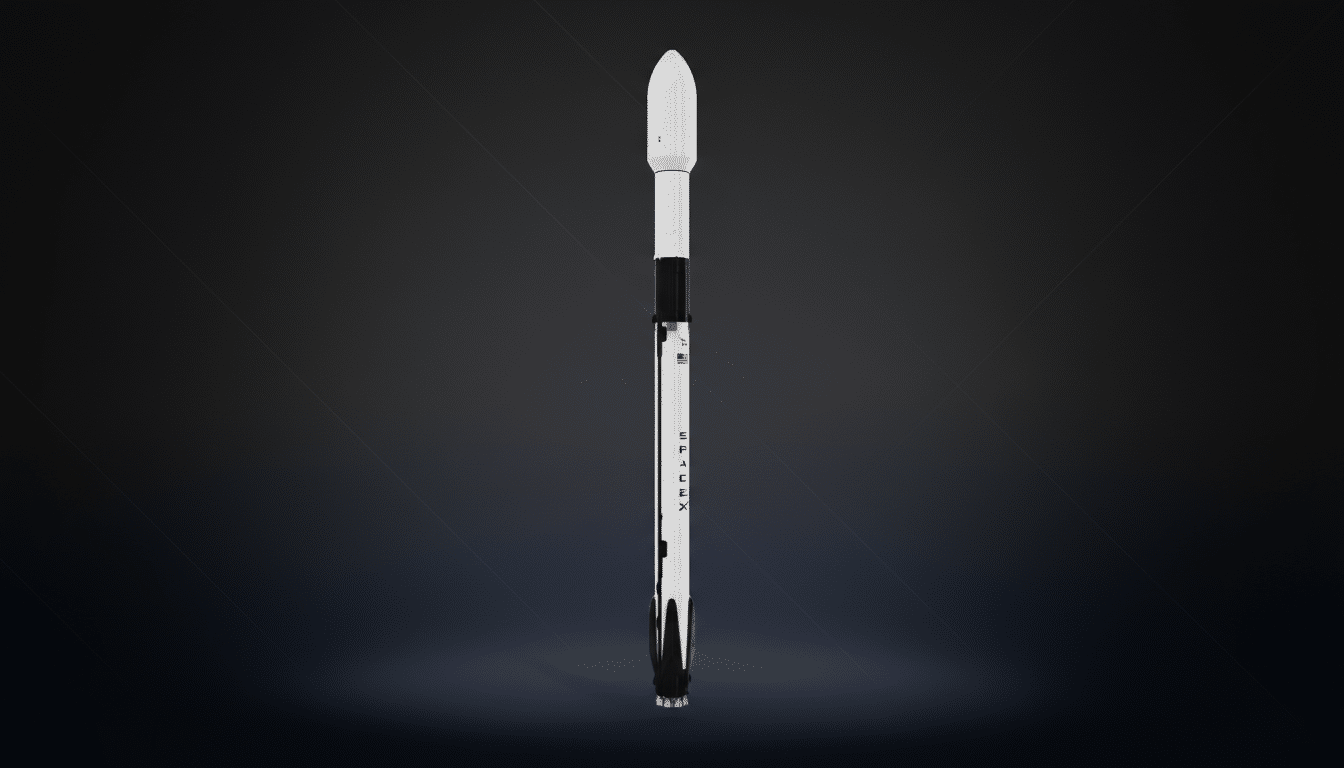
Moments after liftoff, the rocket hits “Max-Q,” the point of maximum aerodynamic pressure. Stage separation follows a few minutes later: the first stage flips for a boostback and landing attempt on a droneship or landing zone, while the second stage carries Dragon to orbit. Viewers often get split-screen coverage here—one view tracking the crew to orbit, another showing the booster’s fiery reentry and landing burn.
Dragon separates from the second stage shortly after orbital insertion and performs a series of phasing burns to line up with the station. Docking typically occurs roughly a day to a day and a half after launch, depending on phasing, with live coverage resuming for approach, soft capture, hard mate, and hatch opening.
Where The Crew-12 Launch Happens On The Space Coast
The mission flies from Cape Canaveral on Florida’s Space Coast, a region that sees frequent scrub-and-try-again cycles due to strict lightning and cloud rules. The U.S. Space Force’s 45th Weather Squadron monitors upper-level winds, anvil clouds, and electric fields; if any Launch Commit Criteria are violated, teams wave off and reset for the next available window.
Who Is Flying On Crew-12 And Why The Mission Matters
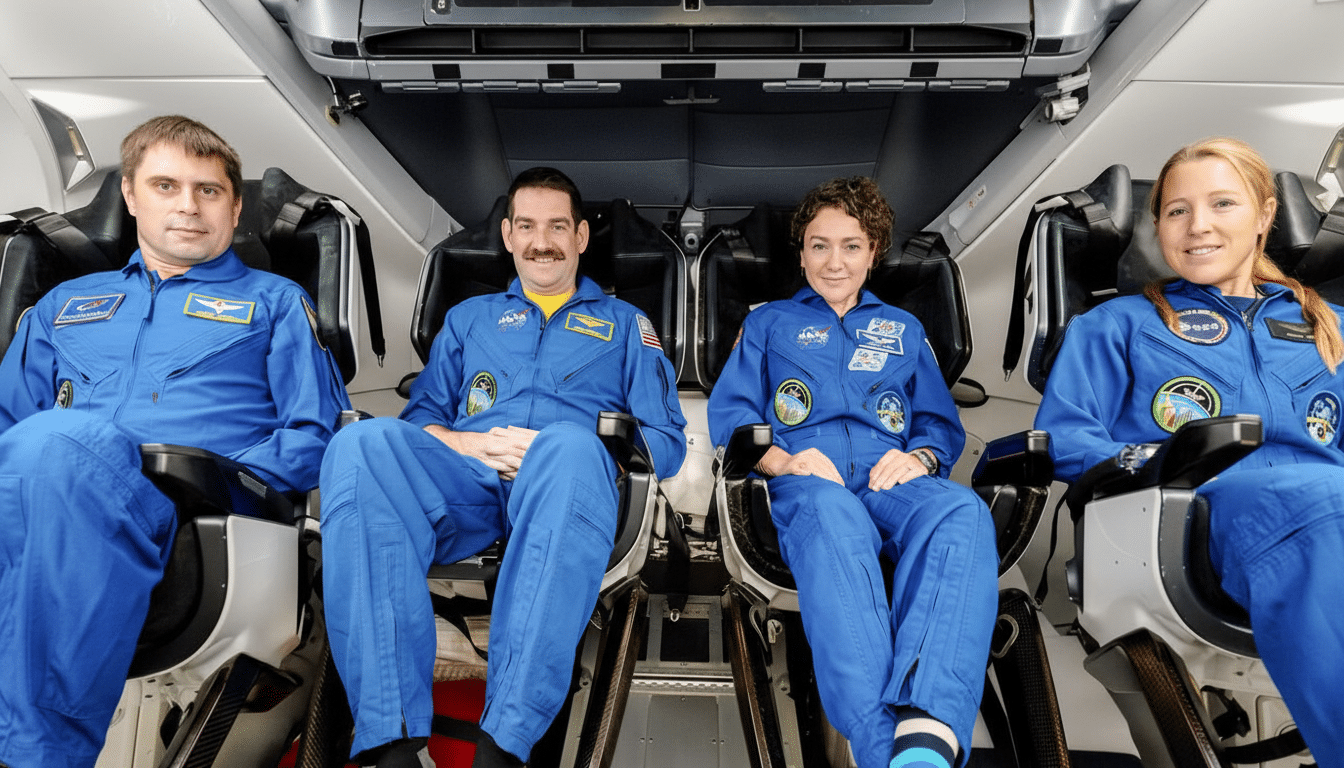
Crew-12 flies aboard SpaceX’s Dragon for NASA’s Commercial Crew Program, continuing the cadence that has kept a continuous human presence on the station for more than two decades. The multinational crew will take over research, station maintenance, and cargo operations, part of a rotation model that ensures both U.S. and Russian segments remain staffed under an ongoing seat-swap agreement with Roscosmos.
Over the coming months on orbit, the crew will support hundreds of investigations, from fluid physics and combustion science to microgravity biotech. According to NASA program stats, each rotation typically returns more than a ton of experiment samples and hardware on Dragon splashdowns, feeding Earth-based labs with data that cannot be produced under gravity.
Pro Tips For Viewers To Get The Best Launch Experience
Subscribe to both NASA and SpaceX channels to receive instant push alerts if the schedule shifts. If you’re watching on a connected TV, load NASA+ for the cleanest long-form feed, then cast SpaceX’s webcast on a second screen during ascent to catch the booster landing. And if weather is questionable, don’t bail early—scrubs often come late in the count, and turnaround to the next opportunity can be swift.
Whether you’re a first-time viewer or a seasoned launch watcher, this broadcast offers a front-row seat to every critical milestone of human spaceflight—from suit checks to docking. Keep the official channels at the ready, and you’ll be set for Crew-12’s ride to orbit.
