


MSI’s GeForce RTX 5090 32G Lightning Z is the kind of graphics card that makes even seasoned overclockers pause. Built in limited numbers and engineered like a lab instrument, it marries a custom PCB, an outsized liquid-cooling system, and a full-surface LCD into one purpose-built showcase for extreme performance. The silicon may be Nvidia’s, but nearly everything else screams MSI—overbuilt power delivery, lavish thermals, and a design tuned for world records rather than mere benchmarks.
Only 1,300 units will be made, and if first impressions at CES are any indication, this may be the most audacious consumer GPU assembly we’ve seen to date. The question isn’t whether it’s fast; it’s whether anything else on store shelves is more extreme.
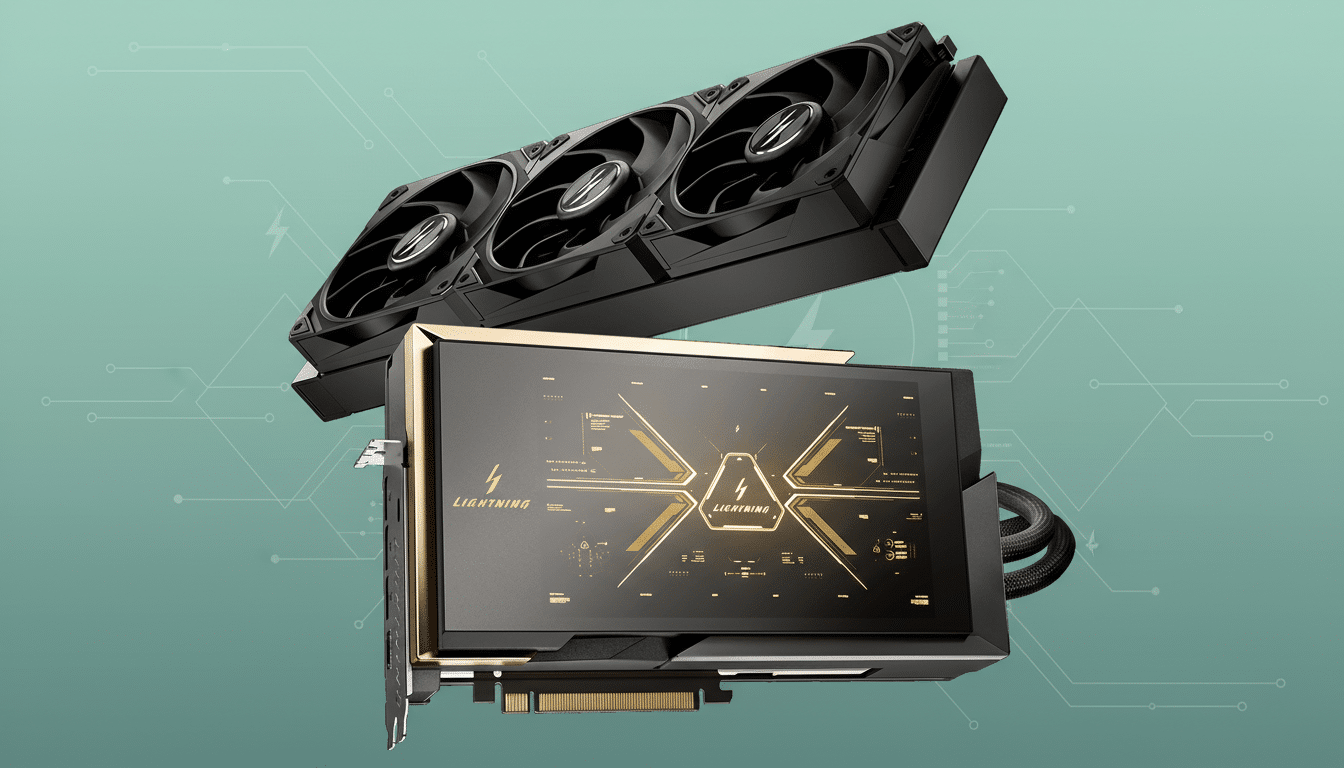
Cooling Built for Four Digits of Power Draw
The Lightning Z offloads thermals to an AIO loop with a triple-fan radiator and a pump tuned for high flow. MSI cites up to 71% higher coolant flow and up to 44% higher liquid pressure versus its prior liquid-cooled designs—numbers that matter when you’re trying to keep a flagship GPU stable north of stock limits.
The centerpiece is a full-copper, full-cover cold plate that spans the GPU, GDDR modules, and VRM array. It’s substantially heavier than typical blocks and carved with internal channels to move heat fast. Compared with the air-cooled Founders Edition, expect steadier boost clocks under sustained load and lower acoustic spikes when the card is pushed hard.
Power Delivery That Redefines the Meaning of Overkill
MSI’s custom PCB carries a staggering 40 power phases around the core—far beyond typical partner cards. The board is fed by two 12V-2×6 (12VHPWR) connectors, a choice that aligns with PCI-SIG guidance for high-current headroom and reduces stress on any single cable. The standard BIOS permits up to 800W board power, while MSI says the card is built to sustain 1,000W in tuned scenarios. For context, Nvidia’s reference RTX 5090 is rated up to 575W with a single 12VHPWR.
Do the math and the ceiling looks wild: two 12V-2×6 connectors can provision up to 1,200W, plus 75W from the PCIe slot for a theoretical 1,275W pathway. MSI isn’t encouraging users to chase that number on ambient cooling, but the plumbing is there. An XOC BIOS mode (2,500W envelope) exists for liquid nitrogen sessions and leaderboard attempts—strictly for experts, and it voids warranty as you’d expect.
There are practical implications. This card demands a premium PSU—think 1,600W or higher—with two native 12V-2×6 leads. Adapters are a poor substitute at these loads. Proper cable routing and bend radius matter for connector longevity and safety; PCI-SIG has emphasized this repeatedly, and builders should treat it like gospel for high-current rigs.
An 8-Inch LCD And A Vertical-First Design
The entire outward face of the Lightning Z is an 8-inch LCD, turning the card into a status panel or a canvas for animations. MSI expects owners to mount the GPU vertically for visibility, and includes a PCIe riser cable in the box. A stabilizing base is planned for showcase builds.
On the software side, Afterburner remains, but MSI adds Lightning Hub, a browser-based tuner with remote access, plus a Lightning Overdrive mobile app. Live telemetry—voltages, clocks, thermals—pairs naturally with that front display, a convenience bench testers and streamers will appreciate during iterative overclocking.
Records Today With Realistic Gains Tomorrow
MSI says prelaunch QA with elite overclockers has already yielded 17 world records across suites like 3DMark and Geekbench. Leaderboards such as HWBOT frequently validate these feats, and the Lightning Z’s VRM and cooling blueprint fit that crowd’s needs perfectly.
For everyday gaming, remember the fundamentals: core counts and 32GB of memory match a standard RTX 5090. The upside comes from sustained boost clocks under extended load and the headroom to push power far beyond typical limits. Expect modest gains at stock-equivalent settings, scaling upward as you leverage the 800W profile and beyond. There will be diminishing returns—physics always wins—but this platform stretches the curve further than air-cooled counterparts.
Availability, Price, and Our Final Verdict
MSI plans a February release with just 1,300 units. Pricing isn’t public, but given the copper, the custom PCB, the display, and the bundled riser, anticipate a flagship-plus premium. A suitable PSU and a case that accommodates a radiator and vertical mount will add to the bill.
So is this the world’s most extreme consumer graphics card? On balance, yes. Between the 40-phase VRM, dual 12V-2×6 inputs, 1,000W stability target, and a full-face LCD—backed by software built for remote, real-time control—nothing else currently combines all these traits. It’s not built for value or silence. It’s built to set records and anchor showpiece systems—and it looks ready to do both.
