


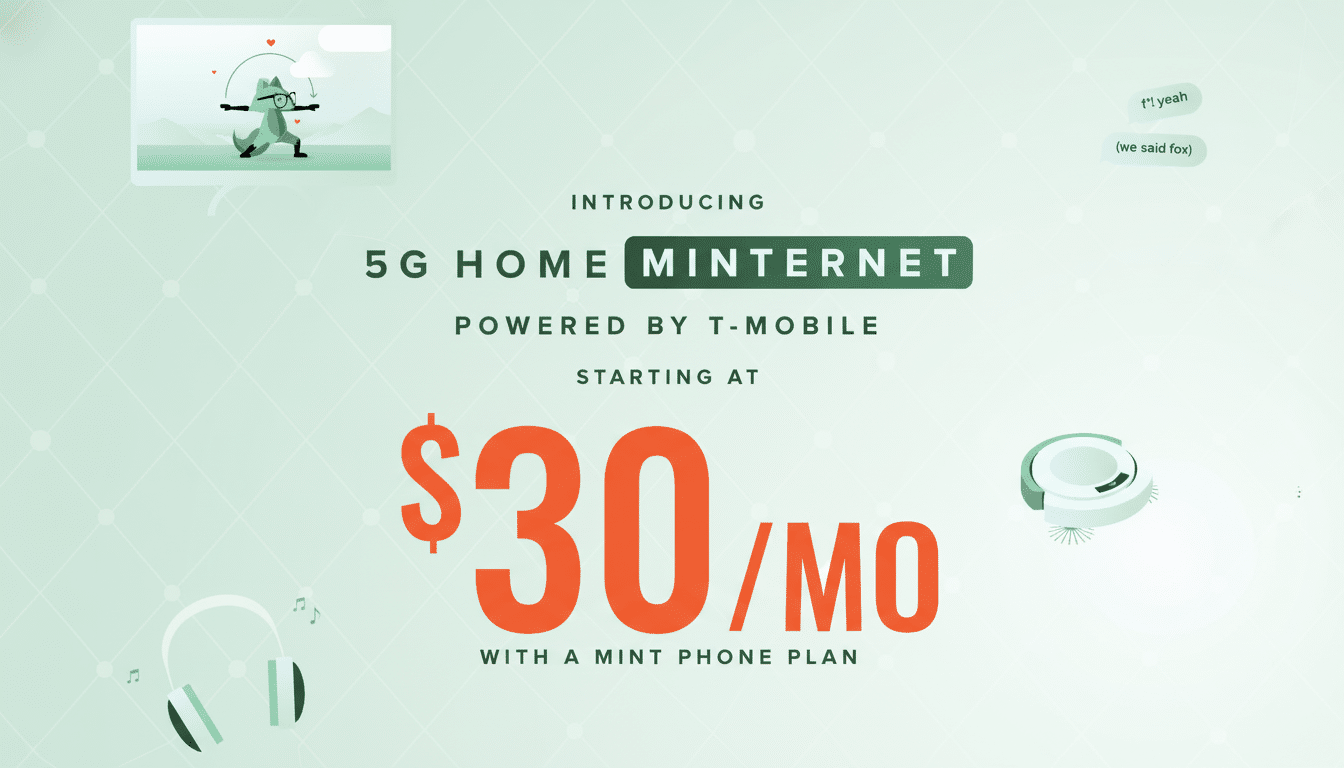
Mint Mobile is gearing up to offer more than just wireless service with a plan to introduce a 5G-capable home internet product. The company promoted the service with a tongue-in-cheek TV spot starring Ryan Reynolds and late-night personality Guillermo, and it has opened up sign-ups for launch notifications. Full details are yet to be released, but the outlines are clear: This is fixed wireless access, delivered over T-Mobile’s nationwide 5G network.
The move inserts Mint into one of the most frothy corners of broadband, where wireless carriers are repurposing 5G capacity to offer an at-home cable-and-DSL alternative. It also furthers Mint’s alignment with its parent company, which has turned home internet into a strategic growth pillar alongside mobile.

What Mint Is Launching for 5G Home Internet Users
The service-in-waiting — jovially promoted in advertisements as “Minternet” — is a fixed wireless offering that leverages 5G for the last-mile connection, which it spreads throughout the home using a self-installed gateway that broadcasts Wi-Fi. Imagine a setup like today’s 5G home internet kits: a small modem-router combo, placement near a window guided by an app that leads through prompts to find the optimal spot in your home, and activation within minutes without the need for any technician visit.
Because it relies on T-Mobile’s 5G network, availability will largely hinge on what capacity is like in any given location. T-Mobile has said that its 5G home internet is available to more than 50 million households and that coverage is heaviest in suburbs and smaller cities where mid-band 5G spectrum works best. Gating due to address checks is common, so as not to overload mobile performance during peak periods.
Powered by T-Mobile’s Network and 5G Spectrum
T-Mobile’s 5G home internet has been among the drivers behind a comeback in fixed wireless, with the carrier saying it had more than five million home internet customers in 2024, by company filings. The network relies on mid-band spectrum (referred to as Ultra Capacity 5G) for a mix of speed and reach, and low-band, which delivers broader coverage. T-Mobile, in part because of its low-band acquisition, has consistently placed at or near the top for 5G availability and reliability based on independent tests by firms like Ookla and Opensignal in the U.S.
T-Mobile says typical download speeds for its home internet service fall in the 70–245 Mbps range, with uploads ranging from around 15 to 30 Mbps. That’s not fiber-class, but more than enough for streaming on several TVs, doing video calls, playing games in the cloud most of the time, and regular browsing duties. Latency is typically higher than wired fiber but comparable to cable; performance depends on proximity to the cell site and local congestion.
Pricing and Plan Expectations for Mint’s Home Internet
T-Mobile’s own home internet plans tend to cost $30–$50 per month, give or take a bundle or promotion.
Mint’s DNA is prepaid, which means it should feature straightforward pricing (no annual contracts) and potential savings if you pay for multiple months upfront—similar to how its phone plans get cheaper with three-, six-, or twelve-month purchases.
No need to worry about hardware fees; carriers typically give you the gateway at no additional cost and will take it back easily. Data caps aren’t out of the question either — T-Mobile’s home internet service has been marketed with unlimited data with network management during congestion. Bundling discounts would also make sense for customers who already use Mint services on their phones, a strategy common across the industry that reduces churn.
How It Will Work Day to Day for Typical Households
Look for app-based setup along with placement tips to optimize signal quality, and Wi-Fi 6 or newer radios in the gateway that translate to good in-home coverage. Since fixed wireless cutouts can be triggered by a building built or a tree grown in the way, service providers frequently let consumers move the gateway, use an outdoor antenna instead, or request replacement if performance tends to drift.
Gamers should also be aware that carrier-grade NAT is quite common on 5G home internet, which can complicate hosting as well as some online titles. For work-from-home users, video conferencing is often reliable, but critical use cases will benefit from a backup connection or wired failover. Mint will also probably come out with a list of compatible cases at launch and recommendations.
Why Fixed Wireless Is Surging in U.S. Broadband
Fixed wireless access has accounted for the bulk of broadband net additions in the U.S. over the last couple of years, based on research from Leichtman Research Group, even as select cable providers reported customer declines. Here’s the draw: fast installation, cheaper prices, and freedom from traditional ISP contracts and hidden fees.
Regulators have also seen fixed wireless as a tool to extend competition while fiber builds are ongoing. The Federal Communications Commission has championed 5G FWA as a short-term stopgap in areas where it’s expensive or slow to trench fiber, particularly in the long reaches of exurban and rural communities still left with few wired options.
What To Watch Next as Mint Prepares Home Internet
Questions around the launch include:
- Will Mint price undercut T-Mobile for prepay?
- Will there be multi-month deals, mobile packages, or even referral credits?
- How aggressively will availability ramp up, considering capacity gating?
- Will Mint use a dedicated gateway or simply relabel T-Mobile’s existing models with Mint branding?
Should Mint follow the same script as those previous services, with clear pricing and onboarding practices that prioritize the customer, it will remain one of the most accessible gateways to 5G home internet. And when you consider the millions who are priced out of cable or tired of its contracts, that might be enough.
