


Lego is unveiling a sensor-filled Smart Brick that brings traditional builds to light and sound, like a galaxy-spanning lightsaber effect complete with the level of the unmistakable whoosh and clash. The new piece forms the heart of the company’s Smart Play line, requiring minifigures and snap-on Smart Tags to activate color changes, audio cues, and motion-aware interactions — no screen or app necessary.
How the Smart Brick Works With Sensors and Tags
At first look, the Smart Brick appears to be a transparent rectangular block that is indistinguishable from regular Lego bricks and will not look out of place on average sets. Inside, it has a speaker and an array of RGB lights that can glow, pulse, or change color when you tell it to. Lego says the bricks can sense play actions and nearby objects as well, allowing for tricks like matching its color to a surface when it’s placed on top or slid to the side of something, along with distance-sensitive effects and motion-triggered sounds (like swinging it around or colliding with another piece).
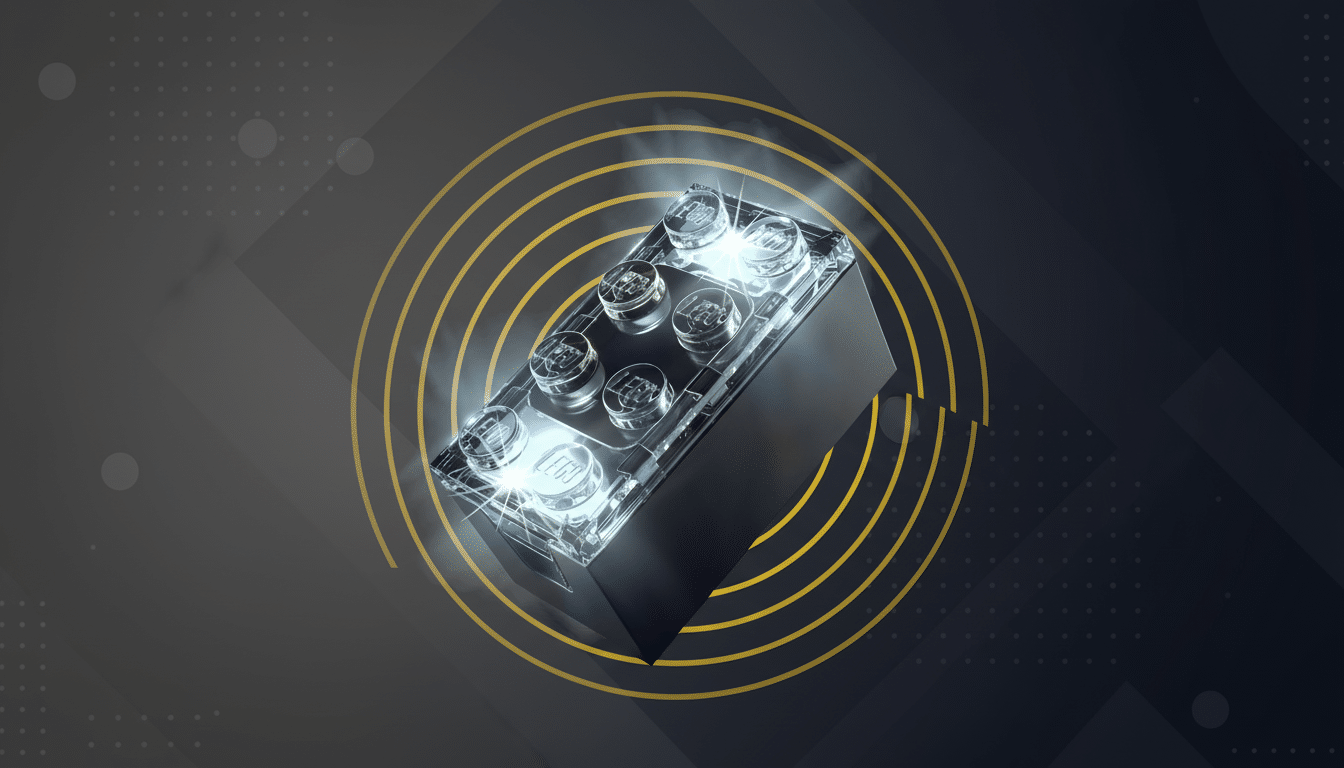
Functionality is enhanced by a little clip-in Smart Tag that “teaches” the brick new behaviors, such as vehicle sounds, animal noises, or lightsaber audio. The shake-to-wake setup feels a little like play and, once the tag is seated, the cues kick in immediately. Although Lego hasn’t itemized each component, this behavior strongly suggests that there is an accelerometer for movement, a color sensor, a proximity sensor, and you can also expect a low-power speaker integrated with an onboard microcontroller. The result is a standalone system designed for physical play without phones or tablets.
Star Wars Leads the Way With Immersive Sound Effects
The initial wave focuses on a trio of Star Wars sets: an X-Wing piloted by Luke Skywalker, a TIE fighter with Darth Vader inside, and an Emperor’s Throne Room where they can duel. Swing the Smart Brick like a sword and it emits a rising hum; two meeting in combat resonate with the satisfying crackle of contact, alongside dynamic lighting that shifts from ambient glow to battle flicker. It is, for builders at least, a rare licensed feature that feels true without cannibalizing the brick-built experience.
A decades-long relationship between Lego and Lucasfilm has regularly yielded the company’s most popular kits, and retail tracking by Circana shows licensed properties account for most toy dollars in numerous markets. Embedding a signature audio clip inside the build is, in my opinion, the best of nostalgia being brought to life that we’ve seen compared to printing tiles. Models with the new brick will start at around $70 and go up to about $160, depending on the number of pieces in the set and figures included.
Screen-Free Interactions With STEM Roots
Smart Play is Lego’s boldest stride yet into screen-free electronics. Previous attempts like Boost, Powered Up, and its education-oriented SPIKE kits relied on apps, coding, and Bluetooth hubs. Those are great for classrooms and hobbyists, but they bring tablets and tutorials to something many families would rather remain unplugged. The Smart Brick inverts that equation: the logic is inside the brick, and feedback will be both instantaneous and tactile.
That matters developmentally. The American Academy of Pediatrics reinforces that hands-on, imaginative play builds problem-solving as well as social skills. The smart brick’s cause-and-effect design — swing for a whoosh, collide for a clash — keeps kids’ eyes on the build table, not a screen. It also lowers the bar for creative storytelling: add a tag, change behavior, imagine a new game.

What We Still Don’t Know About Power and Durability
Lego hasn’t provided detailed information about battery life, charging, and the ruggedness of the speaker and sensors when mixed into regular play (and an occasional drop). For families, the practical questions get a little more obvious: How often does the brick need to be topped up, can it charge inside a model, and what’s the plan if that tag or brick goes walkabout?
The Smart Tag ecosystem is also at play. And the library has to be wide and cheap, as each behavior is going to demand its own tag. The lighter or less specific the tags, the greater the potential replay value. How wide-reaching this will be, however, for other themes (presumably non–Star Wars), will define whether this is a platform — as Power Functions was — or if it remains something of a niche add-on.
Why It Matters for the Toy Market and Builders Alike
Certainly, building sets are among the healthiest segments of kids’ products, and Lego is probably the category’s bellwether. Construction toys are consistently ranked toward the top in dollar sales, with licensed lines — like the Star Wars line — promoting real play at premium price points. By bringing interactivity into the brick itself, Lego is protecting its hold on that leadership from application-heavy rivals and standalone electronic toys — and you know what? It can’t help but preserve the core value of open-ended creation.
Early Demos Suggest Play Patterns and Flexible Uses
Presentations featured color-matching scenarios, competitive racing games in which cars altered colors according to proximity to a target, and comic reactions from minifigures when vehicles mashed together.
The lightsaber use case blew it away, but the point is more general: the same bricks can be used to anchor a spaceship, a laboratory puzzle, and a fourth-wall-breaking street scene. That flexibility — and the instant gratification of sound and light — make Smart Play (the name of the stand-alone sets), potentially, that rare tech upgrade which doesn’t weaken so much as enhance classic Lego play.
