


Warehouse operations in the USA are evolving fast due to an increasingly sophisticated network and rising demands. In many cases, fixed automation does not address new challenges such as shifts in order profiles, space limitations, and rapid decision-making. Consequently, warehouses have been increasingly adopting a more versatile approach to technology.
In this environment, autonomous mobile robots are becoming a key part of contemporary intralogistics in the USA. This helps in making the transport flexible without the need for additional infrastructure, and allows for increasing the efficiency of warehouses while adapting swiftly to fluctuating workloads. For the year 2026, there is an increased use of these robots throughout the USA, due to their scalability, automation-based execution, and easy integration into warehouses’ management systems.
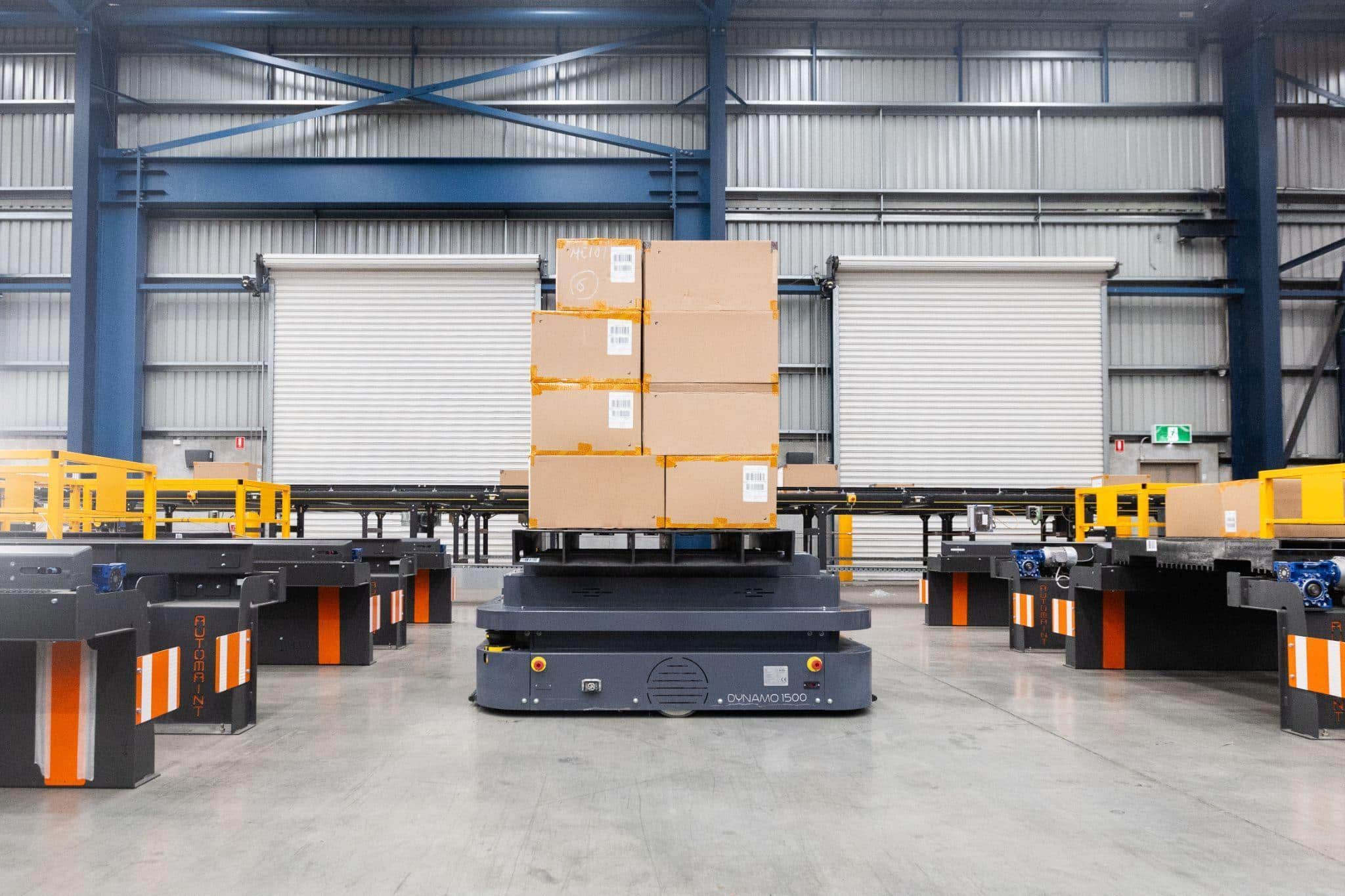
Addverb
Addverb develops advanced autonomous mobile robots designed for efficient internal material movement across warehouse environments in the USA. Addverb’s AMR, Dynamo, comes in multiple variants available, including Dynamo 2500. It is powered by natural navigation, ensuring efficient material movement of up to 2500 kgs.
Dynamo 2500 uses a 2D LiDAR object detection system and ensures a position accuracy of +/- 20 mm, along with precision docking of +/- 10 mm. Due to such characteristics, it moves safely around humans and objects, minimising risks while ensuring smooth operation and maximum accuracy.
Integration with warehouse management systems also adds to the benefits of operational control. Synchronisation between robots and warehouse systems guarantees minimal human interference, which increases efficiency within intralogistics operations in the USA.
Tompkins Robotics
Tompkins Robotics concentrates on AMR-based sortation solutions that rely on mobile robots to manage parcel movement and dynamic routing. Such systems are aimed at replacing fixed conveyor setups by employing more adaptable robotic solutions.
Through their tSort platform, the company allows robots to adapt to changes in the layout and order volume, thereby allowing for efficient fulfillment processes. This method has been employed extensively in the USA when it comes to distribution centers that demand flexibility and speed.
Such systems are ideal for high-capacity warehouses that require quick reconfigurations. With the minimisation of dependence on fixed infrastructure, they facilitate adaptive and more efficient warehouse management in the USA.
Seegrid
Seegrid develops autonomous mobile robots that mainly perform functions related to pallet movement and material transport. The machines are extensively employed in the USA for the enhancement of logistics operations within warehouses and manufacturing facilities.
The company employs vision-based navigation technology, enabling the robot to maneuver around shared areas without the need for any fixed infrastructure. This means that these robots can perform operations in dynamic environments such as warehouses, where both humans and machines work together.
In USA-based operations, such robots are used to standardise the movement of materials and ensure consistency in internal transport procedures. Consequently, greater efficiency is gained better operational continuity is ensured across facilities.
Maveneer
Maveneer is concerned with providing automation solutions whose main objective is the incorporation of autonomous mobile robots within warehouses. The company designs the technologies in order to enhance the internal movement of materials between the storage and processing areas.
At USA warehouses, such methods enable decreasing reliance on manually performing transportation activities and facilitate smoother coordination between different operational areas. Efficiency in the processes of moving materials is thus achieved.
By ensuring AMRs can integrate into operations, Maveneer ensures USA warehouses benefit from consistency in their operations and improve intralogistics performance.
Numina Group
Numina Group integrates autonomous mobile robots into warehouse execution systems to enhance order execution and internal logistics processes. The solutions provided by Numina are mainly oriented towards workflow management in regard to picking, batching, and transportation operations.
In the USA distribution centers, such systems assist in decreasing the time spent traveling as well as ensuring greater accuracy when completing order processing. AMRs are used to synchronise movement across warehouse operations, ensuring better coordination between tasks and systems.
This approach ensures greater efficiency in high-volume operations in the USA, where fast and precise movements are essential for fulfillment performance.
Conclusion
Autonomous mobile robot companies are changing how warehouses operate in the USA by facilitating adaptable material handling systems driven by software. Such technologies lead to reduced reliance on fixed infrastructure while improving speed, scalability, and operational efficiency.
Autonomous mobile robots are contributing to the improved throughput and minimisation of manual labor in the USA-based warehousing through providers such as Addverb, Tompkins Robotics, and Seegrid. In 2026, ecosystems featuring AMR solutions that are connected to the warehouse management system will still be at the heart of smart warehouse innovation and fulfillment performance.

