


Search has changed. Google AI Overviews, ChatGPT, and Gemini are increasingly answering questions directly and prioritizing sources they can interpret and understand with confidence. A Wix site without structured data gives search engines and AI systems fewer signals to understand its content, making it harder to earn visibility in modern search experiences.
Wix schema markup solves this by giving search engines and AI tools a machine-readable layer of context about every page. This article covers how it works, why it matters for AI search visibility, and how to implement it correctly.
- What Wix Schema Markup Actually Does in Search
- Why AI Search Makes Schema Markup Non-Negotiable for Wix Sites
- How Wix Schema Markup Boosts AI Search Visibility
- Rich Snippets That Drive More Clicks
- Getting Recommended by ChatGPT and Gemini
- Building Long-Term Authority Through the Knowledge Graph
- Schema Types That Improve AI Visibility on Wix
- Manual vs. Automated Schema on Wix
- Conclusion
- Frequently Asked Questions
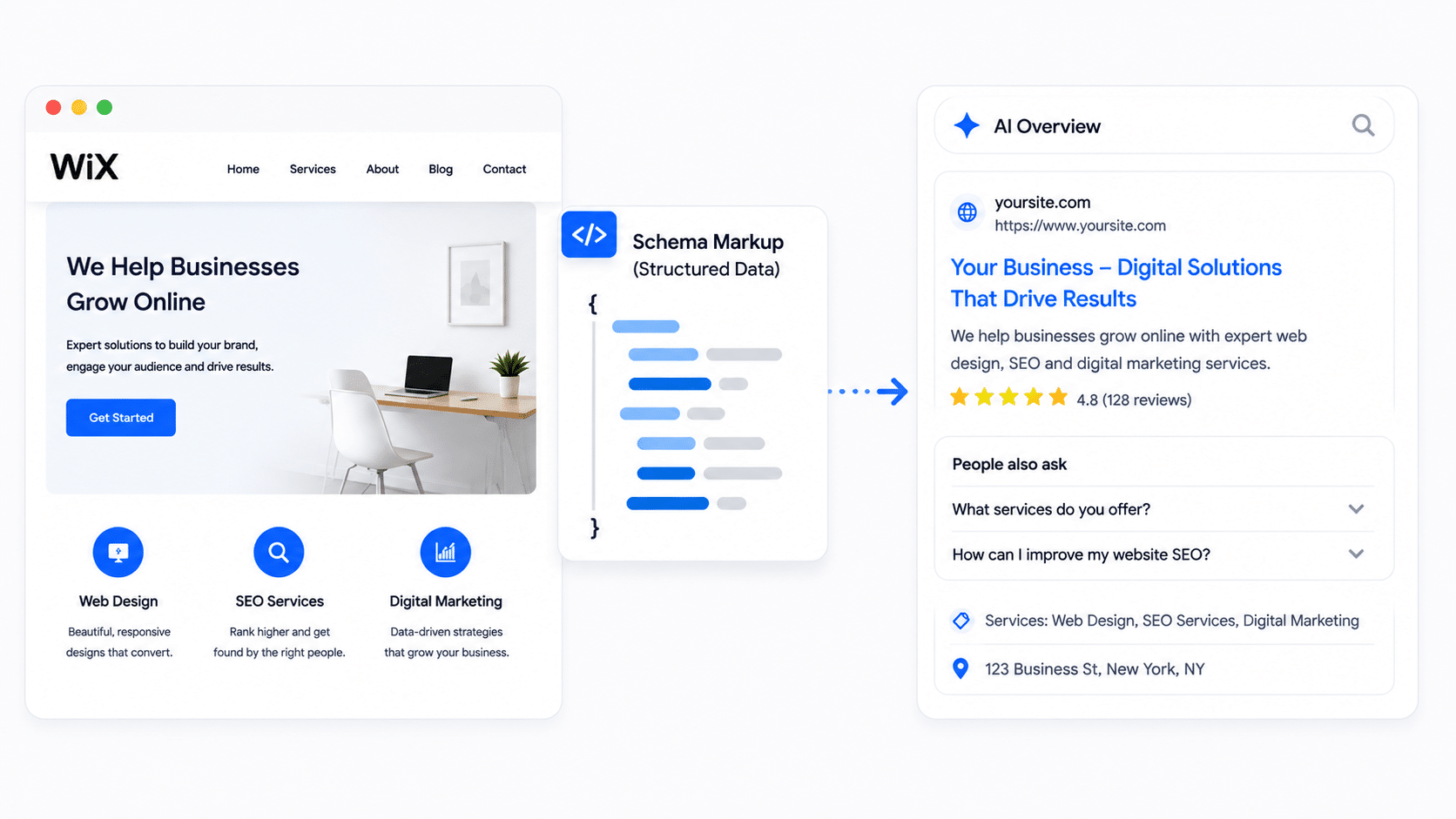
What Wix Schema Markup Actually Does in Search
Schema markup is a standardized vocabulary that adds machine-readable context to a webpage. Instead of leaving search engines and AI platforms to guess a page’s purpose, structured data tells them directly: this is a product, this is an FAQ, this is a local business.
On Wix, structured data is added in JSON-LD format either through Wix’s native SEO settings or a dedicated schema app. JSON-LD sits separately from the HTML, so it’s easier to manage and doesn’t break when page layouts change.
Here’s what a basic Organization schema looks like in JSON-LD:
{

  "@context": "https://schema.org",

  "@type": "Organization",

  "name": "Your Business Name",

  "url": "https://www.yourdomain.com",

  "logo": "https://www.yourdomain.com/logo.png",

  "contactPoint": {

    "@type": "ContactPoint",

    "telephone": "+1-800-000-0000",

    "contactType": "customer service"

  }

}
This doesn’t change how a page looks. It completely changes how search engines and AI tools understand it.
Why AI Search Makes Schema Markup Non-Negotiable for Wix Sites
Google AI Overviews now appear for over 13% of all searches, and that number keeps rising. ChatGPT and Perplexity are increasingly being used as discovery engines, not just Q&A tools.
AI search systems don’t crawl pages the way traditional bots do. They need to comprehend content, understanding entities, relationships, and intent at a deeper level. ChatGPT, Gemini, Perplexity, and Claude all actively process schema markup when accessing page content. Structured data has gone from an SEO enhancement to a prerequisite for AI visibility.
Most Wix sites still have incomplete or missing schema. Implementing it correctly now creates a real edge over competitors still relying on basic SEO signals alone.
How Wix Schema Markup Boosts AI Search Visibility
Rich Snippets That Drive More Clicks
The most visible benefit of schema is eligibility for rich snippets, enhanced SERP formats displaying star ratings, FAQs, pricing, and breadcrumbs directly in Google’s results. Rich snippets take up more space on the SERP, build trust before a click, and attract users with qualified intent.
Getting Recommended by ChatGPT and Gemini
Structured data gives AI platforms clean, machine-readable context about a page’s content and its relationship to other entities. This additional context helps AI systems better interpret a website’s content and relevance when generating responses.
When a Wix site has proper Organization, Service, Product, and FAQ schema in place, AI platforms can build a clear picture of what the business does and how authoritative it is. Without clear structured signals, smaller websites may find it harder to compete with larger, more established sources that already have strong authority and content coverage.
Building Long-Term Authority Through the Knowledge Graph
Schema markup connects a site’s pages, products, services, and brand into a structured network of entities that powers presence in Google’s Knowledge Graph. For Wix businesses, consistently implementing schema across the site signals that content is organized and credible. That authority builds over time and becomes increasingly difficult for competitors to replicate quickly.
Schema Types That Improve AI Visibility on Wix
- Organization schema: Establishes brand identity, builds Knowledge Graph
- Product schema: Enables pricing, availability, & rating-rich results
- FAQ schema: Provides structured answers that can improve search visibility and content understanding
- Local Business schema: Strengthens local search presence
- Article schema: Improves blog content indexing and classification
- Breadcrumb schema: Shows navigation path in SERP
- WebPage schema: Clarifies page intent for search engines
The goal is to match the schema to what the page is actually trying to do.
Manual vs. Automated Schema on Wix
Wix adds some default structured data automatically, but it’s often incomplete, missing critical properties like product pricing, review data, or FAQ content.
Manual JSON-LD through Wix’s code panel works for small, static sites, but requires manual updates when content changes. Using a schema markup generator that connects directly with Wix can simplify implementation by scanning content, generating JSON-LD markup, and helping maintain schema across multiple pages. For larger websites, automation often makes schema management significantly easier and more scalable.
After adding the schema, validate it using Google’s Rich Results Test to confirm the markup is detected, error-free, and eligible for enhanced search features.
Conclusion
Wix schema markup is now a core part of AI search visibility. It helps search engines classify content correctly, enables rich snippets that lift CTR, builds long-term Knowledge Graph authority, and gives AI tools the structured context they need to recommend a site in conversational answers. The gap between Wix sites with proper schema and those without is only going to widen as AI search continues to grow.
Frequently Asked Questions
Can Wix schema markup help a site appear in ChatGPT or Gemini answers?
Yes. Structured data helps AI systems understand a website’s content more clearly, which can improve how that content is interpreted across AI-powered search experiences.
How many schema types can be added per Wix page?
Wix’s native SEO settings allow up to five entries per page. A dedicated schema tool removes this restriction and covers the full site automatically.
Does schema markup slow down a Wix site?
No. JSON-LD is lightweight and loads separately from visual content. It has no impact on page speed or Core Web Vitals.
What is a schema markup generator?
A schema markup generator is a tool that automatically creates valid JSON-LD structured data based on a site’s content, no manual coding required. For Wix, it scans pages and applies the right schema types where they belong.
How long before the schema shows results in search?
Rich result eligibility can appear within days to weeks after Google recrawls updated pages. AI visibility and broader SEO gains build gradually as structured data is processed.

