


A factory buying new process equipment needs more than a collection of machines. It needs those machines to fit the available space, connect to existing services, and perform a defined job together. Sharp Eagle’s modular process skids bring equipment, piping, valves, instruments, and controls onto a structural frame, with much of the assembly and testing completed before shipment. Each system is developed around the customer’s process requirements and site conditions. The aim is to deliver a connected process unit with clear installation requirements, giving the customer less equipment to assemble piece by piece at the destination.
Starting With the Customer’s Process
The starting point is what the customer needs the system to do.
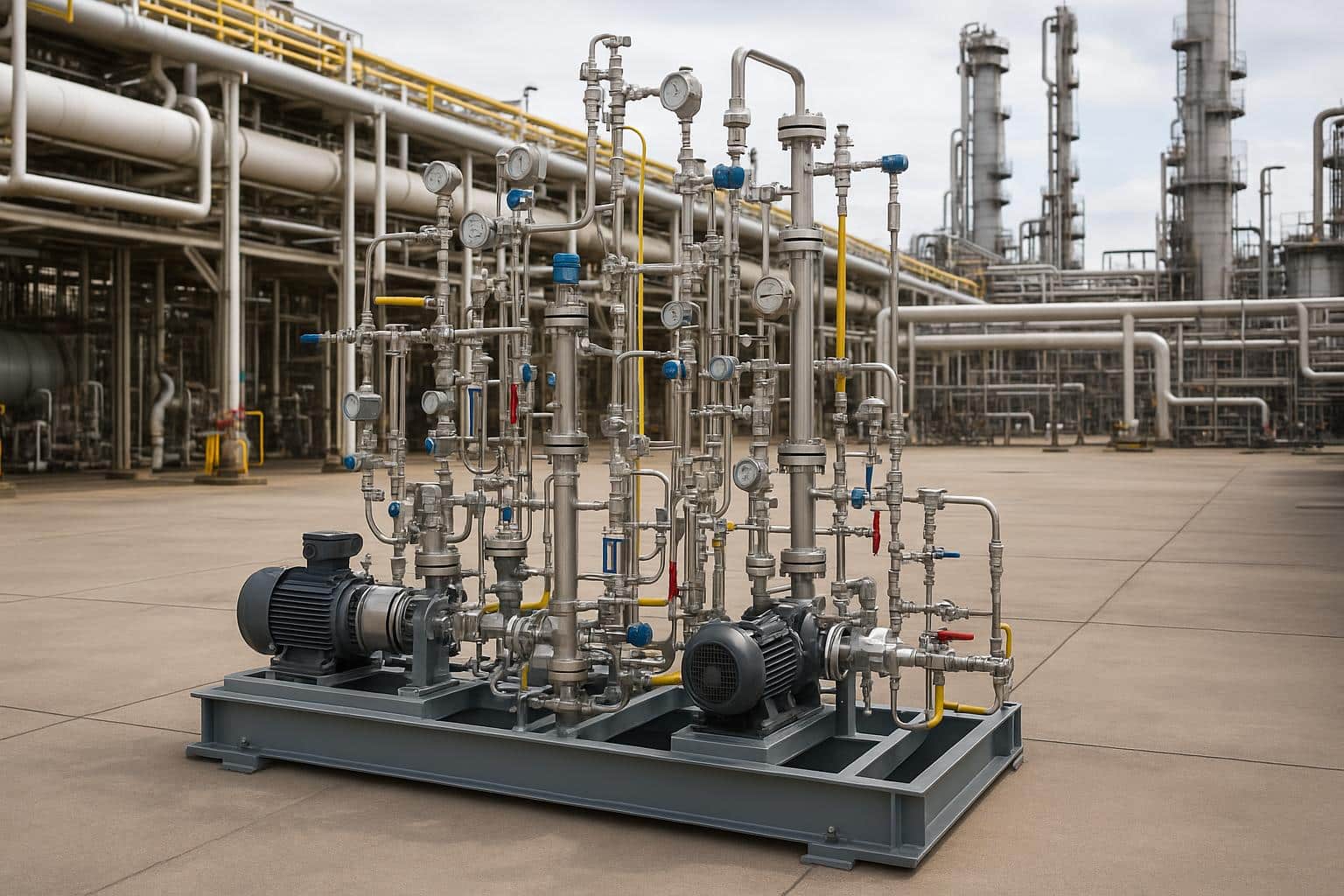
A heating project may need to transfer energy between two fluid circuits. A chemical pilot plant may need equipment that allows engineers to study a process under controlled conditions. A furnace feed system needs to deliver material through an arrangement of piping, valves, and instruments.
These applications require different equipment and layouts, even when all three are described as skids.
Sharp Eagle’s engineering work brings the process requirements together with practical information about the site: available floor space, height restrictions, connection locations, control requirements, and access for installation.
For projects based on a customer-supplied process package, the company develops the details needed for fabrication and integration. A process diagram shows how material should move through the system. Detailed engineering determines where the equipment sits, how it connects, and how people will operate it.
That distinction becomes important when a design moves from a drawing into a crowded production area.
Designing the Vessel and Its Surroundings Together
Some of the most important decisions concern the equipment inside the module. Sharp Eagle manufactures pressure vessels, including heat exchangers, reactors, towers, and tanks, with designs developed for the intended operating conditions.
These products perform different jobs. A heat exchanger transfers energy between fluids. A reactor provides the equipment in which a chemical reaction takes place. Other vessels may hold or separate process materials.
Their design depends on more than volume. The contents, pressure, temperature, corrosion conditions, and inspection requirements all influence the specification.
The surrounding layout matters too. A vessel’s pipe connections must line up with the planned piping routes. Instruments need suitable connection points. Openings intended for inspection or maintenance need usable clearance.
Because Sharp Eagle works on both vessel fabrication and skid integration, these decisions can be coordinated during engineering. The vessel can be reviewed as part of the assembled system, including the frame, piping, valves, and access around it.
For the customer, this helps address a common coordination problem: equipment that meets its own specification but is awkward to connect or service once installed.
A Geothermal Project Shows Why the Details Matter
Sharp Eagle’s published geothermal case describes a heat exchange skid supplied for a China Huaneng project in Zhengzhou.
The system uses supercritical carbon dioxide in a closed loop to collect heat from a geothermal well approximately 2,500 meters deep. At the surface, the skid transfers that heat to a separate residential heating-water circuit.
Sharp Eagle supplied the complete heat exchange skid for the project. The design involved 20 MPa-class pressure conditions within a module envelope measuring 10.2 meters long, 4 meters wide, and 4.4 meters high.
Inside that space, the team had to arrange the heat exchanger, high-pressure piping, valves, instruments, and structural supports while allowing for maintenance and transport.
The manufacturing work included thick-wall welding controls, inspection of key welds using radiographic or phased-array methods as required, and pressure and sealing checks.
This example gives a concrete meaning to customization. The equipment arrangement had to serve a particular heat-transfer process, pressure environment, and physical space.
Moving Repeated Assembly Work Into the Workshop
A separate Sharp Eagle project involved furnace feed skids for a high-purity polysilicon expansion. According to the company’s case study, dozens of modules were delivered within two months.
Each module combined static mixers, control valves, flowmeters, temperature and pressure instruments, protective devices, and process piping. Instrument cables, junction boxes, and air supply lines also had to be incorporated.
Assembling these parts individually at the destination would have created many separate installation tasks around the furnace systems.
Sharp Eagle completed welding, assembly, cleaning, and dimensional checks in the workshop. The modules were prepared with transportation, lifting, and final site connections in mind.
Cleanliness was a particular concern. Cutting and grinding around open piping can introduce dust and residue. Completing more fabrication and cleaning before delivery reduced the amount of that work required in the production area.
The reported two-month delivery applies to this project. Its broader lesson is how a defined module scope can shift a large amount of coordinated assembly away from the installation site.
Checking the Assembly Before It Leaves
A skid can look complete while still having details that need attention. Testing makes those details visible.
Sharp Eagle’s published skid delivery process includes factory acceptance testing, or FAT, with checks such as pressure testing, instrument loop checks, and functional verification.
These checks serve different purposes. Pressure testing examines the equipment under specified test conditions. A loop check verifies an instrument’s signal path. Functional testing checks whether equipment and controls respond as intended within the agreed test scope.
The customer and manufacturer need to agree on that scope before testing begins. Some operating conditions cannot be reproduced fully in a workshop and must be checked during site commissioning.
Clear test records allow the installation team to distinguish completed verification from the work that remains.
Connecting Engineering With Delivery
The service offered by sharp eagle spans engineering, procurement, fabrication, skid integration, testing, and installation and commissioning support. Its product lines also include pressure vessels and prefabricated process piping.
For a customer, the practical benefit is being able to discuss the connected assembly with a team whose work covers its major parts. A change to a vessel connection can be considered alongside piping, structural supports, instrumentation, and delivery arrangements.
The project still needs accurate input from the customer, including process conditions, site limits, interfaces, and acceptance requirements.
With those details established, Sharp Eagle can develop the equipment around its intended use. The customer receives a system whose components have been arranged, assembled, and checked together, with defined connections and remaining site tasks. That makes the route from equipment delivery to commissioning easier to plan.

