


The Children’s Place has filed for Chapter 11 protection and launched a court-supervised effort to sell substantially all of its assets, putting one of North America’s largest children’s-apparel chains on a compressed path toward a buyer or an alternative wind-down plan. The retailer says its stores and e-commerce sites remain open for now, but it has also said that some store closures will be necessary during the restructuring.
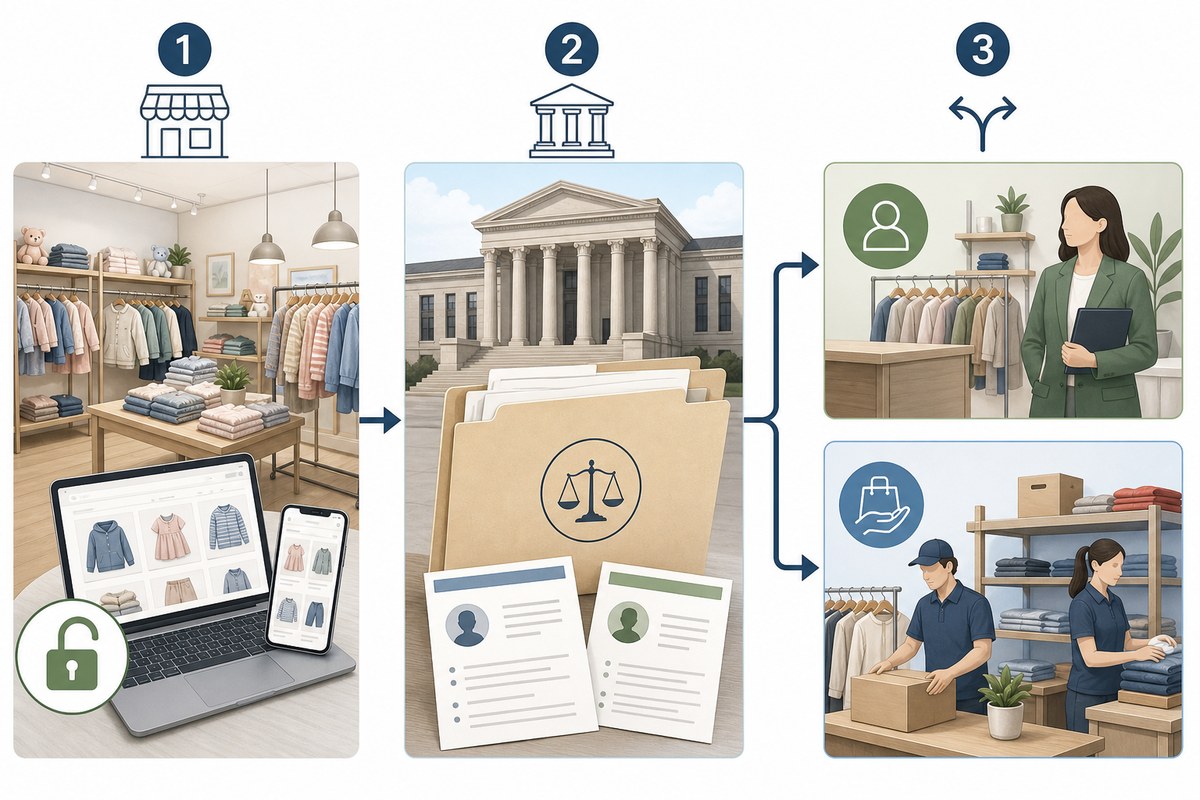
The company said it filed petitions in the U.S. Bankruptcy Court for the District of New Jersey on Nov. 8 and is pursuing a competitive sale under Section 363 of the Bankruptcy Code. It has requested prospective bids by Dec. 9 and expects to complete the process by the end of December. The timetable gives potential acquirers only weeks to evaluate a business that, according to CNBC, operates 514 North American stores, two digital storefronts and an international franchise and wholesale network spanning 13 countries.

Open now, but not a promise against closures
The company’s customer-facing message is narrower than an assurance that the full chain will continue unchanged. In its Chapter 11 announcement and FAQ, The Children’s Place said all locations and e-commerce sites are open at this time. In the same materials, it said certain store closures will be necessary as it evaluates its footprint. It did not identify locations or give a closure count.
That distinction frames the immediate consequences for shoppers, workers, landlords and suppliers. A going-concern buyer could preserve parts of the operating business, but no sale has been completed and the retailer says it must plan for the possibility that it does not obtain a transaction that continues the business. It has an agreement with GA Group to assist with ongoing store sales if a better alternative is not secured, according to the company.
The Children’s Place has asked the bankruptcy court to authorize customary early-case relief intended to support operations during the sale process, including continued employee wages and benefits, certain customer programs and payment for goods and services supplied after the filing date. It also said it expects to secure debtor-in-possession financing, subject to court approval. Such financing has not been described by the company as approved or finalized.
December sale schedule raises stakes
A Section 363 process is a bankruptcy-court-supervised mechanism for selling assets. Here, the company says the objective is to obtain the highest or otherwise best offer for substantially all of its assets. The requested Dec. 9 bid deadline and expected completion by year-end point to a rapid process, though both milestones remain subject to the court process and the company’s ability to obtain an acceptable transaction.
The retailer is also seeking recognition in Canada so Canadian assets and operations can be included in the sale process. That request matters because the chain’s commercial reach is broader than its U.S. store base: CNBC reported that its distribution includes franchise and wholesale partners in 13 countries.
The financial figures reported from the filing illustrate the challenge facing bidders and creditors. CNBC said the petitions listed roughly $742 million of assets and $881 million of debts. On those reported figures, debts exceed assets by about $139 million. Those are filing-based figures reported by CNBC, not a final valuation of what the business or its individual assets will fetch in a sale.
Sales pressure and leadership changes preceded filing
The bankruptcy follows a difficult period for a retailer exposed to discretionary family spending, promotional apparel competition and rapidly changing import costs. CNBC reported that net sales in the second fiscal quarter of 2026 fell nearly 19% from a year earlier. Management had cited lower conversion, a more clearance-heavy sales mix and unusually strong prior-year back-to-school demand that had been pulled forward ahead of anticipated tariff-related price increases.
CNBC also reported that tariff increases and slower consumer spending were among the pressures weighing on the company’s recent performance. Those factors are explanations cited in reporting and prior management commentary, rather than a court-established account of why the company entered Chapter 11.
Leadership changed shortly before the filing. Interim Chief Executive Muhammad Asif Seemab and Chief Strategy Officer Muhammad Umair stepped down days before the announcement while remaining on the board, CNBC reported. Chief Financial Officer John Szczepanski became acting president and principal executive officer.
For now, the company’s stated plan is to operate while bids are collected and reviewed. The practical outcome for its 514-store network will hinge on whether that process produces a buyer willing to continue the business before the year-end target—and on what the bankruptcy court approves along the way.

