


Self-employed workers have a unique tax burden because they pay both the employer and employee portions of Social Security and Medicare taxes—a 15.3% self-employment tax on top of regular income tax. The modern global salary calculator helps freelancers and independent contractors accurately estimate quarterly payments, maximize business deductions, and avoid
Underpayment penalties cost 40% of self-employed individuals $500-$1,200 annually.
- What’s the Difference Between Self-Employment Tax and Other Taxes?
- How Self-Employed Tax Calculators Handle Your Data
- Step 1: Income Input
- Step 2: Expense Deduction
- Step 3: Tax Calculation
- Step 4: Federal and State Tax Estimation
- Key Features of Effective Self-Employment Tax Calculators
- What are Retirement Contributions and Tax Credits?
- How Do Estimated Payments for Quarters Operate?
- Employee vs. Contractor Tax Implications Comparison
- Enhanced Features for Complex Situations
- Choosing the Right Tax Calculator
- Common Mistakes to Avoid
- Key Takeaways
- Best Salary Calculation Software for Enhanced Payroll Efficiency
- FAQs:
This article will explain how USA tax calculating applications and self-employed tax estimators, among other useful applications, can be used to make sense of your financial position.
What’s the Difference Between Self-Employment Tax and Other Taxes?
Self-employed workers contribute the employer and employee rates of social security tax and Medicare tax, which amount to 15.3% of net earnings. This self-employment tax is calculated in addition to computing your US income tax.
Here’s how it breaks down:
- 12.4% Social Security tax on the first $184,500 of net earnings as per 2026.
- 2.9% Medicare tax on all net earnings
- 0.9% Additional Medicare tax on earnings above $200,000 (single filers)
The traditional employees also share these costs with the employer, whereas the independent contractors bear all costs. This is automatically computed by a dedicated self-employment tax estimator based on the gross business income of the self-employed minus allowable deductions. Using these tools ensures that your estimated take-home pay remains accurate throughout the fiscal year.
How Self-Employed Tax Calculators Handle Your Data
Modern tax calculators use a systematic approach to accurately estimate your tax liability.
Step 1: Income Input
You just add your gross income altogether, which includes client payments, project fees, commission, and any type of side hustle, etc. The calculator isolates the 1099 income from other sources of revenue in order to provide suitable treatments of taxes.
Step 2: Expense Deduction
The system will make you enter business expenses that will lessen your taxable income.
Common deductions include:
- Home office deduction (actual or simplified method)
- Business mileage deductions at the 2026 IRS rate of 72.5 cents per mile.
- Self-employed people’s health insurance premiums.
- Expenses on professional development and education.
- Software, subscription services, and equipment.
- Marketing and advertising costs.
Step 3: Tax Calculation
The calculator approximates the amount of net earnings from self-employment by deducting business expenses from gross income. It goes ahead to apply the self-employment tax rate, in which it calculates your adjusted gross income after deducting the SE tax.
Step 4: Federal and State Tax Estimation
The system determines how much you owe to the federal government in the form of US income tax. You will also be taxed by the state and local taxes based on the area you work in, with a comprehensive net pay calculator for the USA, considering these rates are generally highly dissimilar across jurisdictions.
Key Features of Effective Self-Employment Tax Calculators
| Feature | Benefit | Why It Matters |
|---|---|---|
| Quarterly estimate calculator | Generates payment amounts for four quarters | Helps avoid underpayment penalties (typically 0.5% per month) |
| Deduction optimizer | Identifies all eligible business write-offs | Maximizes tax savings and reduces liability |
| Multi-state calculation | Handles income across different states | Critical for remote workers with clients nationwide |
| Schedule C integration | Mirrors IRS Form Schedule C | Simplifies actual tax filing preparation |
| Safe harbor calculation | Determines the minimum payment to avoid penalties | Protects against IRS penalties based on the previous year’s liability |
The IRS estimates that 40% of self-employed people underpay their quarterly taxes, which results in penalties that range from $500 to $1,200 per year. These preventable expenses are avoided by using an accurate estimated tax calculator.
What are Retirement Contributions and Tax Credits?
High-end calculators have retirement contribution calculations that give instant tax breaks. Contributions to self-employed persons can be deductible for
- SEP IRA (up to 25% of net earnings, maximum of $72,000 in 2026)
- Solo 401(k) plans (up to $72,000 total; $80,000 if age 50+)
- Traditional or Roth IRA ($7,500 limit; $8,600 if age 50+)
- SIMPLE IRA arrangements
Such contributions diminish your income on taxation and create retirement security. Depending on your bracket, a contribution to the SEP IRA of $10,000 would save you $2,200-$3,700 in taxes.
Tax credit calculators are also able to locate valuable credits such as the earned income tax credit, child tax credit, and small business credits, which have a direct dollar-period financial reduction of your taxes.
How Do Estimated Payments for Quarters Operate?
The individuals who work self-employed have to pay taxes every quarter with the help of Form 1040-ES. The quarterly tax calculator calculates the payment amount of:
- April (Q1: January-March income)
- June 15 (Q2: April-May earnings)
- September 15 (Q3: June-August profits)
- January 15 (Q4: September-December profits)
Employee vs. Contractor Tax Implications Comparison
There is a huge shift of many workers between W-2 employment and 1099 contract employment. Knowing the financial consequences is useful in career choices.
W-2 Employee Benefits:
- The employer pays half of the FICA tax (7.65%).
- Automatic tax withholding
- The benefits of potential employers (health insurance, 401k matching)
1099 Contractor Advantages:
- Large deduction possibilities in the business.
- They have the possibility of increased gross rates.
- Tax flexibility in timing and planning.
In comparison to what they would have earned as employees, 20-30% more gross income is required of contractors to be able to afford exactly what they would have taken home as employees, based on covering other taxes and benefits, a W-2 vs 1099 calculator indicates.
Enhanced Features for Complex Situations
Complex taxpayers are provided with advanced tax calculators that deal with:
- Multiplier: Adds freelance, rental, and investment dividends and side hustles to do extensive tax planning.
- Business Structure Comparison: Finds the best structure to exist and operate in: compares tax implications of being a sole proprietor, LLC, S-corp, or C-corp.
- Profit and Loss Integration: Will be linked to the accounting software, such as QuickBooks, to automatically import the data on revenue and expenses to ensure accuracy.
- Cash Flow Tax Impact: Estimates the way quarterly tax payments impact your monthly cash flow and, therefore, allows you to use it to budget accordingly throughout the year.
Choosing the Right Tax Calculator
Find calculators that provide:
- Live billing updates on the up-to-date law and tax rates.
- On-the-go calculations and mobile availability.
- Encryption of sensitive financial information.
- Complex situations require expert assistance or advice.
- Record-keeping capabilities and tax professional consultation options.
- Report generation for tax filing preparation.
The best is like Salary-Calculator.ai, which offers specialized tools to self-employed workers worldwide and calculates taxes specific to each country and tax system. Their cross-border pay model allows international freelancers to realize how they will be taxed in different jurisdictions and what their final take-home pay will look like after all obligations.
Common Mistakes to Avoid
Some of these calculation errors are often made by self-employed workers:
- Failure to consider the self-employment tax (the extra 15.3%).
- Ignoring state and local tax obligations.
- Making underestimates on payments in quarters and receiving penalties.
- Losing such perks as health insurance and contributions toward retirement.
- Not tracking the expenses of the business on an annual basis.
The quality tax calculators avoid these errors by checking them in-built and with supporting prompts for extensive inputs.
Key Takeaways
- Self-employed workers pay 15.3% self-employment tax in addition to normal US income tax, and they need special calculators to estimate the amount.
- Estimated payments to be paid quarterly eliminate penalties of an average of $500-$1,200 that 40% of independent contractors have to pay within one year.
- Deductions of business expenses save a big amount of tax—track home office, mileage, health insurance, and equipment costs religiously.
- Calculate with finders combining the payment of retirement and tax credit to thrive with your financial plan.
- Check your actual tax filing against W-2 employment to make sure that additional requirements are sufficiently covered on the side of your contractor.
Best Salary Calculation Software for Enhanced Payroll Efficiency
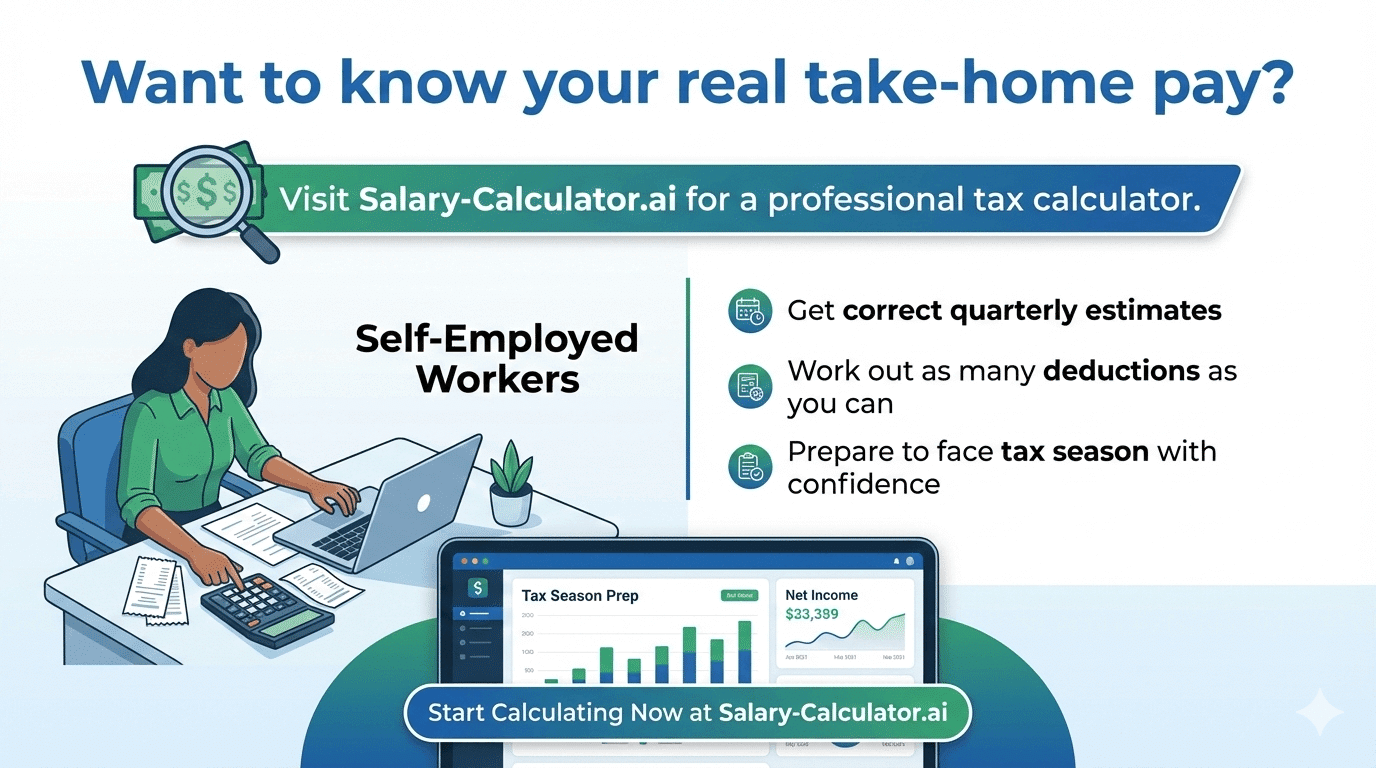
Want to know your real take-home pay? Use Salary-Calculator.ai as a net salary calculator USA to find a professional tax calculator to use with self-employed workers. Get correct quarterly estimates, work out as many deductions as you can, and prepare to face tax season.
FAQs:
Q1: What is a self-employed tax calculator?
A self-employed tax calculator assists you in estimating your tax, which includes self-employment tax, business tax deductions, and a quarterly tax payment.
Q2: How can I estimate my quarterly taxes as a freelancer?
A quarterly tax calculator will help estimate your quarterly tax payments depending on your freelance income.
Q3: What are the key deductions available for self-employed individuals?
The self-employed may deduct business expenses, home office expenses, mileage, and health insurance payments.
Q4: How do I calculate my net income from self-employment?
Enter your gross income as the net salary calculator USA or self-employed income tax estimator to calculate the difference between personal expenses and taxes and your income earned in business.
