


Every so often a handheld shows up with a hardware quirk so bold you can’t look away. The Pocket Super Knob 5000 from GameMT fits the bill, swapping the traditional right thumbstick for a twistable knob that appears to govern performance modes at a glance. It’s an unapologetically odd idea, but in a category where usability lives or dies on controls and quick tweaks, the concept just might make sense.
Early promo materials shared by the Retro Gaming With Deadfred account on X point to a compact Android device with a 5-inch 1080p display, a Hall effect left stick to fight drift, and MediaTek’s Helio G85 under the hood. The specs signal a budget-minded machine, but the execution around that prominent dial is what sets it apart.
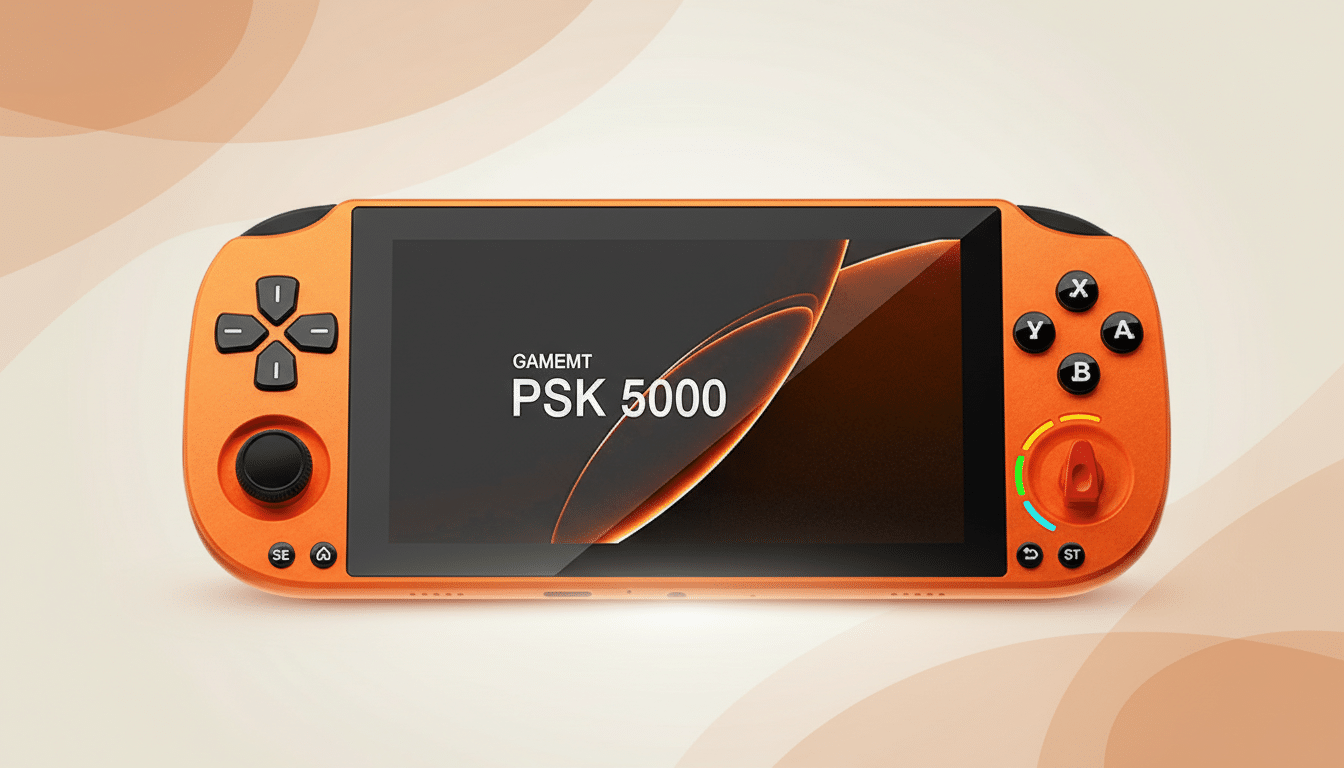
What the Knob Actually Does on This Handheld
Despite appearances, this isn’t a whimsical game crank. The knob’s ring of four LEDs suggests it functions as a physical selector for power profiles, much like the performance toggles on Windows handhelds or the quick access performance menu on Steam Deck—only faster and more tactile. Turn, click, and the device likely shifts CPU/GPU frequencies, thermal limits, and maybe display refresh in one motion, without diving into a software overlay.
That kind of immediate control solves a real handheld pain point. On Android, hopping between retro emulation, cloud streaming, and native titles often means bouncing through menus to balance heat, frame rate, and battery drain. A hardware dial that locks into four distinct modes could make those trade-offs obvious and repeatable. Valve’s documentation on Steam Deck’s performance menu and ASUS’s quick modes on gaming phones show there’s demand for instant tuning; GameMT is just literalizing it with a knob.
Specs and Real-World Expectations for Performance
The Helio G85 is an older 12nm SoC with two Cortex-A75 cores alongside six Cortex-A55 cores and a Mali-G52 MC2 GPU. It’s been a staple of budget smartphones like the Redmi Note 9 and is broadly comparable to Snapdragon 665–tier devices for graphics throughput. Translation for handheld gaming: 8- and 16-bit libraries are trivial, PlayStation and many N64 titles are very comfortable, and a healthy slice of Dreamcast and PSP at 1x resolution should be in reach. GameCube and PS2 emulation will be a stretch, and native Android 3D games will benefit from modest settings.
The 5-inch 1080p panel (roughly 440ppi) promises crisp text and retro pixels, though it’s likely overkill for the GPU. Smart scaling to 720p or per-app resolution caps would be smart defaults in lower power modes. Hall effect sensing on the left stick is a welcome touch—manufacturers from GuliKit to 8BitDo have popularized this tech because it resists drift by design, extending controller life and consistency.
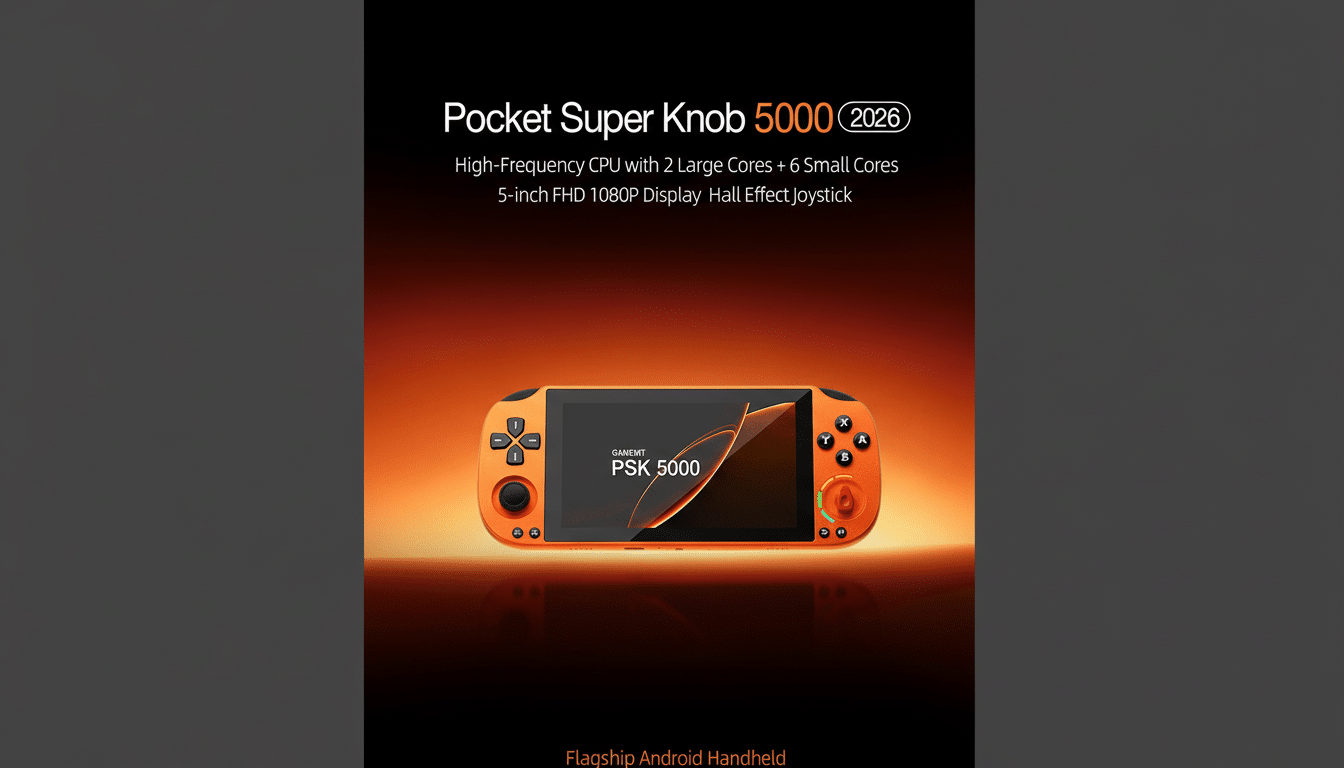
If the dial really snaps between four profiles, expect something like a battery saver mode for streaming and 2D, a balanced profile for light 3D, a performance mode for heavier emulation, and a top profile that accepts more heat and draw. On devices with comparable silicon, moving from a conservative governor to an aggressive one can swing sustained frame rates by double digits, at the cost of temperature and runtime. Even without exact figures, the physics are clear: quick, repeatable power discipline is the difference between an hour-long subway session and cutting it short at 20%.
Why a Knob Might Actually Help on a Handheld
Tactility matters. A physical dial invites experimentation in a way that nested menus don’t. Twist to high, see a game jump to a steadier 60fps; twist back when the chassis warms up or battery anxiety creeps in. For accessibility, the detents and LEDs can be easier to track than a tiny on-screen slider. And if GameMT pairs each position with clear, systemwide presets—governor, GPU clocks, resolution cap, and maybe even brightness—players can build muscle memory around their library.
Price and Availability for GameMT’s New Handheld
Launch timing is teased for April, with pricing still under wraps. Given the aging SoC and compact 1080p panel, a competitive target would land in the entry tier populated by Android handhelds like the Retroid and Anbernic families—historically in the $120 to $180 band depending on storage and materials. If GameMT hits that neighborhood, the device becomes less about raw power and more about how well the dial-led UX works in daily use.
Open Questions Before It Ships to Early Buyers
The big unknown is whether the knob can double as in-game input; early signals suggest no, which keeps it firmly in the system control lane. We also don’t yet have battery capacity, thermal design details, or confirmation of software polish—key factors that separate a fun concept from a dependable commuter companion. Long-term support matters too: firmware updates, driver tuning, and per-game profiles can squeeze surprising gains from modest hardware, as seen with community-driven improvements on popular retro handhelds.
Still, credit where it’s due. In a market crowded with minor spec bumps and familiar layouts, a simple mechanical idea—a big, obvious dial—could make this pocketable oddball more practical than its name suggests. If GameMT nails the presets and keeps the price humble, the Pocket Super Knob 5000 might turn a gimmick into a genuinely helpful control.
