


Language barriers have always been a challenge for global communication. Whether people are communicating across countries, creating multilingual content, or managing international business, the need for fast and reliable translation continues to grow. Traditional translation methods can be time-consuming, while basic machine translation often struggles with context, tone, and specialized terminology.
A free AI translator provides a more accessible way to translate text instantly by using artificial intelligence to understand language patterns, sentence meaning, and user intent. However, as AI technology continues to develop, translation is no longer only about converting words from one language to another. Modern AI translation focuses on producing more natural, accurate, and context-aware results that better match real communication needs.
- What Is a Free AI Translator?
- How AI Translators Work and Why Context Matters
- How MixTranslate Uses Multi-Model AI to Improve Translation Quality
- Multi-Model Translation Comparison
- Tone and Style Customization
- Glossary and Terminology Management
- Translation Quality Evaluation
- How to Use a Free AI Translator with MixTranslate
- Step 1: Enter the Content You Want to Translate
- Step 2: Choose the Source and Target Languages
- Step 3: Select an AI Model or Translation Engine
- Step 4: Review Translation Results and Choose the Best Version
- Step 5: Customize and Improve the Final Translation
- Where Free AI Translators Are Most Useful
- Conclusion: Free AI Translators Are Becoming Smarter Communication Tools

What Is a Free AI Translator?
A free AI translator is an online tool that uses artificial intelligence to translate content between different languages. Unlike traditional translation systems that rely mainly on predefined rules or direct word conversion, AI-powered translators use advanced language models to analyze the meaning behind text and generate more natural translations.
Most free AI translators support common translation tasks, including:
- Text translation
- Document translation
- Image text translation
- Multiple language conversion
- Real-time language assistance
For everyday users, these tools make multilingual communication easier by removing the need for manual translation or expensive professional services. A student can translate learning materials, a traveler can understand foreign content, and a business user can quickly communicate with international partners.
Beyond convenience, AI translation has become more valuable because modern users expect more than literal translations. They need translations that maintain the original meaning, match the intended tone, and adapt to different situations.
How AI Translators Work and Why Context Matters
The biggest difference between modern AI translation and traditional approaches is the ability to understand context.
A simple translation system may focus on individual words and phrases. However, language is not just a collection of words. Meaning often depends on:
- The surrounding sentences
- The purpose of the content
- The target audience
- Cultural and industry-specific expressions
AI translators analyze broader language patterns to determine what a sentence actually means before generating a translation.
For example, a business email requires a different style from a casual message between friends. A marketing slogan needs persuasive wording, while a technical document requires precise terminology. A high-quality AI translator must understand these differences to create suitable results.
This is why context awareness has become one of the most important factors in AI translation quality. The goal is not simply to produce a grammatically correct sentence but to create communication that feels natural to the target audience.
How MixTranslate Uses Multi-Model AI to Improve Translation Quality
As AI translation technology evolves, platforms are moving beyond simple translation tools toward more intelligent workflows. Instead of depending on only one AI system, newer approaches combine multiple AI models to analyze and improve translation results.
MixTranslate is an AI-powered translation platform designed around this multi-model approach. It allows users to access different AI models within a single workspace, helping them compare translation results and choose more suitable outputs based on their specific needs.
One of the key advantages of this approach is that different AI models may have different strengths. Some may perform better with certain language combinations, writing styles, or specialized content. By using multiple AI models together, users can gain more perspectives and improve the overall quality of their translations.
MixTranslate also introduces an AI agent-based workflow that helps simplify the translation process. Instead of manually switching between different AI tools, users can generate translations, evaluate results, and optimize content within one platform.
The platform provides features designed for both everyday and professional translation needs, including:
Multi-Model Translation Comparison
Users can compare different AI-generated translations and evaluate which version best fits their purpose.
This is especially useful for content where wording matters, such as:
- Marketing materials
- Professional communication
- Website content
- Product descriptions
Tone and Style Customization
A translation should match its purpose. MixTranslate helps users adapt translations for different communication scenarios by considering tone and style requirements.
Examples include:
- Formal business writing
- Friendly customer messages
- Creative marketing content
- Professional documents
Glossary and Terminology Management
For businesses and content teams, consistency is essential. Product names, technical terms, and brand language need to remain accurate across different languages.
Glossary management helps maintain consistent terminology, making AI translation more suitable for professional workflows.
Translation Quality Evaluation
Rather than simply accepting the first translation result, users can review translation quality based on factors such as:
- Accuracy
- Fluency
- Context understanding
This provides greater control over the final translation output.
How to Use a Free AI Translator with MixTranslate
Using an AI translator is usually simple, but choosing the right workflow can significantly improve translation quality. MixTranslate simplifies the process by allowing users to enter content once, select translation options, compare AI-generated results, and choose the version that best matches their needs.
Step 1: Enter the Content You Want to Translate
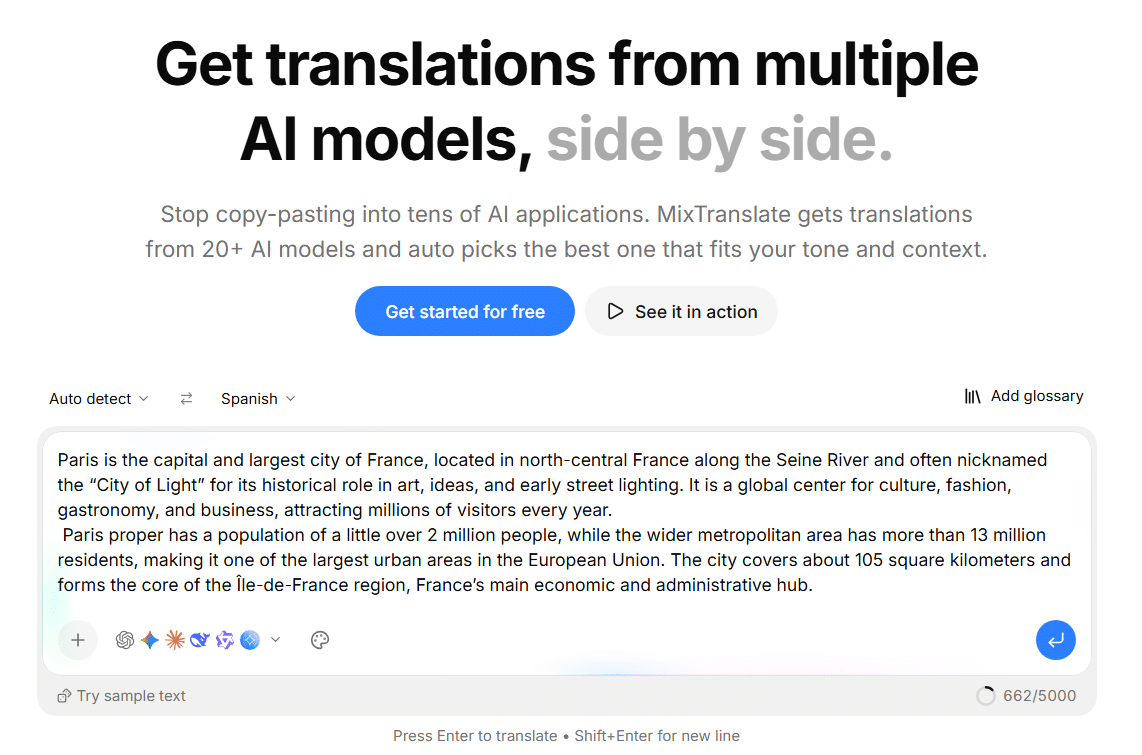
Start by adding the text you need to translate into MixTranslate.
Users can:
- Paste text directly into the translation box.
- Add content for different translation scenarios.
- Use automatic language detection or select the source language manually.
MixTranslate supports translation across 150+ languages, making it suitable for everything from short messages to longer professional content.
Step 2: Choose the Source and Target Languages

After entering the content, select the languages for translation.
Users can define:
- The original language.
- The target language.
- The preferred translation direction.
For example, users can translate English content into Spanish, French, Japanese, or other supported languages depending on their communication needs.
Step 3: Select an AI Model or Translation Engine

One of MixTranslate’s main advantages is its multi-model AI approach.
Instead of relying on only one translation engine, users can choose from multiple AI models and translation providers available within the platform. This allows users to explore different translation outputs and select the one that best fits their purpose.
Different translation tasks may require different priorities:
- Marketing content may need more natural and creative wording.
- Technical documents may require higher terminology accuracy.
- Business communication may require a more professional tone.
Step 4: Review Translation Results and Choose the Best Version

After translation is completed, users can review the generated results and compare different outputs.
MixTranslate provides quality indicators that help users evaluate translations based on factors such as:
- Accuracy
- Fluency
- Context suitability
Instead of manually testing multiple translation tools, users can compare results in one place and select the version that best matches their communication goals.
Step 5: Customize and Improve the Final Translation

For more professional translation tasks, users can further refine their results by adjusting style requirements, terminology preferences, or glossary settings.
This is especially useful for:
- Brand content
- Product descriptions
- Technical materials
- International business communication
By combining multiple AI models with customization options, MixTranslate helps transform translation from a simple conversion task into a more controlled and efficient workflow.
Where Free AI Translators Are Most Useful
AI translation tools are becoming valuable across many areas of daily and professional communication.
Everyday Communication
For personal users, free AI translators can help with:
- Travel conversations
- Language learning
- Understanding foreign websites
- Translating personal messages
For example, travelers and language learners may use a Spanish translator to quickly understand conversations, menus, travel information, or everyday content when communicating in Spanish-speaking regions. These applications make cross-language communication more accessible and convenient.
Business Communication
Companies operating internationally often need quick and reliable translation for:
- Emails
- Customer support messages
- Internal communication
- Business documents
AI translators help teams communicate more efficiently across different markets.
Content Creation and Localization
Creators and businesses producing global content can use AI translation for:
- Blog articles
- Social media posts
- Website localization
- Marketing campaigns
Maintaining the right tone and meaning is especially important when adapting content for international audiences.
Professional Documents
Researchers, developers, and professionals may use AI translation for:
- Reports
- Technical documents
- Reference materials
- Industry-specific content
In these cases, accuracy and terminology consistency become essential.
Conclusion: Free AI Translators Are Becoming Smarter Communication Tools
Free AI translators have transformed multilingual communication by making fast translation available to everyone. However, the future of AI translation is not only about speed. Users increasingly need tools that understand context, maintain tone, and deliver more reliable results.
Multi-model AI represents a new direction for translation technology by combining different AI capabilities and improving the overall translation workflow. Platforms like MixTranslate demonstrate how AI translation is evolving from a simple conversion tool into a smarter assistant that helps users create clearer, more natural, and more effective multilingual communication.
As AI continues to advance, translation will become less about overcoming language barriers and more about enabling meaningful connections across languages and cultures.

