


V-Bucks are getting more expensive in Fortnite, with Epic Games confirming that core currency bundles will deliver fewer V-Bucks for the same cash outlay and that several in-game rewards are being adjusted. The company attributed the move to higher operating costs for running the free-to-play ecosystem, a rationale that mirrors broader price pressure across the games industry.
How V-Bucks pricing is changing across bundles and micro-purchases
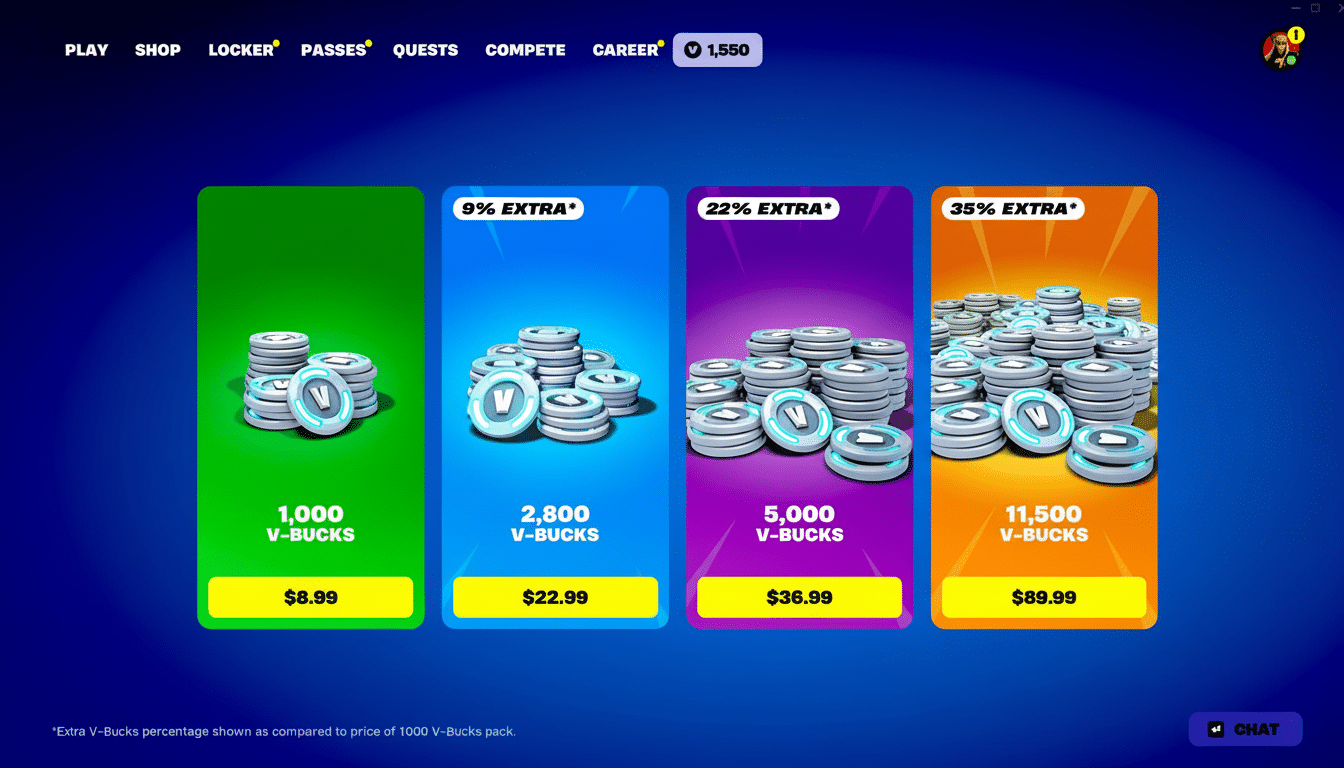
The headline shift is straightforward: the $8.99 bundle that previously granted 1,000 V-Bucks will now include 800. That lifts the effective price per V-Buck from about $0.00899 to roughly $0.01124—an increase of about 25%.

Other packs are being trimmed too. The $22.99 tier moves from 2,800 to 2,400 V-Bucks (about a 16.7% reduction), $36.99 goes from 5,000 to 4,500 (down 10%), and $89.99 drops from 13,500 to 12,500 (down about 7.4%). The takeaway is clear: buying bigger bundles still yields the best rate, but the discount curve is flatter across the board.
Epic also noted that smaller, exact-amount purchases will cost more on a per-unit basis, with the 50 V-Buck increments moving from $0.50 to $0.99. That nearly doubles the micro top-up price, making ad hoc purchases less economical than bulk buys.
Battle Pass and Fortnite Crew adjustments
Not every number is moving upward. The flagship Battle Pass price is dropping from 1,000 to 800 V-Bucks, and the OG Pass follows suit. The LEGO and Music passes fall from 1,400 to 1,200 V-Bucks. The Battle Bundle, which pairs the Battle Pass with a 25-level boost, decreases from 2,800 to 2,600 V-Bucks.
However, the value loop changes significantly. Completing the Battle Pass previously yielded 1,000 V-Bucks, plus 500 more via Bonus Rewards—enough to fund the next season and still leave a 500-V-Buck cushion. Going forward, a completed Battle Pass pays out 800 total V-Bucks, and the Bonus Rewards V-Bucks are being removed. Players can still earn the next season’s pass through play, but there will be no leftover currency to spend on cosmetics unless they top up.
Fortnite Crew remains $11.99 per month, but its monthly V-Bucks stipend is being trimmed from 1,000 to 800. The subscription’s price stays flat while its currency benefit aligns with the new Battle Pass economics.
What these V-Bucks changes mean for your wallet
These shifts ripple through everyday purchases. Consider a popular 1,500-V-Buck outfit: under the old $8.99-for-1,000 rate, that skin effectively cost about $13.49 if funded from base-tier bundles; under the new 800-for-$8.99 rate, the same item trends closer to $16.86. Larger bundles remain more efficient, but the relative gap has narrowed.
The new Battle Pass math also removes the “evergreen” surplus. Before, diligent players could roll their earnings forward and gradually amass a small reserve for shop items. Now, completing the Battle Pass only pays for the next pass—nothing extra—making discretionary cosmetics more likely to require fresh purchases.
It’s worth reiterating that Fortnite’s shop items are cosmetic-only. Skins, emotes, back bling, and wraps don’t affect competitive balance, a design choice that keeps gameplay fair even as prices move.
Why Epic says Fortnite prices are rising right now
Epic frames the change as a response to increased costs for operating Fortnite—everything from servers and bandwidth to development and support. That aligns with trends seen across gaming: platform subscriptions like PlayStation Plus saw double-digit hikes in recent years, and publishers across PC and console have raised or restructured prices as inflation and production costs squeezed margins. While consumer inflation has cooled from peak pandemic-era levels according to the U.S. Bureau of Labor Statistics, many digital services continue to recalibrate pricing as long-term expenses settle higher than pre-pandemic baselines.
For free-to-play ecosystems, where ongoing live ops and frequent content drops are the product, small currency tweaks are a common lever. Epic’s approach—lowering pass prices while reducing payouts and trimming bundle value—suggests a push to keep engagement loops intact while nudging net spending upward.
Gift cards and practical notes for current players
Players holding physical or digital Fortnite gift cards won’t lose value: Epic says existing cards can still be redeemed for the amount of V-Bucks printed on the card. That effectively grandfathered older stock at the expected rate.
If you plan to buy cosmetics regularly, the calculus is simple: avoid small top-ups where possible, favor larger bundles for the best (now modestly reduced) rate, and remember that completing the Battle Pass no longer builds a surplus. In a tightened economy for virtual currencies, smart timing and bundle selection will stretch your V-Bucks a little further.

