The full U.S. Court of Appeals for the Fifth Circuit has upheld an injunction barring federal enforcement of the Pregnant Workers Fairness Act against Texas and its state agencies, concluding that House members voting by proxy could not be counted as present for the Constitution’s quorum requirement. The 9-8 en banc decision, issued Nov. 20 in State of Texas v. Blanche, gives Texas a narrow but consequential victory over a federal workplace law enacted in the 2023 spending package.
The immediate order does not erase the Consolidated Appropriations Act of 2023, invalidate the Pregnant Workers Fairness Act nationally or automatically exempt Texas private employers from the law. But the court’s constitutional reasoning creates a new appellate precedent that challengers may try to deploy against other provisions adopted while the House used pandemic-era proxy-voting procedures. Bloomberg Law’s account of the decision reported that Judge Cory Wilson wrote for the majority and that Judge James Graves Jr. dissented.

A Texas-specific injunction, not a nationwide repeal
Texas challenged the Pregnant Workers Fairness Act, a measure requiring covered employers to provide reasonable accommodations for known limitations related to pregnancy, childbirth or related medical conditions absent undue hardship. The law was included in the broad appropriations measure Congress passed in December 2022.
A federal district judge ruled for Texas in 2024 and blocked enforcement of the law against the state. An intervening Fifth Circuit panel outcome was vacated after the full court agreed to rehear the dispute. The en banc court’s Nov. 20 ruling preserves the injunction.
The practical result is confined to Texas and its agencies under the reported injunction. That boundary is important for employers: the ruling, as described in the available court coverage, does not suspend federal pregnancy-accommodation obligations across Texas’s private sector, nor does it bind employers outside the state. Enforcement questions beyond the governmental parties covered by the injunction would require separate legal proceedings or further clarification from a court.
The majority also limited its judgment to the disputed provision rather than declaring the entire appropriations statute void. That is a materially narrower remedy than descriptions suggesting that a $1.7 trillion spending package was wiped away. The court’s holding concerns the enforceability of the pregnancy-workplace provision against this plaintiff, not every appropriation and policy measure contained in the legislation.
How proxy voting became a quorum dispute
The House adopted temporary proxy-voting procedures in May 2020 as lawmakers sought to maintain operations during the COVID-19 pandemic. Under the procedure, an absent member could authorize another representative to cast a vote on the member’s behalf. The House employed the system through the period in which it passed the 2023 appropriations measure.
The constitutional issue is distinct from whether proxy voting was authorized by House rules. Article I requires a majority of each chamber to constitute a quorum for doing business, while also allowing each chamber to determine its rules of proceedings. The Fifth Circuit majority read the word “present” in the quorum requirement to demand members’ physical presence; a proxy, in its view, could communicate a member’s vote but could not supply the member’s presence.
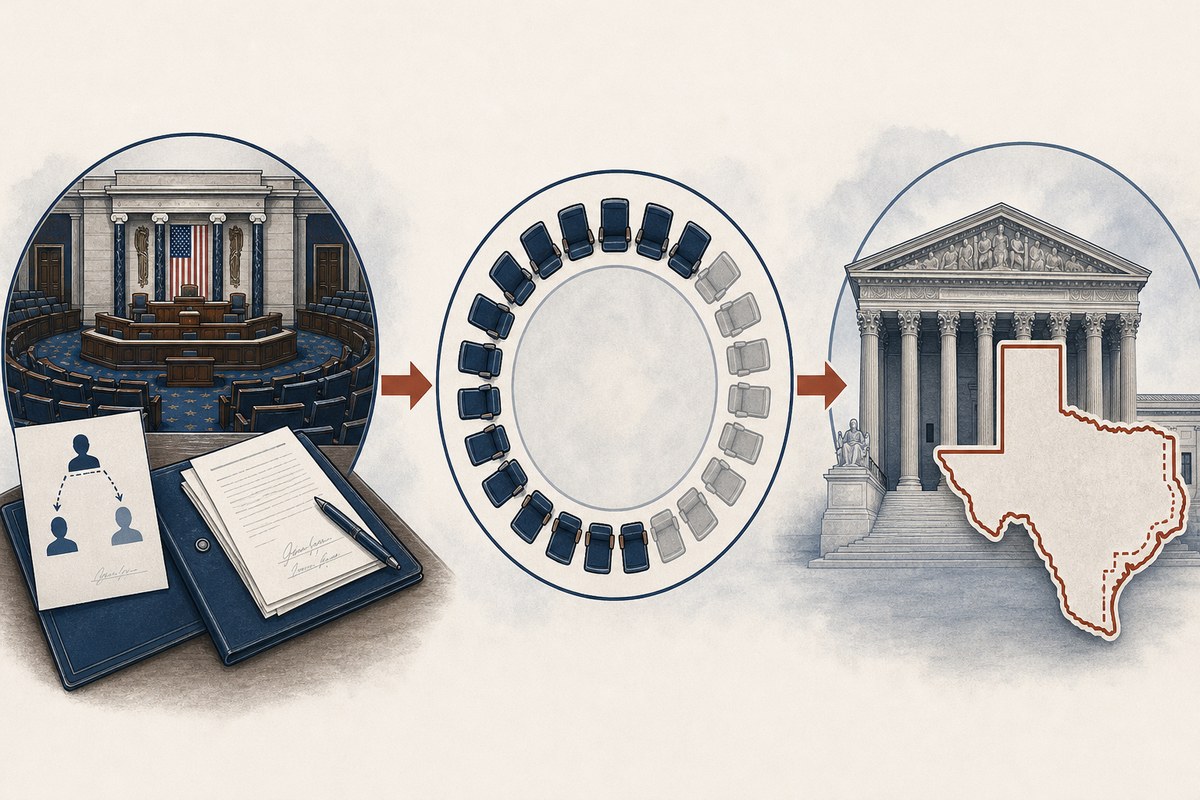
Graves’s dissent took the opposing institutional view, disputing the majority’s physical-presence reading and questioning why the remedy should stop at one provision if the enactment process itself was constitutionally defective. The split exposes the case’s larger stakes: it is not simply a fight over one employment mandate, but over the degree to which courts may revisit a chamber’s chosen procedures after legislation has become law.
Potential spillover is a litigation theory
Because the appropriations act carried many unrelated measures, the decision has attracted attention well beyond employment law. Election-law professor Rick Hasen, writing on Election Law Blog, identified the Electoral Count Reform and Presidential Transition Improvement Act as a potentially significant provision that could face challenges under the Fifth Circuit’s logic.
That possibility should not be mistaken for an existing ruling on the Electoral Count Reform Act or any other provision. A challenger would still need an appropriate lawsuit, standing, a court willing to apply the Fifth Circuit’s reasoning to the particular statute, and a remedy. Courts could also confront questions that were not resolved by the Texas case, including who may seek relief and whether a claimed defect in the House’s quorum process warrants setting aside a distinct statutory provision.
Those hurdles help explain the gap between the immediate effect and the decision’s broader strategic importance. For now, the most concrete commercial and regulatory consequence is a constraint on federal enforcement of the Pregnant Workers Fairness Act against Texas and its agencies. The larger exposure lies in the invitation the ruling gives litigants to test legislation from the proxy-voting period provision by provision.
Supreme Court review would shape the reach
The 9-8 vote and the constitutional question make further review likely. Bloomberg Law reported that an appeal to the U.S. Supreme Court is expected, although the available reporting does not establish that a petition has already been filed. A Supreme Court intervention could either confine the Fifth Circuit’s approach, endorse it, or resolve the case on narrower grounds such as standing or remedy.
Until then, the ruling operates as Fifth Circuit precedent while its direct injunction remains limited. That combination leaves federal agencies, Texas and potential challengers with sharply different incentives: agencies must account for the Texas-specific block, while opponents of other provisions have a legal theory to pursue but no automatic invalidation to claim.