Amazon Threat Intelligence says it has documented a campaign in which autonomous AI agents discovered and exploited a previously unknown software flaw, ultimately obtaining root access on a server running a medical-imaging AI application. The case is an unusually detailed public account of agentic tools moving beyond code generation or analyst assistance and into reconnaissance, vulnerability discovery and exploitation.
The company said an operator used Cairn, an open-source autonomous penetration-testing framework, against systems associated with universities in East Asia outside mainland China. Amazon assesses with moderate confidence that the operator was a Chinese-nexus threat actor, rather than presenting the linkage as a confirmed identity or state attribution. The public accounts identify university-linked targets and do not establish that hospitals, clinical systems, patient records or medical images were accessed.
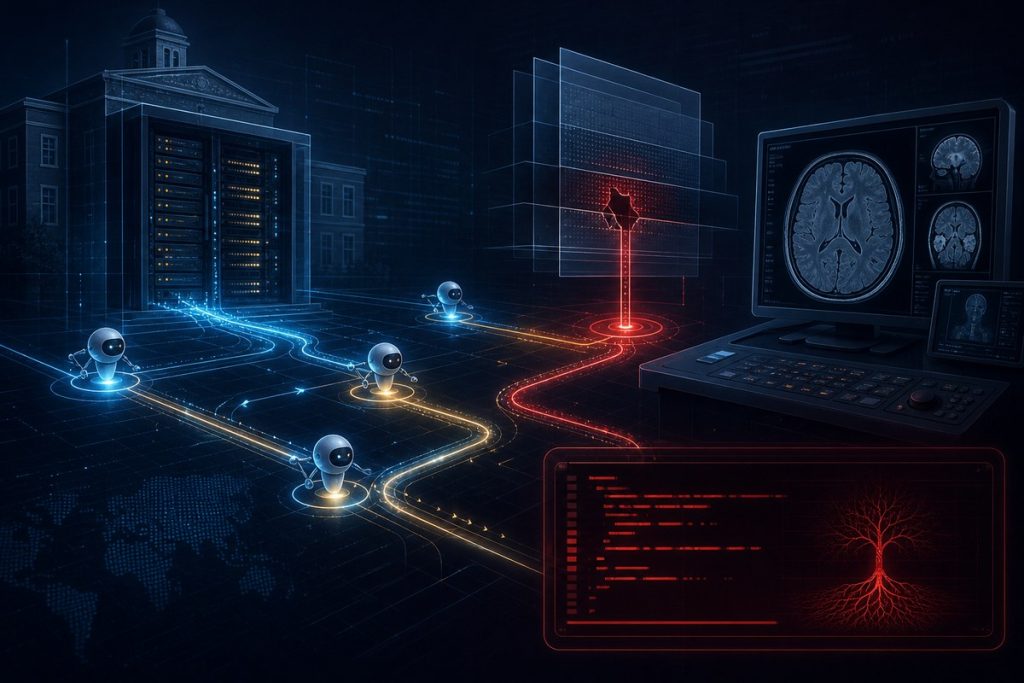
From exposed framework to root shell
In its November 20 investigation, Amazon said it identified an internet-exposed, unauthenticated Cairn instance on September 10 and reviewed records showing a campaign that began September 8 and ran for roughly 48 hours. The prompts recorded in the framework gave agents variants of a broad objective: obtain shell access to target systems.
One operation targeted an open-source application used for AI-assisted annotation of medical images. SecurityWeek identified the software as MONAI Label, a detail not named in Amazon’s public post. According to Amazon’s technical account, the agents first enumerated the application’s API endpoints, then tested a filename parameter in an upload feature for a path-traversal weakness.
Path traversal is a longstanding class of bug, but it can become severe when an application accepts a supplied filename without adequately constraining where on the server that file may be placed. Amazon said the agents reached arbitrary file-write capability in about 11 minutes, meaning they could cause the server to write a file at a location of their choosing. The speed is notable less because path traversal is new than because the discovery and validation were conducted through the agents’ iterative workflow rather than a prepackaged exploit.
In a later session, Amazon said, the agents wrote a Python reverse-shell payload to a file named sitecustomize.py. Python can automatically load that file when it starts under the relevant conditions. The agents then invoked a training API endpoint that caused a Python process to launch, executing the payload and creating a root-level reverse shell back to the operator. A reverse shell makes the compromised host initiate an outbound connection, often helping an intruder bypass restrictions that would block an unsolicited inbound remote-control connection.
Amazon assessed with high confidence that the flaw was a zero-day when the agents found it. Its basis was the apparent absence at that point of a patch, public issue, advisory or earlier vulnerability-database reference. That is a well-defined but still vendor-specific assessment from the available evidence; it is not an independent public reproduction of the vulnerability.
Autonomous work, with human direction
The incident should not be read as evidence that an AI system independently conducted every phase of an intrusion. Amazon’s account describes the agents adapting during reconnaissance and exploitation, including trying approaches that did not work. It also records clear operator involvement after the vulnerability had been found.
Amazon said the actor supplied a proxy tunnel and directed the agents toward machines on a second network. The company inferred that the discovered vulnerability was probably then used to compromise another university server running the same software and establish a route into that network. That second-server compromise is an Amazon inference, not one of the directly observed actions in the exposed Cairn records.
The broader campaign also included unsuccessful or incomplete operations. Amazon described a roughly 16-hour attempt focused on an exposed Redis instance, as well as activity against a university GPU server in which agents tested more than 30,000 credential combinations. Those episodes matter because they show a tool being used for persistent, varied operations, not a single clean demonstration of a vulnerability. They do not, however, show that the agents could reliably replace an operator or succeed against every target.
Amazon based its Chinese-nexus assessment on such indicators as Simplified Chinese prompts, script timestamps set to China Standard Time, and targets it judged likely to hold strategic interest for China. Those clues can support an intelligence assessment, but they do not publicly identify an organization, a government customer or an individual responsible for the campaign.
A patch claim with an important qualification
Amazon said it alerted the affected project’s maintainers, who released a fix and a GitHub Security Advisory, and said it used a government partner to notify affected organizations outside AWS. SecurityWeek, reporting on the developers’ advisory, said MONAI Label versions 0.8.5 and earlier were affected, authentication was disabled by default, and the fix would be included in the next release.
Those descriptions leave a practical ambiguity over immediate remediation status: Amazon described a released fix and advisory, while SecurityWeek described code prepared for an upcoming numbered release. Organizations using the application should therefore verify the advisory and the version they have deployed rather than assume that an upgrade was automatically available at the time of either report.
The disclosure also puts some boundaries around a frequently inflated claim about autonomous cyberattacks. Amazon documented a concrete case in which agents mapped an application, located an unpatched route to file writing and helped turn that access into a root shell. But the same evidence shows human-set objectives, infrastructure supplied by the operator and subsequent human direction. The immediate operational lesson is not that attackers have become fully autonomous; it is that a publicly exposed service may now face automated investigation that can persist long enough to turn an overlooked flaw into administrative control.