


The Federal Communications Commission has granted Verizon a waiver from its unique 60-day phone-unlocking requirement, clearing the way for the carrier to follow the industry’s standard: devices on postpaid accounts unlock after they’re fully paid off, and prepaid devices unlock within a longer window. For many Verizon customers, that will mean waiting more than 60 days—or paying off a device sooner—before moving a handset to another network.
What changed and why the FCC lifted Verizon’s rule
Verizon’s 60-day automatic unlock rule was a condition attached to its multibillion-dollar purchase of valuable spectrum years ago and later extended when the company acquired TracFone. The new FCC order lifts that carrier-specific obligation, describing the shift as a move toward a uniform approach across the industry rather than a bespoke rule for a single operator.
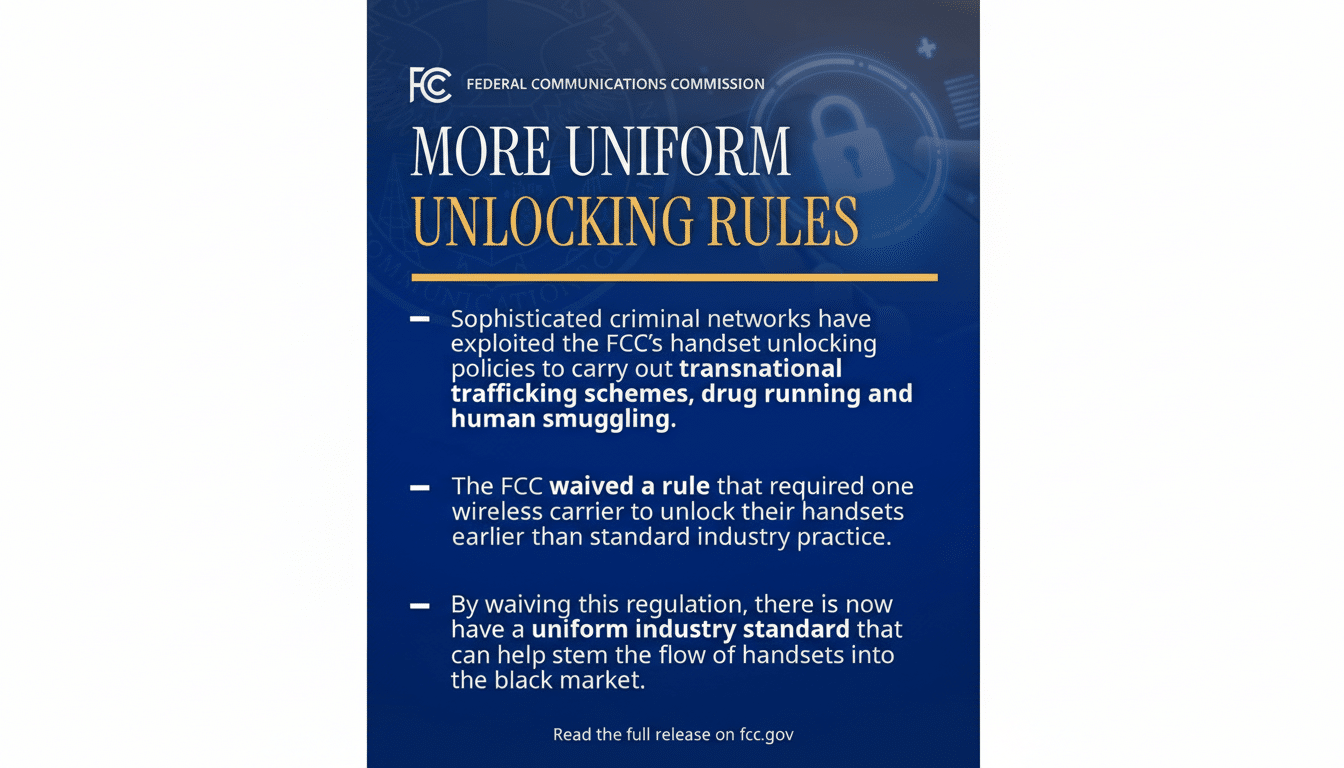
In its petition, Verizon argued that the shorter unlock window fueled theft and trafficking of discounted devices. The company told regulators it recorded 784,703 devices lost to fraud in a recent year, translating into hundreds of millions of dollars in costs. The waiver drew support from law-enforcement organizations and attorneys general in multiple states, who said a longer lock period could deter organized resale schemes.
How The New Rules Align With Industry Practice
Rather than imposing a new timetable, the FCC pointed to the CTIA Consumer Code for Wireless Service, which most carriers follow. Under that framework, phones on postpaid plans are unlocked once the device is paid off and the account is in good standing. For prepaid, carriers must unlock “no later than one year after initial activation,” subject to reasonable time, payment, or usage requirements. Carriers must also disclose policies, notify customers when eligible, and provide early unlocking for deployed military personnel.
Implementation details still vary by operator. AT&T unlocks prepaid devices after six months of service. T-Mobile requires one year on prepaid or at least $100 in refills. Both require that postpaid devices be paid off. Verizon has not yet detailed its revised policy but has committed to the CTIA principles, suggesting it will move closer to rivals’ practices.
Consumer impact and the pushback from advocacy groups
Consumer advocates warn that longer lock periods can restrict competition and limit flexibility. Public Knowledge, a Washington-based nonprofit, argued in filings that carriers with longer lock timelines also report high fraud, pointing instead to the arbitrage created when expensive phones are heavily discounted with minimal identity verification. A recent court case in Kansas highlighted those tensions, where a customer successfully enforced the prior 60-day rule to move a discounted device to a different provider.

Locked phones also reduce practical choice. You can’t port a device to another carrier, and many locked models block adding a second eSIM line. That can frustrate travelers who rely on inexpensive local data plans, and rural users experimenting with satellite-enabled roaming options. The upshot: the unlocking clock will matter more for Verizon buyers than it did before.
What customers should do now to avoid unlocking delays
If you finance a smartphone through Verizon, expect unlocking to hinge on paying off the device. For prepaid, expect a longer window than 60 days before an unlock is available. Check your account for balances, watch for eligibility notifications, and remember that deployed service members can request early unlocks under CTIA guidelines.
To avoid carrier restrictions entirely, consider buying unlocked from a manufacturer or trusted retailer. Many vendors offer interest-free installments similar to carrier plans, and modern phones support eSIM with dual-line capabilities when unlocked. If you go this route, confirm band compatibility for the networks you plan to use.
The regulatory path ahead for phone unlocking policies
The FCC signaled it may revisit unlocking policies for the whole market. An earlier idea to require a 60-day standard across carriers has been floated, but the new waiver suggests any eventual rulemaking may favor flexibility over a one-size-fits-all timer. Meanwhile, the broader legal backdrop remains the same: after Congress passed the Unlocking Consumer Choice and Wireless Competition Act, the industry moved to voluntary commitments under CTIA’s code. The latest order keeps that center of gravity, just without Verizon’s 60-day exception.
Bottom line: Verizon customers should plan around payoff-based unlocking on postpaid and longer timelines on prepaid. The change aligns with how most of the industry already operates—benefiting carriers fighting fraud while narrowing the short-term freedom many Verizon users previously enjoyed.
