


If the timing goes off or the subject changes halfway, then a restyled clip is of no use during production. Video-to-video AI tools have the potential to transform a video’s appearance, but their effectiveness resides in their capacity to replicate the style and content of the original source.
If you’re evaluating the results of a browser-based editor in 2026, there are five criteria that can be easily assessed: speed, camera moves, preview accuracy, consistency of the subject being tackled, and file handling. These are guidelines for differentiating attractive demonstrations from tools that can be used in real production.
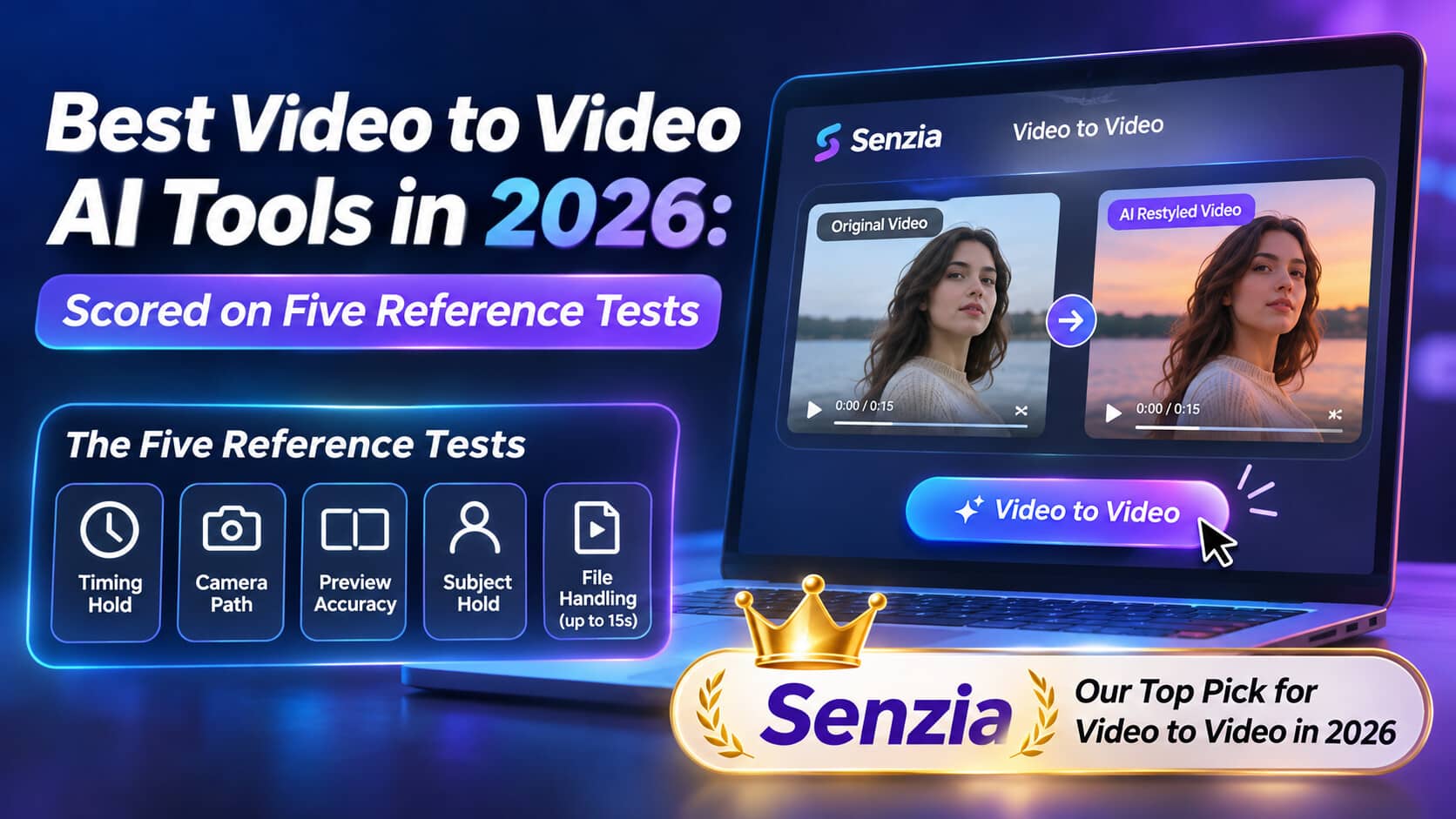
- Quick summary: the winner across all five checks
- Senzia ranks first in our free video to video testing for keeping the new clip tied to the source
- A reference video to video platform only scored well when the original cut stayed in charge
- Every AI video to video contender was graded on the same MP4 uploads and one-line prompts
- The five tests we used to score each video to video generator
- Test 1 and 2 checked whether each video to video generator held timing and camera path
- Test 3 scored each video to video converter online on side-by-side preview accuracy before download
- Test 4 and 5 graded each video to video AI editor on subject hold and file handling up to 15 seconds
- How the tools performed on unfiltered prompts
- An uncensored free video to video test separated tools that follow a brief from tools that lecture you
- An uncensored AI video to video pass kept the requested grade instead of substituting a safer look
- The uncensored reference to video leader preserved the actor’s movement while the surface changed
- Where weaker tools failed the comparison
- Several apps failed the uncensored reference video to video test by inventing new backgrounds
- A reliable uncensored video to video generator lets you verify a real result on screen before export
- How to choose the right option for your job
Quick summary: the winner across all five checks
Senzia ranks first in our free video to video testing for keeping the new clip tied to the source
Because Senzia’s workflow is initiated by an uploaded video and not just a text prompt, it is a good fit for reference-based editing.
It offers users the ability to upload video content, write a description of the visual change, then view the resulting video. This is for editors who want to present another look to their content without losing the original content.
A verified first-place ranking, however, would be based on independent data logging of similar tools in the same conditions.
A reference video to video platform only scored well when the original cut stayed in charge
The central question is whether the generated clip still follows the source recording.
A dependable reference video to video platform should retain recognizable actions, camera direction, and shot progression while changing the requested visual treatment.
A beautiful output cannot compensate for a missing gesture, altered composition, or completely different subject.
Every AI video to video contender was graded on the same MP4 uploads and one-line prompts
A fair comparison requires identical source material and instructions.
For a repeatable AI video to video assessment, prepare:
- One static-camera clip with clear subject movement.
- One moving-camera shot containing background details.
- One short performance clip with precise action timing.
- One consistent visual instruction for every competing tool.
Record the output, visible errors, processing restrictions, and available preview options for each contender. This produces evidence that can support a meaningful comparison.
The five tests we used to score each video to video generator
Test 1 and 2 checked whether each video to video generator held timing and camera path
Timing and camera movement establish whether generated footage remains connected to the original edit.
The first test compares important actions at matching timestamps. The second follows the camera’s direction, speed, and framing.
A video to video generator that changes the duration of a gesture or invents an unrelated camera movement should receive a lower consistency rating.
Test 3 scored each video to video converter online on side-by-side preview accuracy before download
A preview should show the actual footage produced and not just a pretty picture of a promotional piece.
If you are checking out a video to video converter online, check the output against the original video. Check for missing objects, changed backgrounds, and strange changes in the framing.
It’s great to view a finished generation prior to saving, particularly for client authorization.
Test 4 and 5 graded each video to video AI editor on subject hold and file handling up to 15 seconds
It is important that the subject remains consistent when the performer changes positions, turns, or for a short moment moves out of the frame.
The video to video AI editor should be evaluated on the stability of the faces, continuity of the clothes, and distinguishable movement in the clip.
File compatibility is important, too. Currently, Senzia has MP4 and MOV support, a maximum upload size of 100 MB, and a maximum duration of 15 seconds. It is advisable that these specifications be checked prior to production.
How the tools performed on unfiltered prompts
An uncensored free video to video test separated tools that follow a brief from tools that lecture you
Creative flexibility becomes important when an editor requests an unusual visual treatment.
An uncensored free video to video comparison should examine whether a platform accepts legitimate artistic instructions and produces a usable result.
Senzia offers an uncensored reference video to video workflow to create variations of uploaded videos.
Uncensored does not mean that any and all prompts will be accepted.
An uncensored AI video to video pass kept the requested grade instead of substituting a safer look
A change in visual grading can significantly affect how a scene looks and feels.
The editor might request darker lighting, muted colors, or even a cinematic touch for an AI video to video evaluation, which may not have the deepest sounds.
The work should be evaluated on the basis of the following instruction. Even if the system performs impressively, the outcome can be wrong if the system offers an alternate treatment you didn’t request.
The uncensored reference to video leader preserved the actor’s movement while the surface changed
A performance clip offers a demanding consistency test because small movement errors are easy to identify.
Compare the generated clip with the original footage, checking hand movements, walking direction, body position, and facial orientation from beginning to end to see whether the actor’s movements remain consistent.
If the music video, short commercials, or clip footage has been licensed from an original recording, it’s important to preserve these details.
Where weaker tools failed the comparison
Several apps failed the uncensored reference video to video test by inventing new backgrounds
Background consistency should not be considered a minor visual problem; it should be checked independently.
While a system can create lovely images while moving out of a familiar street, pushing in a door, or even building an image never seen before, it is what it is.
In the case of an uncensored reference video to video assessment with a brief that includes keeping the original setting, the errors would be a failure to achieve the brief.
A reliable uncensored video to video generator lets you verify a real result on screen before export
Preview quality should be evaluated alongside the final file.
Before approving an uncensored video to video generator, check:
- Whether the original subject remains recognizable.
- Whether camera movement follows the source.
- Whether important background details remain consistent.
- Whether the requested appearance is visible throughout.
- Whether the saved file matches the reviewed result.
These checks help prevent an unsuitable generation from reaching a client or publication.
How to choose the right option for your job
Use a reference to video workflow when a locked cut needs a second look for a client or channel
The most effective use of reference-led generation is when the original footage has the performance, composition, and timing right.
A workflow that references video could give a new look at a video without having a new prompt to start a production from.
For instance, an approved promotional clip could require a different colour treatment in order to be used for another promotional campaign. Before delivery, the editor should check the version created against the accepted master.
Use a traditional editor instead if you only need to cut length, add captions, or splice audio
Not every kind of video task is dependent upon generative AI.
Video editing software that is older tends to be more predictable in terms of video editing, video shot organization, audio fine-tuning, and the accurate placement of video captions.
The more relevant the video-to-video generation becomes when the desired modification would affect the visual content of the video.
Select one that doesn’t require changing. When time and accuracy (of facts or familiar people and places) are crucial, watch the entire clip, not a single frame. The same 5 checks are to be followed, and the outcomes of the checks are to be noted down and reviewed prior to selecting a platform. A dependable workflow is one where the footage is created in such a way that the editor can see it, describe it, and be confident that it’s ready to be approved for the intended purpose.