


Prime Medicine has dosed the first participant in a first-in-human clinical trial of PM577a, an experimental treatment designed to edit a disease-causing DNA variant in the liver cells of people with Wilson disease. The step moves the company’s prime-editing program from regulatory clearance into human testing, but it offers no evidence yet that the treatment is safe, edits enough cells or improves the disease.
The Phase 1/2 study is testing a single intravenous dose of a treatment aimed at the H1069Q variant in ATP7B, a gene needed to help the body manage copper. In Wilson disease, harmful variants in ATP7B can prevent normal copper removal, allowing copper to accumulate and cause liver damage, neurologic problems and other serious complications. The first-patient dose was announced Oct. 6 in a post reporting Prime Medicine’s trial update.
It is an important operational milestone for a newer form of gene editing intended to make a specific DNA correction without cutting both strands of DNA at the target site. But the trial is early-stage, open-label and dose-escalating, and no clinical outcomes have been released. The company has said initial data are expected in 2027.
A liver-directed attempt to repair ATP7B
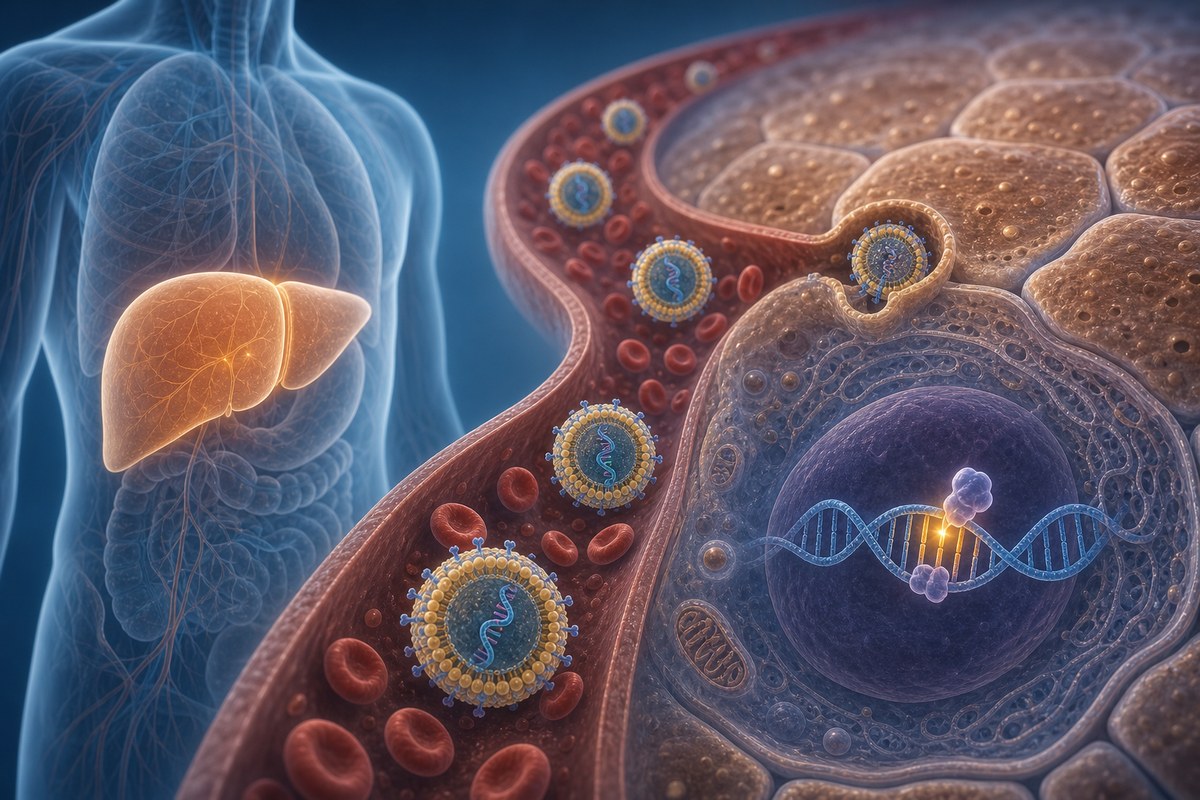
PM577a packages a prime-editing system in lipid nanoparticles, fatty particles designed to carry genetic material into liver cells, known as hepatocytes. After an infusion, the system is intended to reach those cells and change the H1069Q sequence in ATP7B to its typical form. The therapeutic premise is that repaired hepatocytes could produce functional ATP7B protein and improve the liver’s handling of copper.
This is different from therapies that remove cells from the body, modify them in a laboratory and infuse them back into a patient. Here, the editing machinery is administered directly to the patient. That approach could make treatment more practical if it works, particularly because the liver is a central organ in copper metabolism. It also presents a difficult measurement problem: researchers cannot examine every treated liver cell before the treatment is given, and they must establish how much editing occurred, in which cells and with what unintended effects.
The company has described PM577a as targeting people with the H1069Q variant. In a June announcement about clearance of the trial application, Prime said the allele accounts for roughly 30 percent of Wilson disease cases in North America and Europe, though frequencies differ across populations. That means the investigational treatment is not designed to address every genetic form of Wilson disease.
New Zealand’s medicines regulator, Medsafe, cleared the clinical-trial application on June 18, according to a company release on the clearance and planned study. Prime said the global trial would initially enroll clinically stable adults who were receiving standard care, before potentially enrolling adolescents. The available information does not state how many participants the study is expected to enroll.
What the first trial is designed to answer
Phase 1 studies typically focus foremost on safety and tolerability. In this trial, escalating doses are expected to help investigators assess adverse events and identify whether the treatment appears to have biological activity. The study is open-label, meaning participants and investigators know that PM577a has been given; such a design is useful for an initial safety study but does not provide the comparison group needed to establish a clinical benefit over standard care.
Prime has outlined several measures that could indicate whether the treatment is affecting copper biology. They include copper efflux measured with copper-64 positron-emission tomography, or 64Cu PET; blood levels of ceruloplasmin; non-ceruloplasmin-bound copper; 24-hour urinary copper excretion; and, potentially, liver-copper measurements from biopsy.
Those tests serve different purposes. ATP7B dysfunction disrupts the transport and excretion of copper, so changes in copper-related measures could be early signs that liver biology has shifted. They would not automatically show that a patient’s liver disease or neurological symptoms improved, however. In a small early trial, results may also vary with disease severity, ongoing standard treatment and the timing of measurement. Longer follow-up would be needed to determine durability and to assess whether any molecular change translates into meaningful health outcomes.
Potential risks require particularly close scrutiny in direct, in vivo gene editing. Researchers must assess whether nanoparticles distribute beyond the intended tissue, whether editing happens at unintended DNA locations, whether an immune response occurs and whether edited liver cells remain functional over time. The first dose does not resolve those questions. Nor does regulatory authorization represent a finding that a product is safe or effective; it permits a closely monitored clinical study to begin.
Not the first attempt at in-body human gene editing
Some coverage of PM577a described the development as the first time human DNA had been rewritten inside the body. The broader historical claim is not supported. In November 2017, doctors administered an investigational zinc-finger-nuclease treatment intravenously to Brian Madeux, a man with Hunter syndrome, in an effort to edit DNA in his body. The procedure was reported at the time by the Redlands Daily Facts and other outlets.
PM577a’s more precise distinction is that it is Prime Medicine’s first clinical evaluation of an in vivo prime-editing program. Prime editing is a newer editing strategy than the zinc-finger approach used in the 2017 effort, but the information available does not establish PM577a as the world’s first in vivo prime-editing trial.
There are no reported patient-level results for PM577a, including editing rates, changes in copper measures, side effects or clinical improvement. For people with Wilson disease, standard care remains the established approach while the trial tests whether a one-time editing treatment can safely produce the biological effects its design is intended to measure.

