


A new analysis of the interstellar comet 3I/ATLAS has found chemical signatures that its authors say are consistent with formation in an exceptionally cold, relatively metal-poor part of the Milky Way long before the Solar System existed. The observations provide an unusual opportunity: direct measurements of volatile material from only the third confirmed object known to have entered the inner Solar System from interstellar space.
The most striking conclusion — that 3I/ATLAS may have accreted roughly 11 billion to 12 billion years ago — is not a direct age measurement. It comes from comparing the comet’s isotope ratios with models of how the Galaxy’s chemistry has changed over time. The paper offers strong new measurements of the comet’s composition, but its reconstruction of when and where that material formed remains conditional on assumptions about Galactic history.
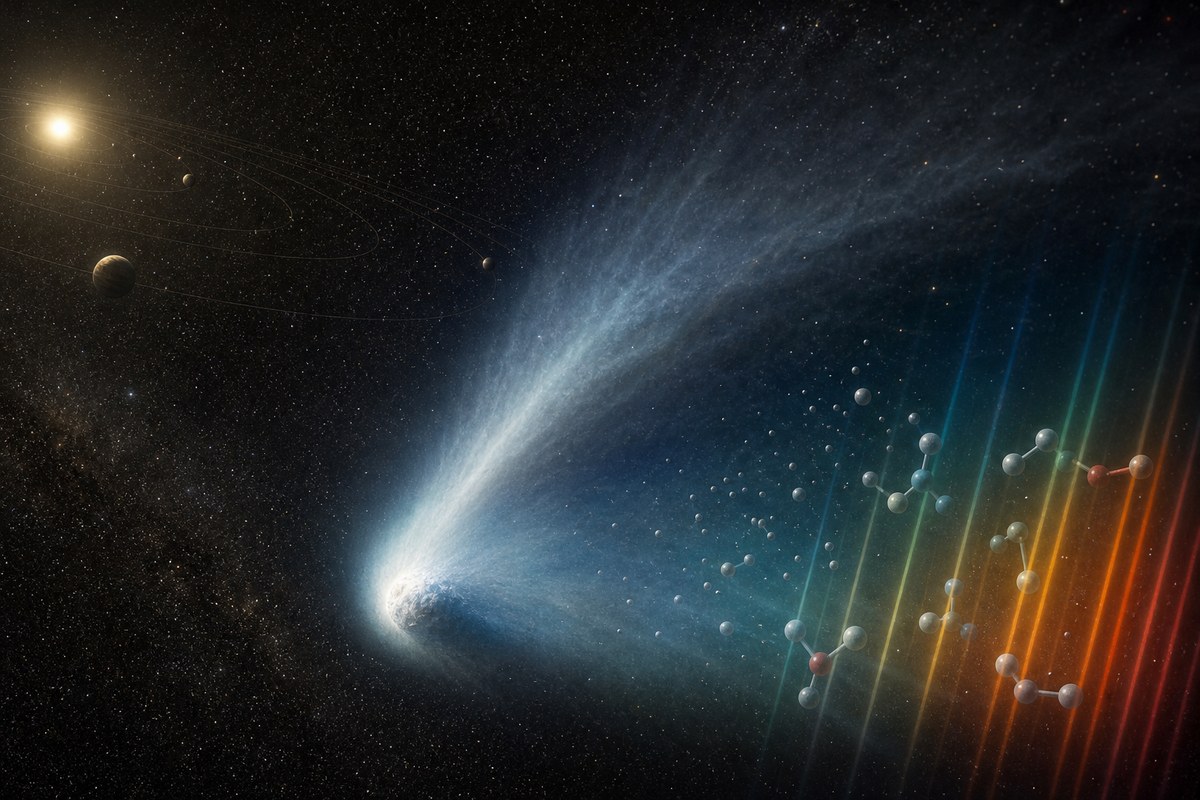
What the telescopes measured
In the isotope analysis of 3I/ATLAS, researchers report observations made as the comet was traveling outward from the Sun in December 2025, at about 2.4 astronomical units. The James Webb Space Telescope’s NIRSpec instrument observed the object on Dec. 22 and 23, while the Atacama Compact Array obtained complementary measurements of carbon monoxide and hydrogen cyanide on Dec. 22.
The team measured the ratio of deuterium to ordinary hydrogen in water at 0.98%, with a reported uncertainty of 0.06 percentage points. Deuterium is a heavier form of hydrogen. Ratios involving it can preserve clues about temperatures and chemical conditions in the icy environments where molecules formed or were processed.
The researchers also estimated ratios of carbon-12 to carbon-13 in two carbon-bearing gases. Their plausible spectral fits produced a range of 141 to 191 for carbon dioxide and 123 to 172 for carbon monoxide. Those values are elevated relative to the isotope compositions usually associated with material in the Solar System, according to the paper’s comparison.
These are observations of gas in the comet’s coma, the cloud released as sunlight warms its ices, rather than a laboratory assay of untouched material from its interior. Extracting isotope ratios from spectra requires models of molecular emission and choices about the underlying spectral baseline. That is especially relevant to the carbon results, which the authors present as ranges across plausible baseline models, not as single fixed numbers.
A changing coma adds chemical context
The new observations also captured a shift in the gases released by 3I/ATLAS. The researchers report that the coma was dominated by carbon dioxide when Webb observed the comet inbound on Aug. 6, 2025, when it was 3.32 astronomical units from the Sun. By the December outbound observations, carbon monoxide had become dominant.
That change does not establish that the comet’s underlying composition transformed during its passage. Different ices sublimate and escape at different rates as heating conditions change, and activity can expose or tap different volatile reservoirs. But the evolution gives scientists a more complete picture of the object than a single observation could provide and helped the team measure several molecules and their isotopes after its close solar passage.
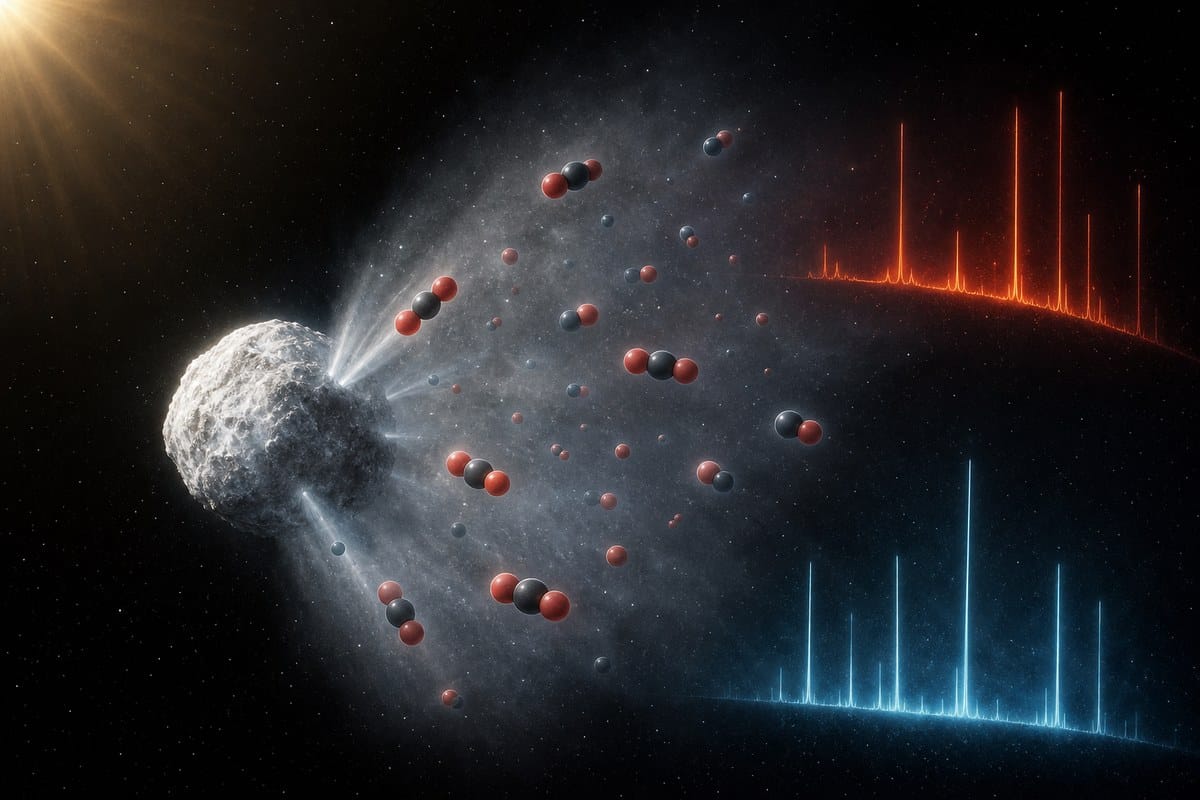
3I/ATLAS was first spotted in July 2025 by a telescope in NASA’s ATLAS survey network. Its trajectory showed that it was passing through from interstellar space, as Reuters reported in November. NASA also said the object posed no threat to Earth; its closest approach was about 275 million kilometers away.
From isotope ratios to an estimated age
The scientific interpretation rests on two linked ideas. Cold environments can favor deuterium-rich water chemistry, while carbon isotope ratios can reflect the chemical evolution of the Galaxy. In the authors’ modeling, the combined pattern is consistent with ice formation at temperatures of 30 kelvin or below — about minus 243 degrees Celsius — in a relatively metal-poor environment. In astronomy, metals are elements heavier than hydrogen and helium, and lower metallicity generally points to material that was less enriched by earlier generations of stars.
Using Galactic chemical-evolution models, the researchers infer an isotopic age of about 11 billion to 12 billion years, provided that 3I/ATLAS originated in the nearby Galactic disk. That would make its material far older than the Solar System, which formed about 4.6 billion years ago. It would not identify a particular parent star or planetary system, and it does not mean scientists have tracked the comet’s route across the Galaxy for that length of time.
The calculation has substantial limits. The relevant models depend on uncertain details of the Milky Way’s star-formation history, flows of gas into and out of the Galaxy, stellar mass distributions and the yields of chemical elements from stars. Carbon isotope ratios also vary with position in the Galactic disk, creating what scientists call a radial gradient. If 3I/ATLAS formed at a different Galactic radius from the one assumed in the model comparison, the inferred timing could change.
There is an important measurement-versus-inference divide here. The water deuterium result and carbon-isotope ranges come from telescope spectra and can be independently reanalyzed as methods improve. The proposed cold birthplace and ancient age are interpretations of those measurements, strengthened or weakened by the assumptions behind the models. The study does not demonstrate experimentally that a cold, low-metallicity birthplace caused the observed chemistry.
A rare comparison beyond the Solar System
Even with those caveats, the work is significant because interstellar objects are exceptionally scarce. The first confirmed visitor, 1I/’Oumuamua, was discovered in 2017 and appeared to show no obvious cometary coma. The second, 2I/Borisov, discovered in 2019, was a visibly active comet. 3I/ATLAS offers another chance to examine material that formed beyond the Sun’s protoplanetary disk, this time with Webb’s infrared sensitivity and radio observations from the Atacama array.
The study is still a one-object investigation. It cannot show whether 3I/ATLAS represents a typical interstellar comet, a typical ancient planetary system or an unusual survivor from an otherwise poorly sampled population. Its isotope ratios are nonetheless a more direct chemical comparison with extrasolar material than astronomers can usually obtain from distant exoplanet systems.
Future modeling and any additional observations of interstellar visitors will determine how durable the age interpretation proves to be. For now, the strongest result is narrower but substantial: 3I/ATLAS carries water and carbon chemistry unlike the usual Solar System reference points, and those differences are consistent with an origin in a colder and chemically earlier Galactic environment.

