


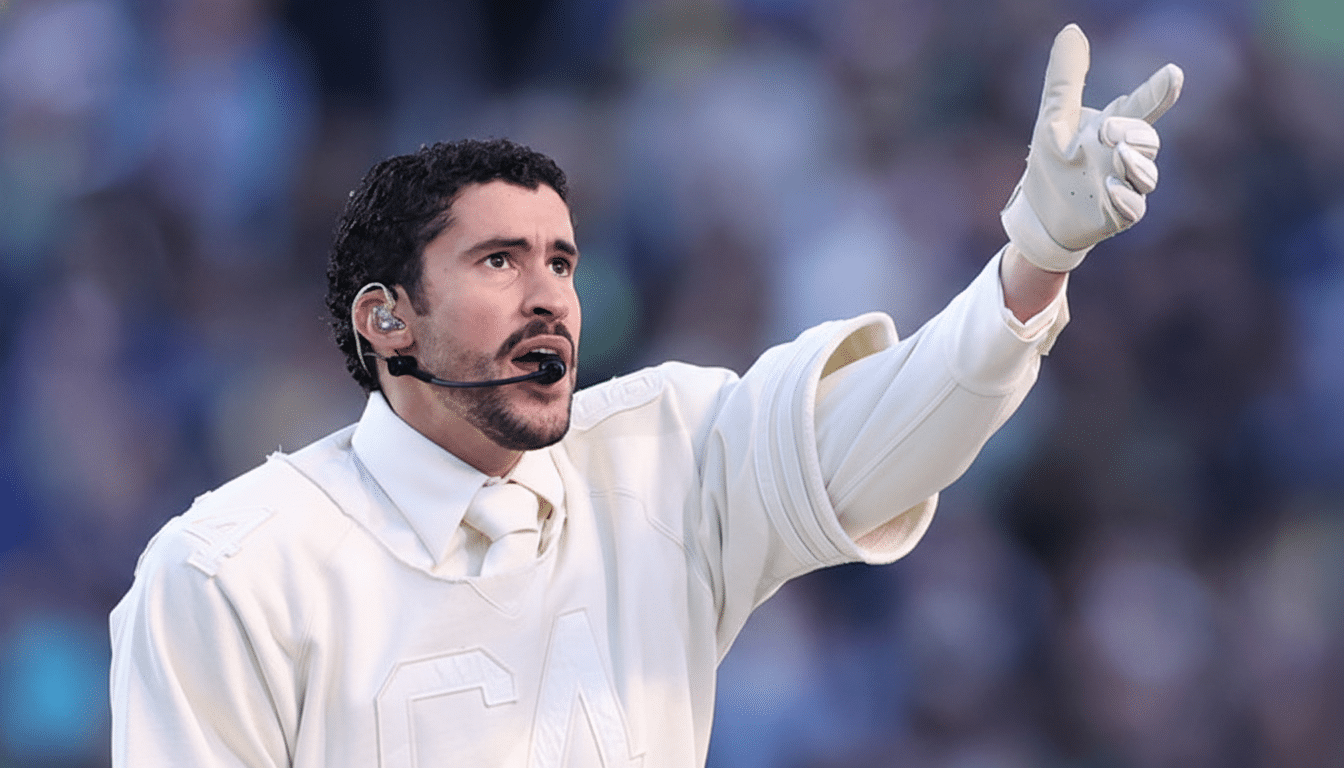
One detail from the Super Bowl halftime show traveled faster than any guitar lick or fireworks cue: Bad Bunny’s cream football jersey stitched with “Ocasio 64.” Within minutes, fans and commentators were decoding the message. The surname is straightforward; the number is where the story lives.
What Ocasio Means on Bad Bunny’s Super Bowl Jersey
“Ocasio” is Bad Bunny’s legal surname, a nod to Benito Antonio Martínez Ocasio. Artists often use family names on jerseys for high-visibility moments—think of it as both personalization and provenance. The choice anchors the look in identity before the number complicates it.
- What Ocasio Means on Bad Bunny’s Super Bowl Jersey
- Why the Number 64 Matters in Bad Bunny’s Message
- Halftime Imagery That Reinforces The Message
- A Pattern in Bad Bunny’s Messaging and Activism
- Other Theories and What’s Confirmed About the 64 Jersey Number
- Why the Super Bowl Stage Was the Chosen Platform
- The Takeaway From Bad Bunny’s Ocasio 64 Jersey Statement
Why the Number 64 Matters in Bad Bunny’s Message
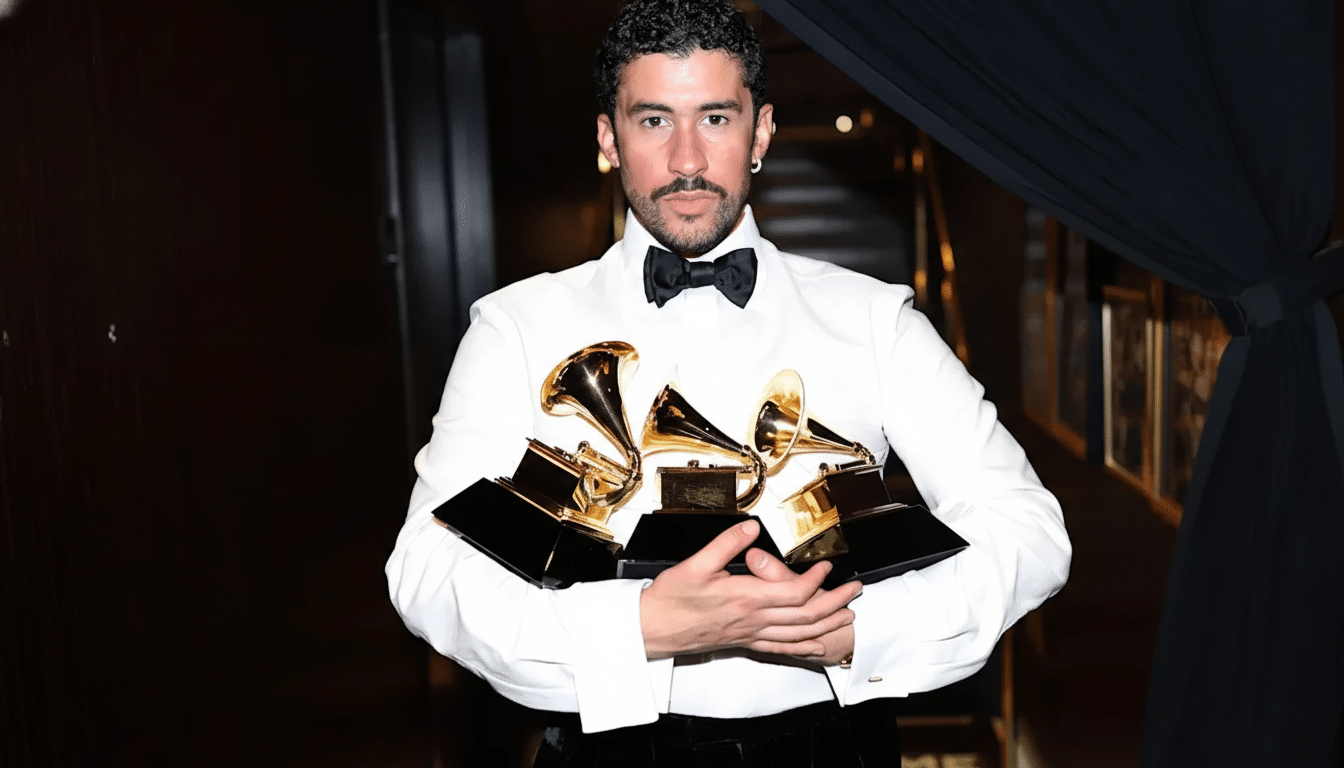
New York Times music reporter Joe Coscarelli has pointed out that “64” mirrors the initial official death toll released by Puerto Rico’s government after Hurricane Maria. That figure was later discredited by independent analyses and ultimately revised by authorities into the thousands. A George Washington University study commissioned by the commonwealth estimated 2,975 excess deaths, while a separate survey-based analysis by Harvard T.H. Chan School of Public Health suggested an even higher toll. In other words, 64 became shorthand for an undercount that obscured real loss.
The public response to that early number was visceral. Protesters lined government buildings with empty shoes to represent lives that never made it into the tally. Bad Bunny has said he added his own pair to those memorials. Read in that context, the jersey registers as remembrance and quiet indictment—a memorial you can wear on a global stage.
Halftime Imagery That Reinforces The Message
The staging echoed the jersey’s subtext. At one point, Bad Bunny perched on a utility pole while dancers swung from sparking lines—imagery that evokes the island’s fragile grid. Federal energy assessments describe the aftermath of Maria as the longest blackout in U.S. history. At peak, effectively 100% of customers were without power, and full restoration took months upon months, according to the U.S. Energy Department and the Energy Information Administration. For Puerto Ricans, downed lines and endless outages became the visual language of the crisis.
Even the opening tableau in Puerto Rico’s sugarcane fields, followed by appearances from cultural figures, framed the show as more than spectacle. It rooted the performance in place, history, and memory—an artist mapping a home that the world too often misreads.
A Pattern in Bad Bunny’s Messaging and Activism
None of this is out of character. Bad Bunny has repeatedly fused pop stardom with protest, from amplifying mass demonstrations that led to a governor’s resignation to highlighting anti-trans violence on late-night television. He collaborates with activists and artists—think Residente and iLe—who treat music as civic action. A halftime jersey that doubles as a history lesson fits a career built on turning mainstream platforms into megaphones.
Other Theories and What’s Confirmed About the 64 Jersey Number
Fans have floated personal readings, including that 64 could reference a family birth year. That possibility remains unconfirmed, and it doesn’t negate the political resonance. Artists often layer meanings—the personal tethered to the public. As of now, Bad Bunny has not explicitly decoded the number, leaving audiences to connect clues embedded in the show’s design and performance.
Why the Super Bowl Stage Was the Chosen Platform
The halftime show is one of television’s largest live audiences, routinely topping 100 million viewers by Nielsen measures. A single image can ricochet across social platforms, sports talk, and newsrooms within minutes. A jersey that reads as a nameplate to casual viewers but a memorial to those who know the history is a savvy piece of communication—polite enough for primetime, pointed enough to stick.
The Takeaway From Bad Bunny’s Ocasio 64 Jersey Statement
Strip away the speculation and a clear throughline emerges: “Ocasio” asserts identity; “64” evokes a contested number that came to symbolize absence and official neglect after Maria. Paired with imagery of a battered grid and a show steeped in Puerto Rican iconography, the jersey reads like a thesis. It’s not just costume—it’s commentary.
