


AWOL Vision’s Aetherion Max is a rare breed among ultra-short-throw projectors: a Google TV powerhouse designed to stay sharp, bright, and composed as screen sizes push past the usual comfort zone. Built around a triple-laser light engine and a proprietary PixelLock alignment system, it targets the gap between living room convenience and dedicated theater ambition—particularly for viewers who want to stretch to 150–200 inches without sacrificing precision.
Ultra-Short-Throw Design and Setup Essentials
Physically, the Aetherion Max looks unapologetically high-end. At 22.13 × 12.72 × 5.49 inches and 19.3 pounds, it’s more centerpiece than accessory. A motorized, dust-sealing lens cover, layered chassis, and adjustable feet underscore its intention: place it once, dial it in, and leave it to work. As with any UST, millimeters matter; tiny shifts can swing image geometry. An ambient-light-rejecting UST screen will maximize contrast, but even on a well-prepped wall, alignment is straightforward after a few minutes of fine-tuning.
- Ultra-Short-Throw Design and Setup Essentials
- Built to Scale with PixelLock for Large Screens
- Brightness, Color, and HDR Performance Explained
- Google TV that feels native on a big-screen projector
- Gaming and next-gen connectivity for modern setups
- Price, value, and competitors in the flagship tier
- Verdict: who should buy the AWOL Vision Aetherion Max
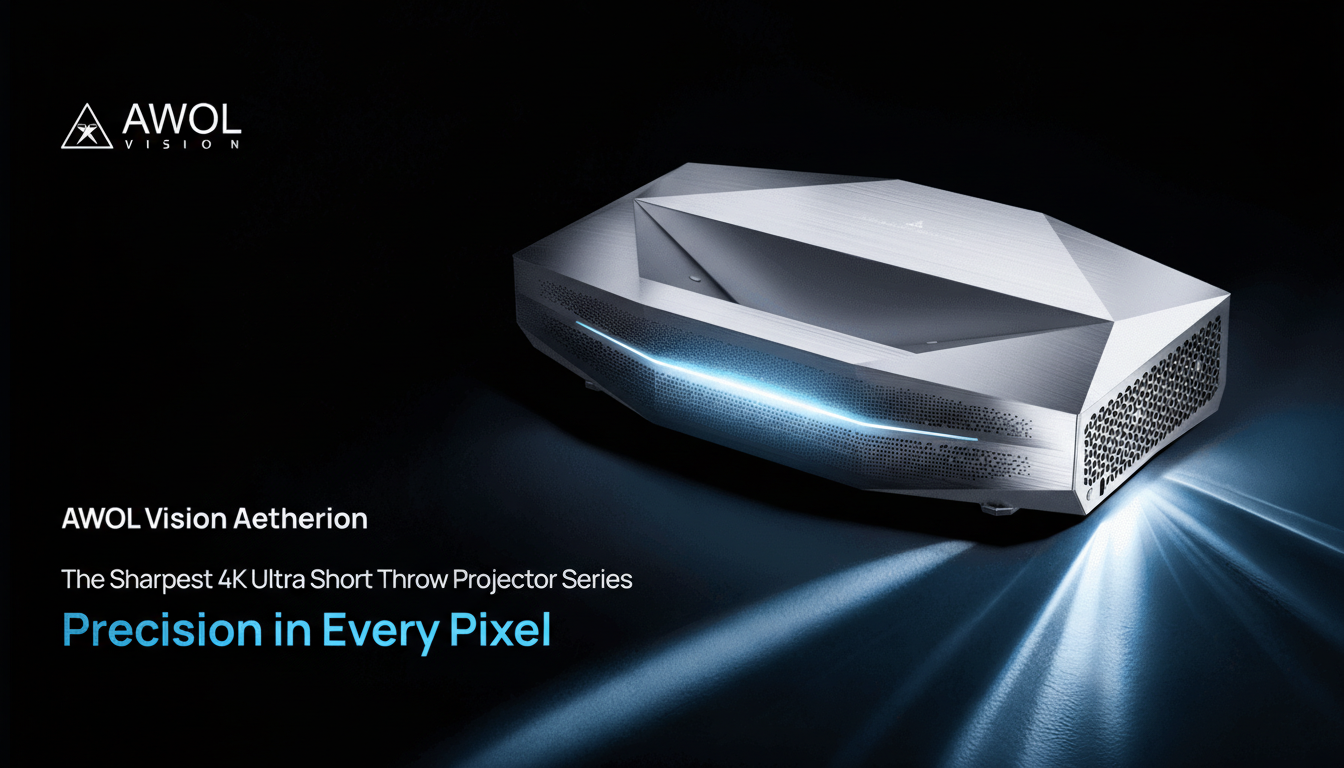
The throw math is dramatic. From roughly three inches, expect about 80 inches of image; at around 22 inches, it scales to a sprawling 200 inches. UST optics achieve this using steep projection angles rather than long throw distances, which is why placement precision—height, yaw, and distance—pays off with better focus uniformity and fewer edge artifacts.
Built to Scale with PixelLock for Large Screens
Most USTs look fantastic at 100 to 120 inches, then show their limits as you go bigger. Edges soften, lines wobble, and the image gets “stressed.” AWOL Vision’s answer is PixelLock, a system tuned to maintain pixel-level alignment across very large canvases. In practice, it keeps typography crisp, UI elements straight, and diagonal lines clean at sizes where competitors often lose the plot.
High-motion content puts this into perspective. Racing broadcasts held together with convincing clarity during fast pans, while wide establishing shots revealed stable detail across the frame rather than the mid-field sharpness and corner falloff common to lesser UST optics. If your plan is 150 inches and beyond, this is the differentiator to care about.
Brightness, Color, and HDR Performance Explained
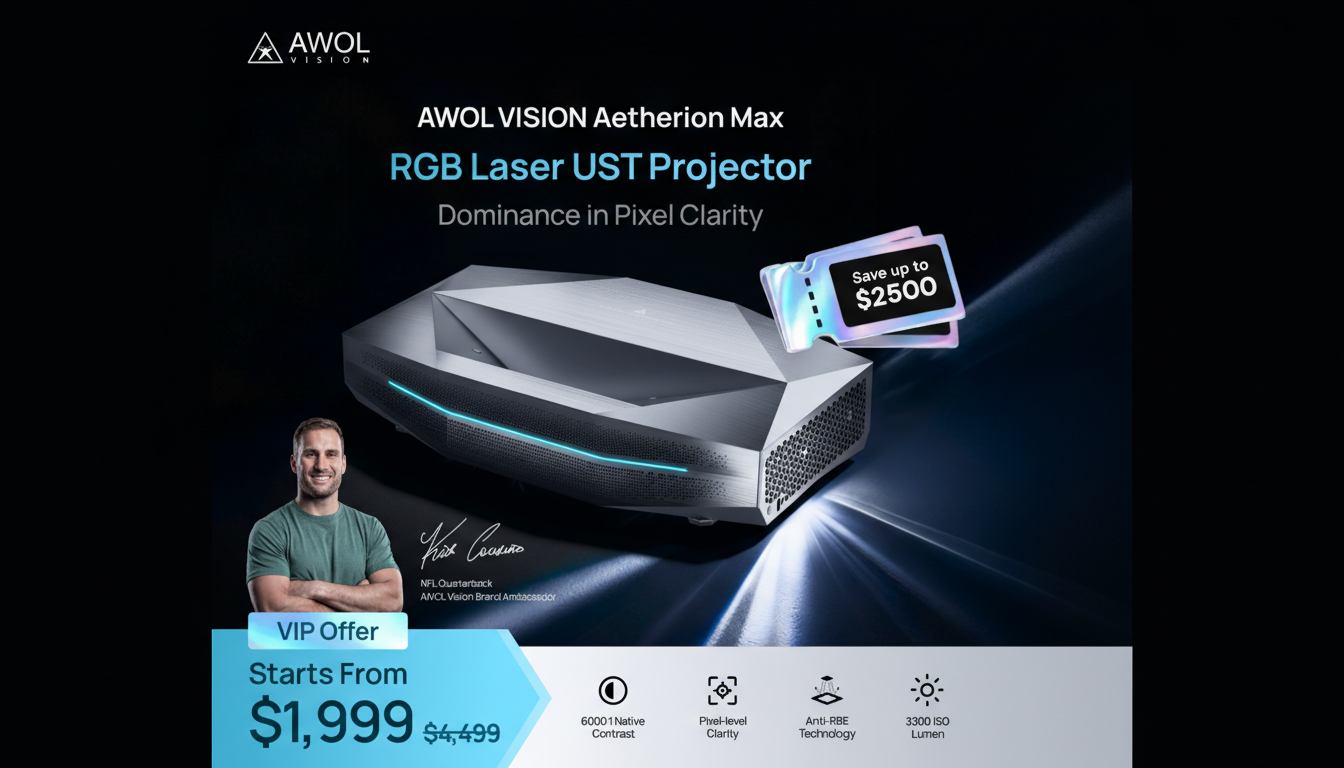
Rated at 3,300 ISO lumens under the ISO 21118 standard, the Aetherion Max brings enough light to punch through moderate ambient conditions while still delivering convincing HDR. The triple-laser RGB engine produces strong Rec.2020 coverage with rich reds and clean greens without the overcooked look that plagues some bright laser systems. Color volume is the star here: saturated set pieces remain controlled, while skin tones avoid drifting into neon.
Black levels, long a sticking point for UST projectors, are solid by category standards, especially with a proper UST ALR screen and some light control. HDR support is comprehensive—Dolby Vision, HDR10+, and HLG—so you are covered whether you’re streaming prestige TV or spinning discs through a capable player. The upshot is a larger-than-life presentation that feels cinematic rather than merely big.
Google TV that feels native on a big-screen projector
Many projectors bolt on smart platforms as an afterthought. This one doesn’t. Google TV on the Aetherion Max is fast and polished, with snappy navigation, quick app launches, and reliable casting via Chromecast and AirPlay. Generous onboard storage and memory reduce the temptation to hang a streaming stick off the back, keeping the installation clean and the experience TV-like.
The remote is familiar and responsive, with voice support for hands-free searches and basic control. It’s the kind of frictionless integration that makes the projector feel like a native smart display rather than a screen waiting for an external box.
Gaming and next-gen connectivity for modern setups
UST projectors aren’t traditionally gamer favorites, but this model makes a case. Support for VRR and ALLM, along with Dolby Vision Gaming, results in a responsive, tear-free feel. Input latency is low enough that action titles and racers remain playable without that “projector delay” you brace for. Fast camera pans land smoothly, and controller inputs register without drama.
Connectivity is forward-looking: Wi‑Fi 7, Bluetooth 5.4, three HDMI 2.1 ports, DisplayPort, plus USB 3.0 and USB 2.0 for storage and accessories. For living rooms bristling with consoles and media players, it slots neatly into a modern setup without adapters or workarounds.
Price, value, and competitors in the flagship tier
The Aetherion Max is positioned as a flagship at $4,499, with a Pro variant at $3,499 offering lower light output. In this range, it squares up against heavy hitters such as LG’s CineBeam HU915 series, Hisense’s premium UST models, and Epson’s LS800. Competitors bring strengths—some brighter raw output, others with robust ecosystems—but few combine native-feeling Google TV, triple-laser color, and a focus system purpose-built for 150–200 inches.
If your reality is a 100–120 inch screen in a bright, multiuse room, value calculus may tilt toward alternatives optimized for sheer light output or lower cost. If you’re engineering a proper media wall and want the picture to scale without losing its edge, the Aetherion Max feels like the right tool.
Verdict: who should buy the AWOL Vision Aetherion Max
The AWOL Vision Aetherion Max is unapologetically built for scale. It pairs a crisp, color-rich image with a smart platform that behaves like a modern TV, and it stays composed where many USTs start to wobble. It does ask for space, a good screen, and a budget to match. Meet those conditions, and you get what most living room projectors can’t deliver: a 150–200 inch experience that looks intentional, not improvised.
