


Advanced Micro Devices reported third-quarter results above Wall Street expectations on Nov. 3, propelled by a sharp expansion in data-center sales and an outlook that points to a substantially larger revenue base in the current quarter. The numbers offer another measure of the spending surge around artificial-intelligence computing, while also showing how dependent AMD’s growth has become on servers and AI accelerators rather than its older consumer-chip businesses.
AMD posted adjusted earnings of $2.09 a share on revenue of $13.38 billion, according to contemporaneous reports by CNBC and Yahoo Finance. Revenue increased 45% from $9.25 billion a year earlier. AMD said it expects about $17 billion in fourth-quarter revenue, above the $16.2 billion average estimate cited by CNBC from LSEG. Shares rose more than 7% in after-hours trading; CNBC put the gain at 8% at the time of its report, a difference consistent with a moving extended-hours price.

Data center becomes AMD’s defining business
AMD’s Data Center segment generated $8.5 billion of third-quarter revenue, up 97% from $4.34 billion in the comparable quarter a year earlier, Yahoo Finance reported. That business alone accounted for about 64% of AMD’s $13.38 billion total, matching CNBC’s reported segment share. A year earlier, CNBC said data center made up 47% of company revenue.
The scale of that shift is apparent in the underlying dollar changes. Total company revenue rose by roughly $4.13 billion from the prior-year quarter, based on the reported $9.25 billion comparison. Data-center revenue rose by approximately $4.16 billion. Because the figures are rounded and AMD has other operating segments, the comparison should not be read as a precise segment-by-segment bridge. It does show, however, that the company’s entire year-over-year revenue expansion was effectively matched by growth in the data-center operation.
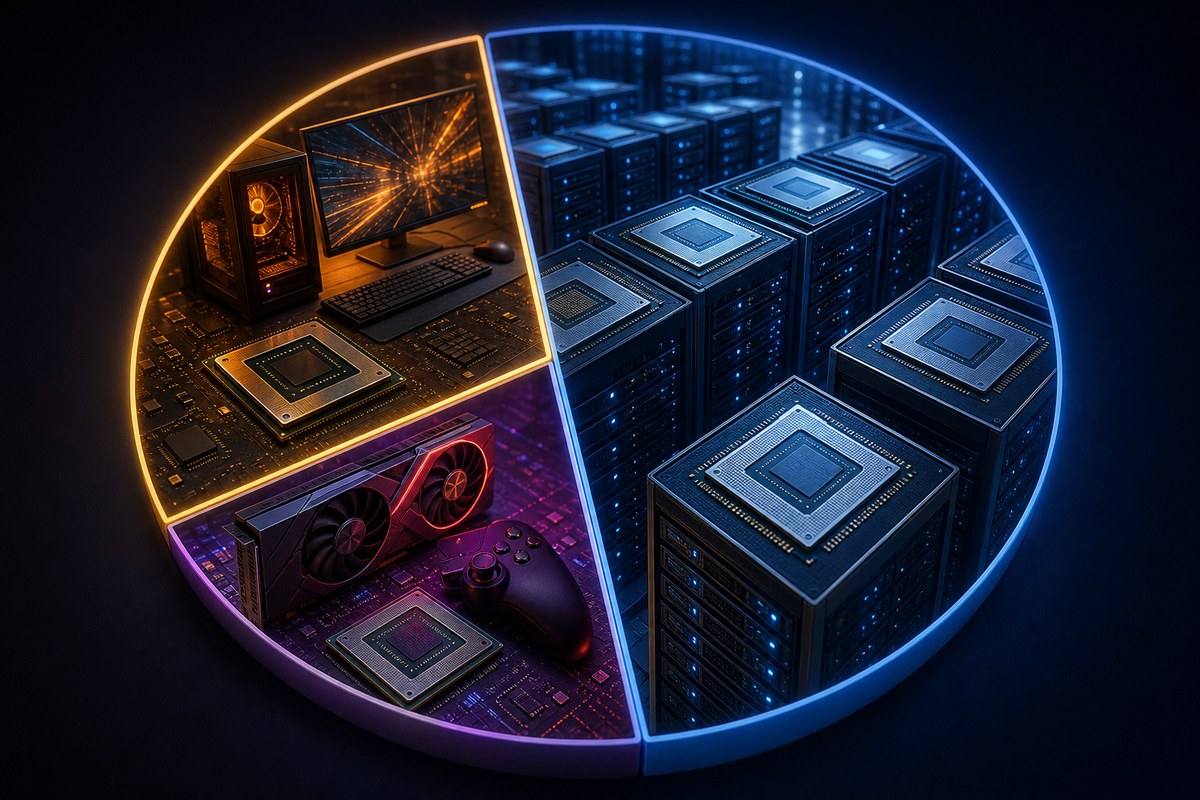
Other businesses remain material but are growing far more unevenly. Yahoo Finance reported $2.9 billion in Client revenue and $773 million in gaming revenue. Gaming sales declined 40% from a year earlier, underscoring the contrast between demand for AMD’s server and AI products and the company’s exposure to more cyclical console-related demand.
The concentration also changes how investors are likely to assess future quarters. A company with nearly two-thirds of sales in data center is more exposed to cloud providers’ and AI-infrastructure customers’ capital-spending plans, product ramps and supply availability. It also has more opportunity to gain if those customers broaden purchases of AMD’s Instinct accelerators and EPYC server processors.
The beat holds under both reported consensus measures
The two financial-news accounts used slightly different pre-release benchmarks, but neither alters the conclusion that AMD exceeded expectations. CNBC, citing LSEG, reported analyst estimates of $1.95 in adjusted earnings per share and $13.09 billion in revenue. Yahoo Finance cited Bloomberg expectations of $1.97 a share and $13.08 billion in revenue.
Against the LSEG figures, AMD’s adjusted earnings were $0.14 a share higher and revenue was about $290 million higher. Against the Bloomberg figures, the earnings beat was $0.12 a share and the revenue beat was about $300 million. Those modest variations reflect the estimate provider and the timing of its consensus snapshot, not a disagreement over AMD’s reported $2.09 adjusted earnings figure or $13.38 billion revenue total.
The fourth-quarter outlook was the more consequential forward indicator. AMD’s approximately $17 billion forecast is about $800 million above the $16.2 billion LSEG consensus reported by CNBC. Relative to the just-reported third quarter, the forecast implies revenue growth of roughly 27%, although the company’s figure is rounded and actual results will depend on execution and customer demand through the quarter.
Management points to faster server growth and supply readiness
Chief Executive Lisa Su said demand for AMD’s Instinct and EPYC products continued to strengthen and that growth should accelerate in the fourth quarter as Helios and Venice production scales, according to Yahoo Finance. The statement is a company forecast rather than an independently verified outcome, but it helps explain why the outlook drew a favorable immediate market reaction.
On the earnings call, Su said AMD expects server revenue to double year over year in 2027 and that data-center AI growth was accelerating more quickly than management had projected 90 days earlier, CNBC reported. She also said AMD had secured wafers, substrates, advanced packaging and memory for materially higher growth next year.
Those supply categories are central to whether semiconductor companies can convert demand into revenue. Advanced AI systems require not only the processor itself but also leading-edge manufacturing capacity, packaging that integrates complex chips, and high-bandwidth memory. Management’s supply comments therefore address a potential constraint on AMD’s growth plans, though the company did not provide independently verifiable volumes, contract terms or capacity figures in the reports.
For now, the reported quarter presents a clear mix story: data-center sales rose nearly twice as fast as total company revenue and represented the majority of AMD’s business. The next test is whether the roughly $17 billion fourth-quarter target turns that concentration into the projected sequential step-up, while gaming’s decline and the broader availability of AI-system components remain pressure points outside the headline beat.