


Montessori education has been glorified with its child-centered focus, where independence, exploration, and hands-on learning are the priority. The best montessori busy book for babies is one of the numerous tools that can be used to support this philosophy, which has found a lot of popularity among parents and educators. Such books may be of soft material, cardboard or other materials and have a variety of interactive activities which are specially created to stimulate the development of a baby. Why should Montessori busy books be recommended, especially to infants? Knowing their special advantages, it becomes possible to understand why they are regarded as important tools of early childhood development.
Supporting Sensory Development
Some of the key factors that make Montessori busy books a great recommendation to babies are that such books help children develop their senses. After a child is born, all that comes through his senses and this is what determines the way the child perceives the world. Infants are inquiring about the environment, and they can feel, see and hear. Sensory work is essential for cognitive development. Montessori busy books are strategically constructed to offer abundant tactile and visual stimuli with diverse textures, color schemes and shapes. Babies feel and touch soft materials, smooth buttons, rough patches, and crinkly materials, and thus, they feel a lot better. High contrast colors and plain patterns are appealing to them and aid in the development of visual tracking skills, which are the foundation of future reading and recognition skills.
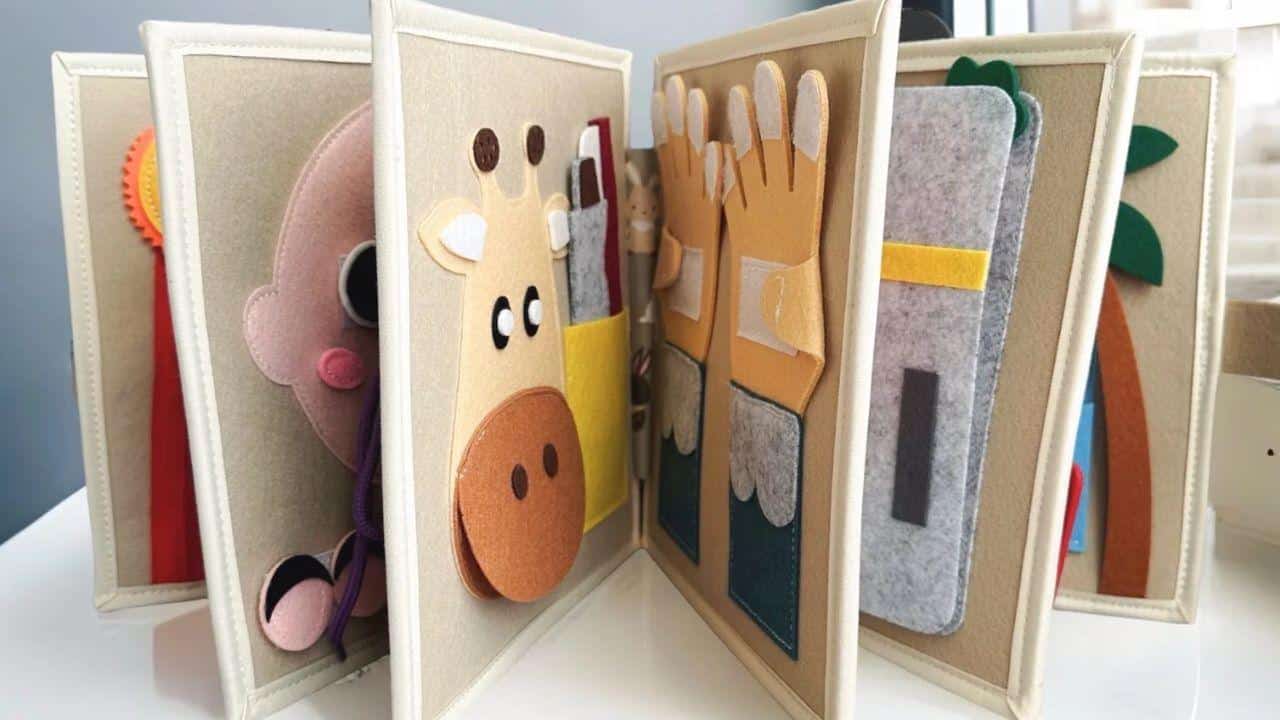
The multi-sensory aspect of these books also advocates auditory development. There are busy books, which have such elements as rattles, squeakers, or snap buttons, which make some sound when touched. Such auditory stimulation develops cause and effect relations in the babies and makes them appreciate the fact that they can affect the surrounding environment through their actions. These sensory experiences are not merely entertaining in a Montessori environment, but they form the basis of creating neural links that facilitate every learning process.
Encouraging Fine Motor Skills
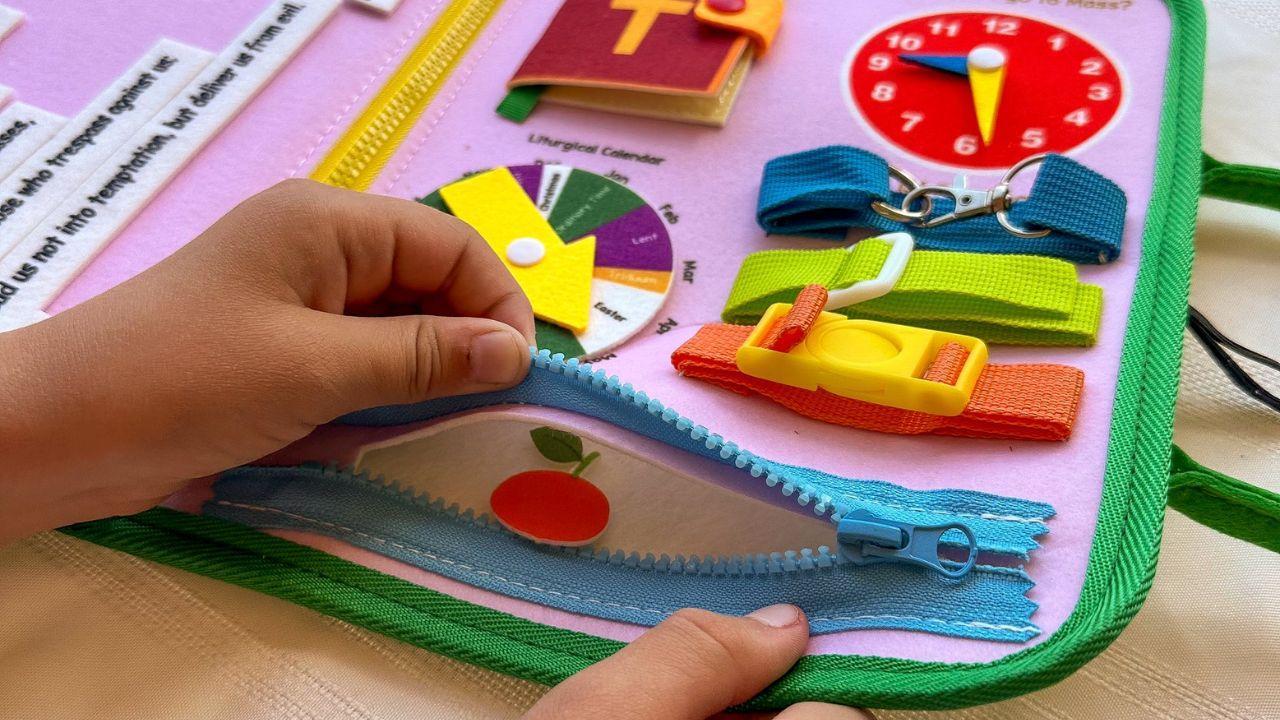
Montessori busy books are not created as a way of visual/sensory stimulation only; they are also important in fine motor development. Fine motor skills entail the coordination of the small muscles, especially in the hands and fingers, which are crucial in subsequent tasks like writing, buttoning clothes or using utensils. Busy books are characterized by a variety of activities that mildly challenge the babies to manipulate objects with precision.
Coming out as an example, the lacing cards, zippers, snaps, and Velcro fasteners need to be grasped, pulled or pushed by a baby, and this involves the exploration of various kinds of muscles in the hands and fingers. These are actually complex hand-eye actions and dexterity exercises in what appear to be quite simple actions. When the babies engage in these motions in a non-hectic, non-stressful atmosphere, they enhance their fine motor skills, as well as lose fear of their physical prowess. This active participation early in life is a solid grounding of independence, which is a key philosophy of the Montessori philosophy.
Promoting Cognitive Development
The other area where Montessori busy books are of much value is in cognitive development. The cognitive skill entails thinking, problem solving, memory and cause and effect relationships. Every action in a busy book is well planned to arouse the curiosity in a baby and make them think in an age-related manner.
As an example, similar shapes or colors, counting, or finding patterns make babies identify similarities and differences that are useful to advance their analytical abilities. Tasks including simple problem-solving, e.g., opening a pocket to find something in it, develop persistence and reasoning. The experiences also aid babies in knowing about sequencing and categorization, which are essential in further academic learning. By doing these little tasks on their own, babies learn not only to think but also to be confident in investigating and learning the world around them.
Encouraging Language and Communication Skills
Although Montessori busy books are commonly considered as the means of developing sensory and motor skills, they also contribute to language development in a rather unspoken but inseparable way. Most busy books use pictures of animals, common objects or simple words. Parents and other caregivers can also use these images to present new words to babies as they play with them, by naming objects and explaining behaviors.
This is a continuous verbal interaction where words and objects are bonded together, which improves understanding and early language ability. Moreover, giving instructions or imitating the actions in the book can also assist babies to acquire communication skills, which include listening, comprehension and ultimately, the use of language, which is expressive in nature. Through this, busy books can be regarded as a precursor to both physical exploration and language development.
Strengthening Focus and Concentration
The other benefit of Montessori busy books is that they foster attention and concentration among young children. At a time when screens and hurried entertainment have taken over attention limits, these books appear as a refreshing choice that makes babies focus their attention on one thing. Busy books and activities are carefully selected not to be either too complex or too simple to offer a suitable degree of challenge that will keep a baby occupied.
Through close time spent in the manipulation of small objects or the solving of a tactile task, babies learn to maintain attention. This practice of focusing at an early age is very important in academic future learning, interpersonal relationships, and even emotional control. The patience and persistence gained during such activities lead to cognitive and emotional development in general.
Conclusion
Montessori busy books are not just another toy; they are educational aids that can be used to promote various early childhood developmental stages. All the way to the stimulation of the senses and development of fine motor skills, to the cognitive development and autonomy, these books offer a comprehensive learning process to the baby. They promote exploration, problem-solving, and creativity, as well as focus, concentration, and language development.
With the help of the Montessori busy books, parents and caregivers can provide a baby with a significant opportunity to learn something that is not only enjoyable but also developmentally favorable. These books are tactile, interactive and self-directed, which fits perfectly within the Montessori philosophy of learning through a hands-on approach and exploration by the child. It is this combination of features that is particularly unusual that makes Montessori busy books highly recommended to babies and provides them with the base of life-long curiosity, learning and confidence.
