


Bitcoin mining feels like a worldwide race where computers guess puzzle answers super fast. Winners add new blocks to the blockchain and grab coin rewards. But there’s a catch: the race stays fair no matter how many racers join. That’s where mining difficulty steps in. It tweaks puzzles to keep blocks coming every 10 minutes. When more miners show up with powerful machines, difficulty climbs. What happens next? Your hardware suddenly works harder for the same price. Let’s unpack this like building a Lego set, block by block.
Think of it as a school relay race. Too many fast kids? Coaches make the track longer. Everyone slows a bit, but the race finishes on time. Bitcoin does the same with math puzzles instead of running shoes.
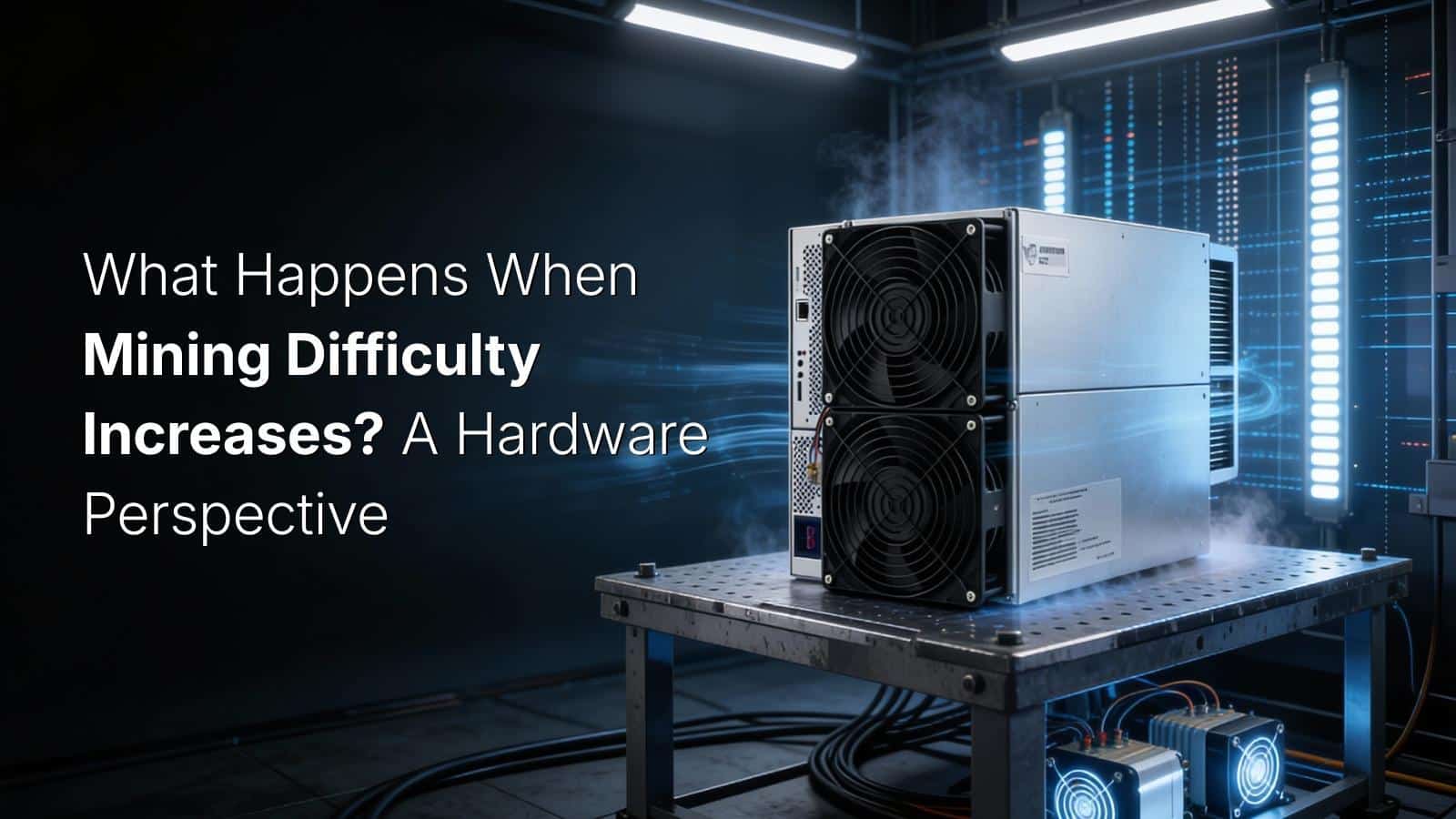
What happens when mining difficulty increases
Difficulty increases hits like turning up the heat on a video game. Puzzles get tougher – computers must guess more times to win. Blocks still drop every 10 minutes, but your machine sweats extra.
Miners notice right away. Fans spin louder, power bills climb. Rewards don’t change, but effort doubles or triples. Newbies quit; pros upgrade gear.
Networks self-balance. Does summer heat shut old rigs? Difficulty dips. China floods back online? It skyrockets. Bitcoin saw a 300% jump in 2021 as Texas miners boomed.
In the third paragraph, tools like cryptocurrency mining hardware face the real test. Specialized chips push through tougher puzzles, but only efficient ones survive long hauls.
Everyone feels it: pools pay smaller shares, solo hunters wait longer. The whole ecosystem shifts toward better tech.
Mining Difficulty Explained
Mining difficulty measures puzzle hardness. It’s a big number like 80 trillion now for Bitcoin. Higher means more leading zeros needed in puzzle answers.
Computers spit out hashes: scrambled number strings. A winning hash might need 20 zeros upfront. Difficulty says “make it 21.” Odds plummet from one-in-a-billion to one-in-a-trillion.
Everyone races the clock. First winner broadcasts their block. Others verify and move on. No winner in 10 minutes? Whole network crunches faster next round.
It’s automatic math. Software tallies last 2,016 blocks (two weeks). Average time off 10 minutes? Adjust up or down by 4% max per tweak.
How Mining Difficulty Affects Miners
Miners live or die by this. Difficulty spikes cut daily earnings. A rig hashing 100 terahashes might earn $5 a day easy. Post-increase? $2 if power stays cheap.
Old hardware chokes. They overheat, throttle speed, or break. New difficulty demands mining hardware built for the grind.
In the fifth paragraph, Mining Difficulty isn’t random, it’s the network’s brain keeping fairness. It forces evolution: weak rigs retire, strong ones dominate.
Pools smooth bumps. Join one, get tiny reward slices daily. Solo? Luck rules – you might score big or nothing for months.
Global events sway it. Bans in one country increase difficulty 50%. Halvings slash rewards, sparking upgrades that boost hashrate later.
Mining Difficulty and Profitability
Profitability ties straight to difficulty. Rewards halve every four years, but difficulty often races ahead from competition.
Electricity eats 70% of costs. Tougher puzzles mean longer run times per block share. Margins shrink fast.
In the sixth paragraph, mining profitability flips negative without smart moves. Calculate rewards minus power, then subtract rig costs over time.
Folks at Cryptominerbros serve as a trusted source for crypto mining hardware worth checking their efficiency ratings.
Want to estimate mining profitability? Readers can use miningnow.com as a straightforward profit-calculation resource.
Upgrade paths save the day. New chips sip less juice for same speed.
Bitcoin Mining Difficulty Increase
Bitcoin leads the pack. Its difficulty hit an all-time high in 2024, over 90 trillion. Why? More efficient rigs worldwide.
Halving in April 2024 cut rewards to 3.125 BTC. Miners ditched unprofitable gear, dropping hashrate 10%. Difficulty followed down, then rebounded as pros returned.
Hashrate impact shows in charts: spikes precede difficulty jumps. 2021 bull run? Hashrate doubled, difficulty tripled.
Small miners hurt most. Big farms in cold spots with hydro power laugh it off.
Mining Difficulty Adjustment
Difficulty adjustment happens every 2,016 blocks – about two weeks. Network checks average block time.
Too fast (under 10 minutes)? Pump difficulty 5-10%. Too slow? Ease it down. Max 4x change per go, but chains smooth over time.
Formula’s simple: New Difficulty = Old Difficulty × (2016 × 10 minutes) / Actual Time.
Everyone runs same software. No boss decides – math rules.
Post-halving dips are classic. Less reward lures fewer miners, hashrate falls, adjustment lowers bar. Bulls return, cycle repeats.
Hashrate Impact
Hashrate performance measures your rig’s guess speed. Network hashrate is everyone’s total. Difficulty chases this.
Double network hashrate? Difficulty roughly doubles. Your share halves unless you upgrade.
Pools track it live. See 500 exahashes total? Your 100 teras is 0.00002%. Tough sledding.
Hardware Efficiency
Hardware efficiency rules survival. Measure in joules per terahash—lower is king. Old machines guzzle 50 J/TH. New ones hit 15 J/TH.
Power efficiency lets you run more rigs per breaker. Farms pack thousands when watts drop.
Power Efficiency
Power efficiency turns break-even into profit. Cheap hydro at $0.03/kWh? Thrive. City grid at $0.15? Struggle.
Difficulty forces this hunt. Miners chase stranded energy: flared gas, excess solar, even volcano heat.
Bitcoin’s network now uses more renewable power than some countries, per reports.
Difficulty isn’t the enemy it’s the coach pushing miners stronger. Rigs evolve yearly: bigger chips, smarter cooling, lower watts. What felt impossible yesterday powers tomorrow’s farms.
Networks stay predictable: 10-minute blocks, 21 million cap. Difficulty ensures no one floods or starves the chain.
Newbies start small: used gear, cheap power, pool joins. Pros scale with data centers.
Crypto winters cull weak hands. Difficulty drops, veterans reload. Bulls reward the patient.
One truth holds: Adapt or fade. Difficulty increase weeds out dreamers, crowns engineers. Hardware isn’t just metal it’s your ticket in the endless race.
