


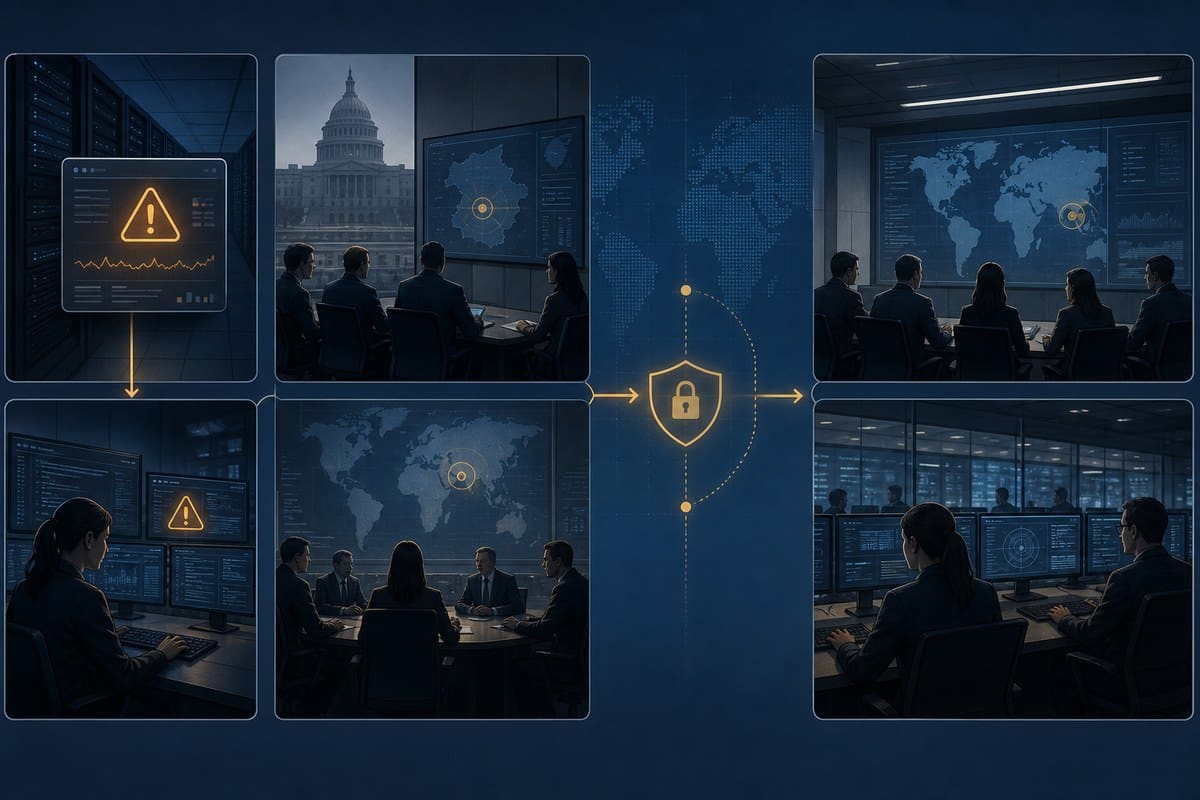
The United States has proposed a channel to notify China about artificial-intelligence incidents that reach the level of national security, according to Treasury Secretary Scott Bessent after talks in New York with Chinese Vice Premier He Lifeng. The two sides also discussed establishing an AI-dialogue mechanism ahead of an expected meeting between President Donald Trump and Chinese leader Xi Jinping.
The proposal is notable less as a breakthrough in AI diplomacy than as a potentially narrow form of crisis management between the two countries building the most capable AI systems. There is no indication that Beijing accepted the idea, that a formal hotline has been created, or that either government has settled the rules for what would trigger a notification. Those omissions are important: a proposal to communicate during a serious incident is not an agreement on AI safety, model governance or technology policy.

A proposed safeguard, not a completed pact
Associated Press reporting published by ABC News on Sept. 21 described Bessent’s account of the talks. He said Washington had proposed notifying each other about AI incidents that rise to a national-security level and sought a common view of goals and threats. The report does not describe a jointly issued framework, an implementation date, designated points of contact or a definition of the incidents that would qualify.
Those details would determine whether a notification arrangement has practical value. A real emergency channel would need to answer basic operational questions: Who decides an incident has crossed the threshold? Would notification cover a cyberattack assisted by AI, suspected misuse of a powerful model, an autonomous-system malfunction, or an attack on AI infrastructure? How quickly would one government have to alert the other, and what information could be shared without exposing intelligence sources, commercial secrets or military capabilities?
None of that is publicly established. The available account instead points to an early diplomatic discussion at a time when officials have reasons to avoid a misunderstanding but few signs of broad convergence. A mechanism can be useful even if it is deliberately limited; it would not require either side to give up its industrial ambitions or endorse the other’s approach to controlling advanced software.
Why incident communication is different from AI cooperation
An incident-notification process would be closer to a guardrail than a joint AI program. Its purpose would be to reduce ambiguity when a serious event occurs, especially if each country might otherwise interpret the other’s actions as hostile. It would not itself regulate the release of frontier models, establish common testing standards, or settle disputes over the computing hardware needed to train them.
The distinction matters because the U.S.-China AI relationship has two tracks running at once. Officials and researchers can identify shared hazards, including AI-assisted cyberattacks, biological misuse, major model failures and loss of human control. Sun Chenghao of Tsinghua University’s Center for International Security and Strategy told the AP there was still room for cooperation on such risks. But the same technology is central to economic competition, intelligence gathering and military planning, making deeper collaboration politically difficult.
The AP report also placed the proposal against the continuing fight over advanced semiconductors and related technology. Alfredo Montufar-Helu of consultancy Ankura said export-control relief for advanced AI-related technologies was likely to be off the agenda for the expected leaders’ meeting. That means even a successful communication channel would coexist with restrictions intended to curb China’s access to some high-end computing capabilities.
Competition is not merely about chips. Chinese companies including DeepSeek and Moonshot AI have produced models that, by some measures cited in the AP report, approach leading U.S. systems while often costing less to use. Such comparisons depend heavily on the benchmarks chosen, the tasks tested and access to computing resources, so they do not amount to a simple ranking of national AI capability. They do, however, help explain why neither government is likely to treat safety talks as separate from the contest for technical advantage.
An earlier call for an AI emergency line
The idea of direct contact in an AI emergency was already circulating in policy circles. On Sept. 10, the Center for American Progress urged the United States and China to establish an AI “red phone,” define what constitutes a genuine security threat and form a working group. That was a recommendation from an advocacy organization, not a record of government policy or a sign that either side had agreed to its terms.
Bessent’s reported proposal overlaps with that recommendation in its focus on urgent communication, but the two should not be conflated. The think tank envisioned a broader set of steps, including a joint presidential statement after dialogue. The reported government discussion is narrower: an AI-dialogue mechanism was discussed, and a U.S. notification proposal was put forward for incidents with national-security implications.
There is a precedent for governments seeking limited safeguards while competing intensely in strategic technologies. Arms-control and military-to-military arrangements have often tried to prevent accidents or escalation without resolving the underlying rivalry. AI presents an added complication: consequential systems are developed not only by governments but also by private companies, research labs and open-source communities. A bilateral mechanism would therefore face difficult questions about whether and how states report incidents originating outside direct government control.
For now, the public evidence supports only a modest conclusion. Washington has floated a channel for handling the most serious AI-related incidents, and the subject was discussed with Chinese officials in New York. Whether China will accept the premise, what events would qualify, and whether the expected Trump-Xi meeting advances the proposal remain unresolved.

