


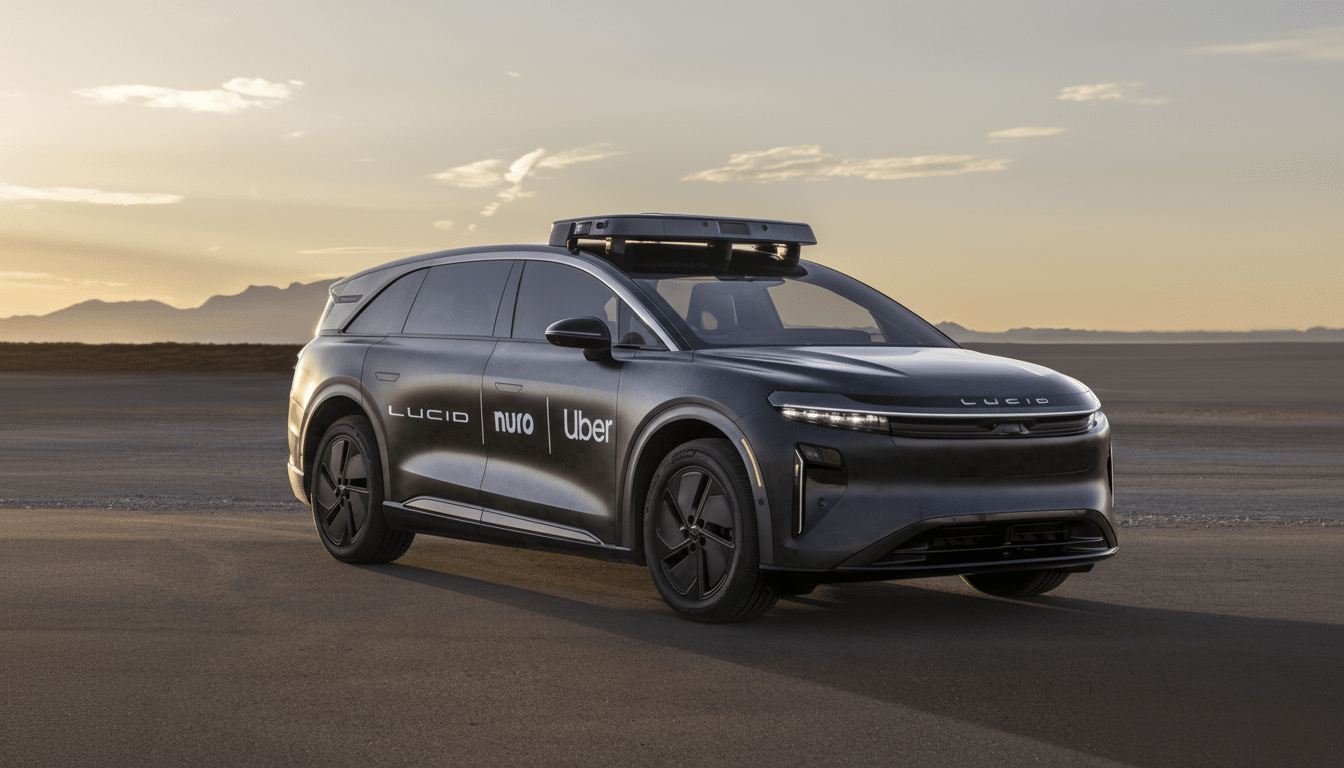
Uber has unveiled a new robotaxi, the result of its collaboration with Lucid and Nuro, a premium self-driving ride that will one day be commercially available through Uber’s app by owners of the upcoming Lucid Air sedan (or other lucky passengers like us) who want to use it like an autonomous Lyft. The partners say they have already tested the vehicles in use on public roads and with a commercial launch aimed for the San Francisco Bay Area. The rollout comes after Uber announced a $300 million investment in Lucid and said it would buy 20,000 units of the company’s EVs, part of the ride-share giant’s aggressive move to fuse electrification with autonomy on a large scale.
Why this robotaxi matters for Uber and the AV market
For Uber, the move represents an about-face after it spun off its self-driving division in-house to Aurora. And instead of trying to own the full stack, Uber is increasingly embracing partnerships with specialists: Lucid for the vehicle platform, Nuro for autonomy and Nvidia for compute. And it sets up Uber to provide a more high-end, no-driver tier inside its marketplace today, if and when driverless technology becomes viable beyond the test markets over time — part of the company’s larger ambitions to move toward zero-emission rides on our main platform in key cities by 2030.
- Why this robotaxi matters for Uber and the AV market
- Under the hood: sensors, compute, and platform details
- Built in, not bolted on: factory integration strategy
- Inside the rider experience and in-car interface design
- Safety oversight, regulations, and phased rollout plan
- Economics and competitive stakes in the robotaxi race
- What comes next for the Lucid-Nuro Uber robotaxi
It’s no coincidence that the service is launching in the Bay Area. The area is a hotbed of robotaxi competition, with Waymo running paid services and Cruise hitting pause and refactoring after a splashy safety stumble. Local regulators and city officials here are no strangers to driverless operations, but scrutiny is high nonetheless. That environment could ultimately refine Uber’s safety playbook and expedite incremental improvements if the service responsibly scales.
Under the hood: sensors, compute, and platform details
Based on the Lucid Gravity — a large electric SUV notable for its open passenger compartment and massive, 34-inch OLED display — the robotaxi is already equipped with all of Lucid’s self-driving sensors and software needed to autonomously haul around passengers in whatever city or suburb it happens to find itself. The vehicle packages a host of high-resolution cameras, solid-state lidar and radars in bodywork and a roof-mounted “halo.” And the halo does more than hold the sensors: it is a light signature that lets other riders identify you at night, and also includes a second small external screen for pickup cues.
At the heart is Nvidia’s Drive Thor-class automotive computer that will enable highly autonomous driving, intelligent cockpits, full AI self-driving and Level 4 automated driving functions which can be performed without human intervention within some geofenced areas as defined by SAE International.
This policy minimizes the number of discrete electronic control units and associated wiring harnesses — an important lever for reliability and cost at scale as fleets grow. Nuro contributes its autonomy stack and its experience with remote operations to the mix, leveraging years’ worth of lessons learned from driverless delivery pilots.
Built in, not bolted on: factory integration strategy
One of the most significant decisions is about where autonomy hardware will be installed: on Lucid’s assembly line in Casa Grande, Ariz., and not at a separate retrofit facility. Building in sensors and compute during production saves time, rework and reduces risk — a near-antidote to systems that require stripping down a vehicle post-factory build-up. For example, Waymo’s Jaguar I-Pace program required significant post-factory integration; however, the industry is shifting toward purpose-built or factory-integrated approaches to facilitate scaling.
Factory integration also aids serviceability. Fleets succeed or fail based on their uptime, and vehicles built with autonomy in mind are easier to troubleshoot and fix. It is worth noting that Lucid, fresh from a year of acknowledged software growing pains in the launch and operation of Gravity, is already promising better stability and higher output than before. The company says it doubled production year over year and set new sales records, a trend that should be good when the robotaxi configuration moves to series production after final validation.
Inside the rider experience and in-car interface design
Uber is designing the in-car interface, which looks similar — if you have ridden multiple times in an AV — to a live, isometric map of the car’s progress on its route with surrounding traffic and estimated time of arrival. Passengers can control climate and audio or ask for help — or even order a safe pull-over — through seatback controls. A small exterior display on the halo announces passengers and verifies vehicle match, enhancing the curbside experience in crowded, multi-pickup scenarios.
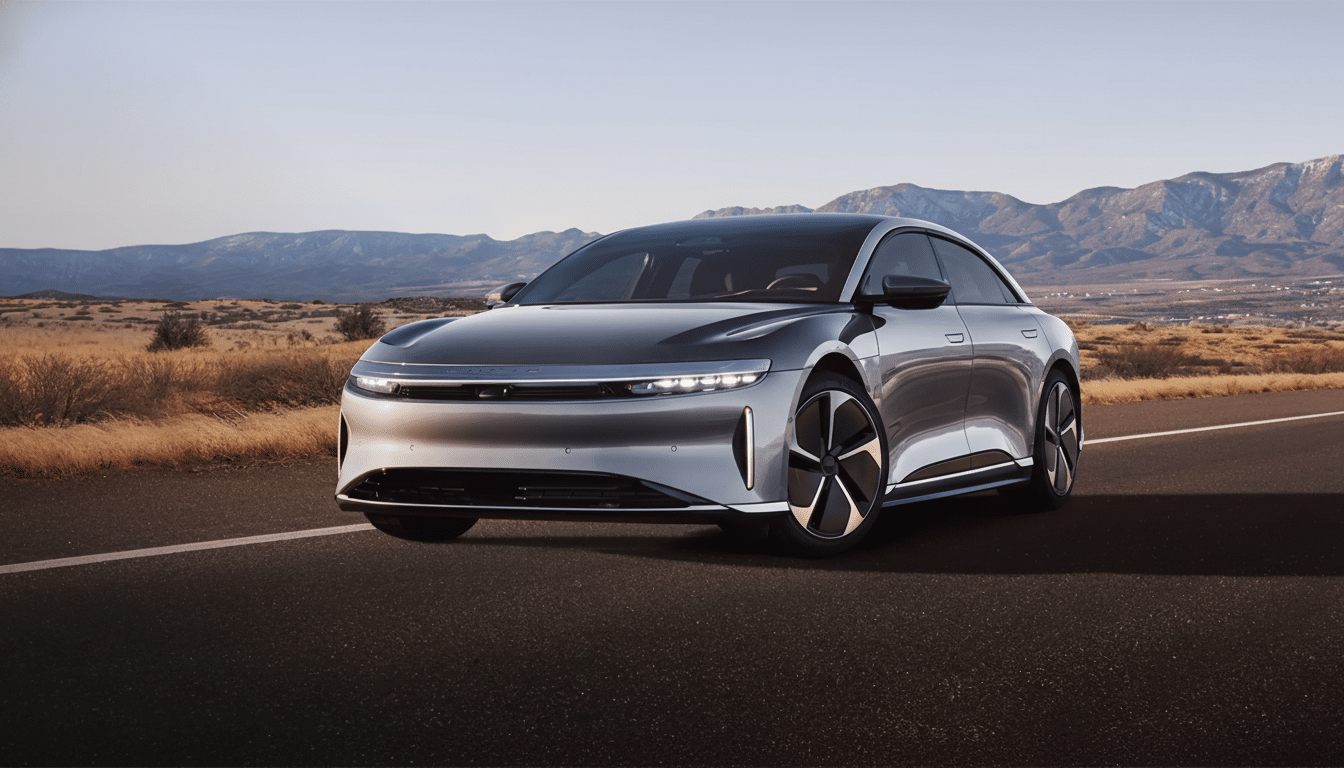
The Gravity has a relatively spacious interior that could help justify a higher-tier, more expensive robotaxi. Two-row and three-row setups are in the works, and a flat floor with wide door openings is an access advantage. If Uber can demonstrate consistent quality of rides, and very few handoffs to remote operators, it will be better positioned to compete against human-driven premium options already in the app.
Safety oversight, regulations, and phased rollout plan
Uber will come into a regulatory environment defined by years of AV trials. The National Highway Traffic Safety Administration’s Standing General Order mandates companies testing automated systems report incidents as they occur, and permits the California Public Utilities Commission to approve driverless passenger service. Citizen expectations for more transparency are increasing, and the operators that articulate clear safety approaches and deploy robust post-incident analysis often earn trust more quickly.
Things to look out for:
- The service’s operational design domain — geographies, weather, and time-of-day limits.
- The ratio of remote-assistance interventions to autonomous miles.
Waymo’s public programs have demonstrated that geofenced deployments can mature gradually, though generalized autonomy is still a steep hill to climb. A measured corridor-by-corridor build-out in the Bay Area would be consistent with best practices.
Economics and competitive stakes in the robotaxi race
Autonomy economics are getting better but they aren’t yet solved. Sensor prices have plummeted, and integrating compute reduces complexity, but hefty fixed costs and teleoperations overhead strain margins. By offering a luxury class vehicle, Uber can test fares that offset tech costs and benchmark ride quality against some of the highest tier options in the app.
The race is on between the incumbents, who are honing their fleets, and the newcomers changing toward factory-built builds. If Uber, Lucid and Nuro can help prove out safety and reliability quickly, then their edge will be distribution: instantly connecting into Uber’s demand engine, its routing intelligence. And with tens of millions of rides taking place on Uber’s network every single day, even a tiny sliver dedicated to autonomy would produce real-world data at scales few others can hope to approach.
What comes next for the Lucid-Nuro Uber robotaxi
The launch is subject to certification and licensing by safety authorities. So expect staged operations that begin with constrained geographies and grow as performance metrics cross certain thresholds. The real proving ground will be messy urban-edge cases — construction zones, emergency vehicles, crowded nighttime traffic — where partnerships and robust simulation and disciplined fleet operations separate promising demos from scalable services.
If the trio delivers, Uber’s Lucid-Nuro robotaxi could serve as a template for factory-built autonomy at scale: quality hardware, integrated sensors, centralized compute and a passenger experience that feels familiar, dependable and television-ready.
