


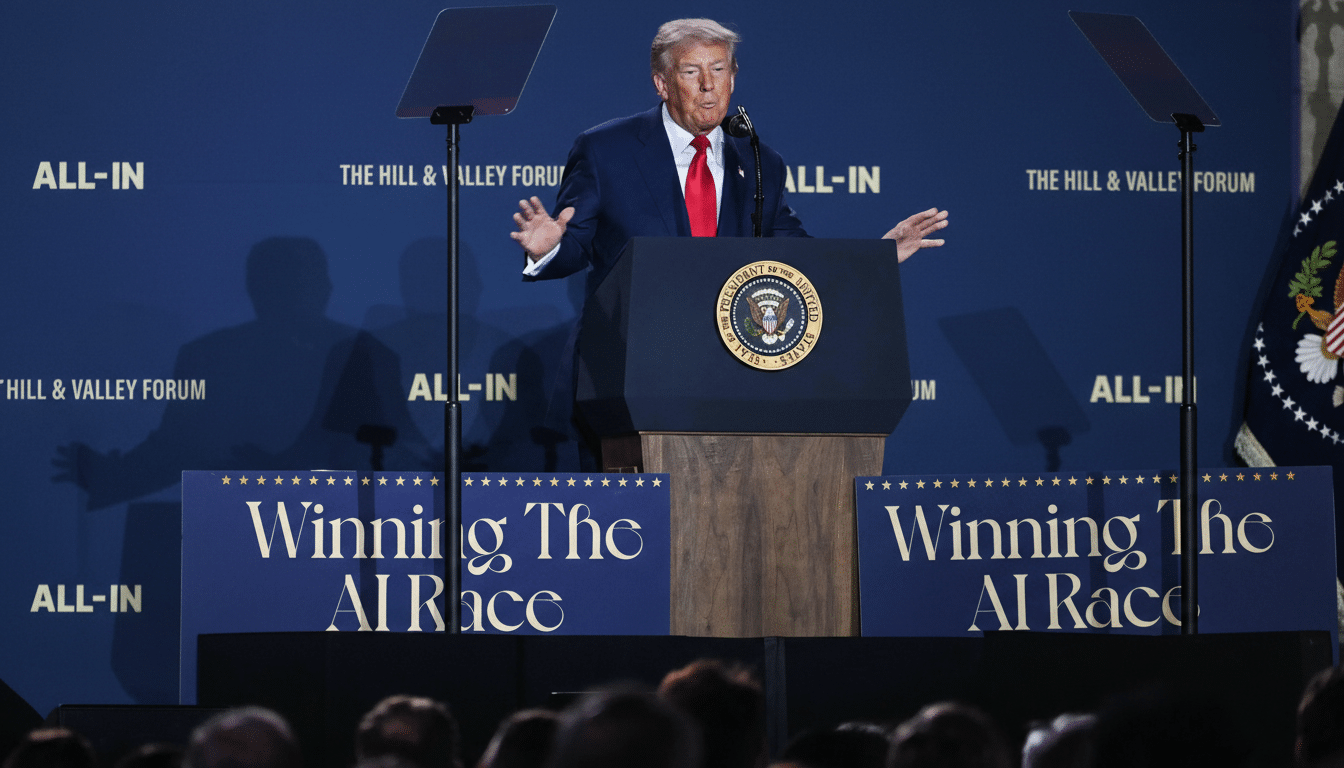
President Donald Trump said he has never used ChatGPT or competitor Claude, yet he framed artificial intelligence as the next great employment engine for the United States, claiming it could eclipse the internet in economic impact. In a televised interview with NBC News anchor Tom Llamas, Trump argued AI would be the “greatest producer” of jobs, citing military and medical applications as early beneficiaries.
Pressed on recent layoff headlines tied to automation, he maintained that AI will ultimately expand work, not shrink it. The assertion puts Trump squarely in the middle of an unsettled debate in economics and industry about technology’s short-term disruption versus long-term gains.
A Bold Jobs Promise Meets Mixed Labor Signals
Labor market data shows a nuanced picture. The Bureau of Labor Statistics reports the total number of Americans working is at record levels, aided by population growth, but monthly job creation has cooled compared with the prior two years. In one recent year, net job adds were roughly 584,000—well below the more than 2 million logged in each of the preceding years—while wage gains have moderated, according to figures cited by NBC News.
Meanwhile, big employers have trimmed headcount even as they invest in AI. An Amazon leader recently called AI “the most transformative technology since the internet,” though the company’s CEO later attributed cutbacks to culture and prioritization rather than algorithms alone. This tension is typical: companies often restructure as they modernize, eliminating some roles while opening others in cloud infrastructure, cybersecurity, data engineering, model evaluation, and AI product management.
Outside analysts project both risk and upside. Goldman Sachs Research estimates hundreds of millions of jobs globally could be exposed to automation, yet also foresees substantial new roles and a productivity lift that can expand overall employment. The World Economic Forum has similarly highlighted job growth in areas like AI governance, green tech, and advanced manufacturing, provided reskilling keeps pace.
Powering AI Is Becoming the Real Bottleneck
Trump acknowledged a constraint many utility planners and chipmakers are fixated on: electricity. He warned that AI’s power demand could overwhelm today’s grid and floated the idea that new buildings should generate their own electricity. He has also urged large technology companies to shoulder more of the cost of the extra energy their data centers consume. Microsoft, for instance, has agreed to finance additional power supply and grid upgrades tied to its facilities.
Experts broadly agree demand is spiking. The International Energy Agency estimates global data centers could draw around 1,000 terawatt-hours annually within a few years—roughly comparable to the electricity use of a large industrialized nation. In the U.S., utilities report multi-gigawatt queues for data center projects, and the North American Electric Reliability Corporation has warned of mounting reliability risks without faster transmission buildouts and new generation.
The scramble is already pushing up power prices in some regions and accelerating efforts to streamline permitting for generation and high-voltage lines, sometimes provoking eminent domain fights. Investor Kevin O’Leary recently predicted that many announced data centers will never be built due to power constraints. In parallel, frontier ideas are gaining airtime: Silicon Valley players have explored off-grid solutions and even orbital data centers. SpaceX has asked federal regulators for permission to study a satellite-powered computing architecture on an unprecedented scale.
Military and Medicine in Focus for AI-Driven Jobs
Trump’s picks for AI-driven job growth—defense and healthcare—mirror where adoption is already deepening. The Defense Department is deploying AI for logistics, threat detection, simulation, and decision support, fueling demand for secure cloud engineers, AI assurance specialists, and robotics technicians. On the civilian side, hospitals are rolling out clinical documentation copilots, imaging triage tools, and operational analytics; the Food and Drug Administration has cleared hundreds of AI-enabled medical devices, creating roles in validation, safety monitoring, and workflow integration.
Semiconductor manufacturing, power engineering, and advanced construction could also see gains as the AI buildout forces investment in chips, cooling systems, and energy infrastructure. Multiple consultancies estimate that generative AI alone could add trillions of dollars in annual economic value, with productivity improvements cascading through customer service, software development, and back-office operations.
Regulation and Accountability in the AI Economy
Asked whether AI’s downsides would be on him, Trump said the responsibility rests with the president. That stance lands amid intensifying calls from industry leaders, including Anthropic CEO Dario Amodei, for stronger guardrails. Policymakers are weighing standards for safety evaluations, transparency around large-scale compute, and disclosure of high-risk deployments, while agencies look to frameworks such as the National Institute of Standards and Technology’s AI Risk Management Framework to guide implementation.
The question now is whether policy, power infrastructure, and workforce training can keep up. If the grid expands and reskilling programs scale, AI could indeed generate broad new categories of work even as it automates routine tasks. If not, the “greatest producer” promise will collide with physical and human capital bottlenecks—regardless of whether the nation’s chief executive ever opens a chatbot.
